Keeping up with social media today can feel like running on a treadmill that never slows down. New formats appear overnight, trends expire within days, and audiences expect polished video content at a pace that traditional production workflows simply can’t sustain.
That’s exactly why AI has moved from being a “nice-to-have” experiment to becoming a core part of modern video production. Faster editing, smarter automation, and data-informed creative decisions now allow teams to produce more content without sacrificing quality.
But here’s the challenge: with dozens of platforms promising efficiency and innovation, finding the best AI-driven tool for scalable social media video production isn’t always straightforward. Some digital storytelling tools specialize in automation, others focus on avatars or generative media, while a few aim to streamline the entire production pipeline.
To help you cut through the noise, we reviewed the leading solutions shaping video workflows today, analyzing their features, scalability, usability, and real-world value, so you can confidently choose the tool that fits your content strategy now and as it grows.
Understanding the features of AI video editing software
Not all AI video editing software is built the same, and understanding the differences is the first step toward choosing the right platform for your workflow. Some tools focus on fully generating videos from prompts, while others enhance existing footage through automation, avatars, or intelligent editing features. As AI continues reshaping production, these technologies are helping teams streamline workflows, expand creative possibilities, and produce engaging content more efficiently.
At a high level, AI video tools use machine learning to automate tasks like editing, motion tracking, and content creation from scripts or natural language inputs, dramatically boosting productivity while reducing manual effort.
To make sense of this rapidly evolving space, it helps to break the ecosystem into core categories.
The role of AI in video production
AI is transforming video creation by simplifying complex processes and allowing creators to focus more on storytelling rather than repetitive technical work. Below are the primary types of AI video tools shaping modern production pipelines.
1. Automated video editing tools: These platforms analyze raw footage, identify the strongest clips based on factors like motion or facial expressions, and assemble polished edits complete with transitions, overlays, or music. This level of automation can compress editing timelines from weeks into days.
2. Text-to-video and generative AI platforms: Generative systems can transform text prompts, images, or clips into fully realized videos using deep learning models, essentially acting like an invisible production team that builds scenes from descriptions. These tools are advancing quickly, with new capabilities appearing frequently as the technology evolves.
3. Avatar and AI presenter tools: Some platforms specialize in virtual presenters that deliver scripted content on screen, producing lifelike speakers that can be customized with different backgrounds, pacing, and visual styles.
4. Image-to-video generators: If you already have strong visual assets, these tools convert photos or illustrations into motion graphics, animated slideshows, and social-ready videos, making them especially useful for marketing teams repurposing existing content.
5. Social media–focused video generators: Designed for high-output environments, these tools help brands produce content across multiple channels when time, talent, or resources are limited, enabling broader reach without expanding production teams.
6. AI-assisted creative enhancement tools: Modern editing software can automatically suggest cuts, generate subtitles, stabilize shots, and adjust lighting in real time, expanding what both professionals and beginners can accomplish. In some advanced workflows, creators also combine these tools with external data sources, such as a Netflix scraper, to analyze publicly available metadata, trends, or content structures that inform creative direction and competitive research.
This structured view makes one thing clear: AI is an ecosystem of technologies redefining how videos are imagined, created, and scaled. Once you understand these categories, it becomes much easier to evaluate which platform aligns with your content goals and long-term growth strategy.
Benefits of AI for social media video creation
AI is no longer a futuristic add-on, it has become a measurable performance driver across modern video workflows. From faster production cycles to smarter personalization, the data shows that teams adopting AI aren’t just creating more content, they’re creating content that performs better. Below are some of the most impactful, research-backed benefits shaping today’s social video strategies.
Dramatically faster production timelines
Speed is one of the biggest reasons organizations are turning to AI-powered video tools. Over 60% of marketers report that text-to-video platforms cut content creation time by more than half, while some teams have reduced time-to-market from three weeks to just 24 hours.
In some cases, AI optimization has led to faster production cycles, allowing brands to respond to trends in near real time, a major advantage in social media environments where relevance can disappear within days.
Significant cost reductions without sacrificing output
Beyond speed, AI is reshaping production economics. Research shows that AI video tools can reduce production costs, making high-quality video accessible even to smaller teams.
Real-world examples reinforce this shift: one retailer lowered production expenses, using AI for scene selection and color grading while maintaining creative quality.
The takeaway? AI enables scalable video production without requiring equally scalable budgets.
Measurable gains in efficiency and workflow automation
AI adoption has surged because it directly improves operational performance. Today, 83% of marketers report increased efficiency, and 79% say AI helps them deliver content faster across marketing channels.
Additionally, 47% of marketers leverage automation to make processes more efficient, while 92% use it for data analysis and reporting, freeing teams to focus on strategy instead of manual tasks.
This shift signals a broader evolution: AI is becoming the operational backbone of modern content teams.
Stronger engagement and performance outcomes
Video already drives business results, marketers say video has increased traffic, leads, and sales. AI enhances those outcomes even further. Some teams report doubled audience engagement after optimizing videos with AI-driven insights and edits.
Smarter personalization and audience targeting
Personalization has shifted from a competitive advantage to a baseline expectation. AI supports hyper-personalized strategies by analyzing conversations, sentiment, and trends in real time, capabilities that marketers increasingly rely on for social media monitoring.
It’s no surprise, then, that nearly 75% of marketers now use AI for media creation, positioning it among the top use cases for the technology.
When content aligns more closely with audience preferences, engagement naturally follows.
Rapid adoption signals long-term strategic value
If you’re wondering whether AI video is just a trend, the adoption curve says otherwise. 63% of video marketers already use AI to create or edit videos, a significant jump from the previous year.
More broadly, AI adoption in marketing has reached 88%, highlighting how quickly it has become embedded in everyday workflows.
For organizations focused on scalability, this signals a clear direction: AI isn’t replacing video strategy, it’s redefining what’s possible.
Top 6 AI-driven tools for scalable social media video production
Choosing the right platform is about finding a tool that can support your workflow today and scale with your content demands tomorrow. AI-powered video platforms now automate editing, transcription, and even AI-driven content creation, allowing teams to scale output while focusing more on strategy and storytelling rather than logistics.
Below are five standout tools shaping modern video production. Each excels in different areas, from automation to avatar-driven content, but one clearly pushes the boundaries of intelligent, engagement-focused creation.
1. Async
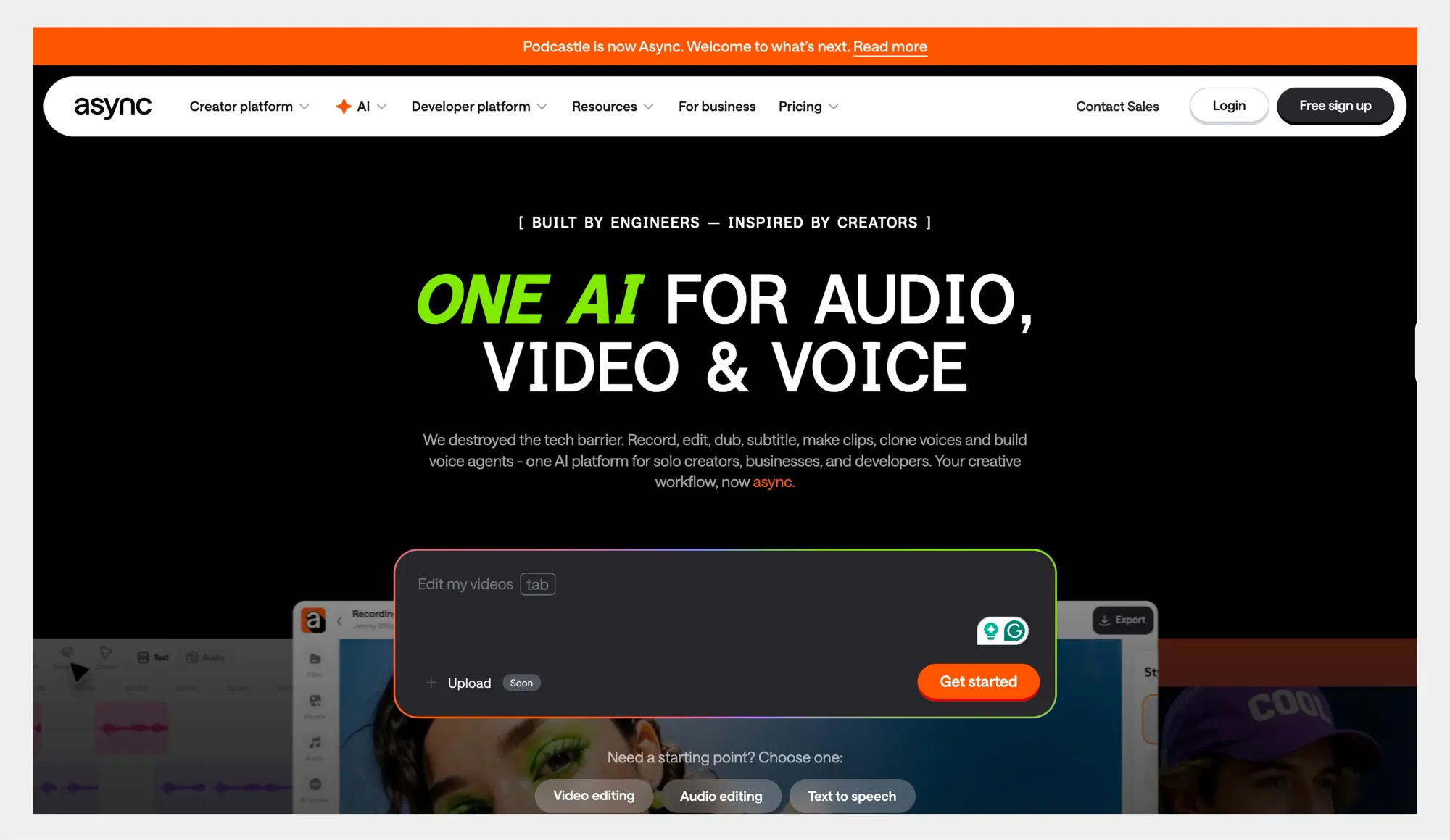
Async positions itself as a unified AI platform where users can record, edit, dub, subtitle, generate clips, and even clone voices, all within a single workflow designed for creators, businesses, and developers. Instead of forcing teams to juggle multiple tools, it removes technical barriers by consolidating production capabilities into one environment.
What truly differentiates the platform is Async Intelligence, an engagement engine that analyzes recordings to identify what resonates with viewers, where drop-offs occur, and which moments should be optimized, then converts those insights into actionable edits. Early coverage notes that this data-driven automation is designed to improve viewer retention while streamlining editing workflows.
Async also provides AI-powered tools specifically aimed at making content creation “fast and simple,” helping teams produce social-ready videos without unnecessary friction. The result is a platform built not just for editing, but for intelligent scaling.
Pros
• All-in-one workflow reduces tool switching
• Engagement-focused AI helps optimize performance
• Supports multiple production tasks from recording to clipping
• Designed for both solo creators and enterprise teams
Potential considerations
• Advanced AI features may require some onboarding for new users
• Teams transitioning from traditional editors may need workflow adjustments
Pricing: Pricing varies depending on features and usage tiers, with many AI video platforms starting around $11.99 per month and scaling based on functionality.
Best for: Organizations that want an intelligent, scalable production engine rather than just another editing tool.
2. Lumen5
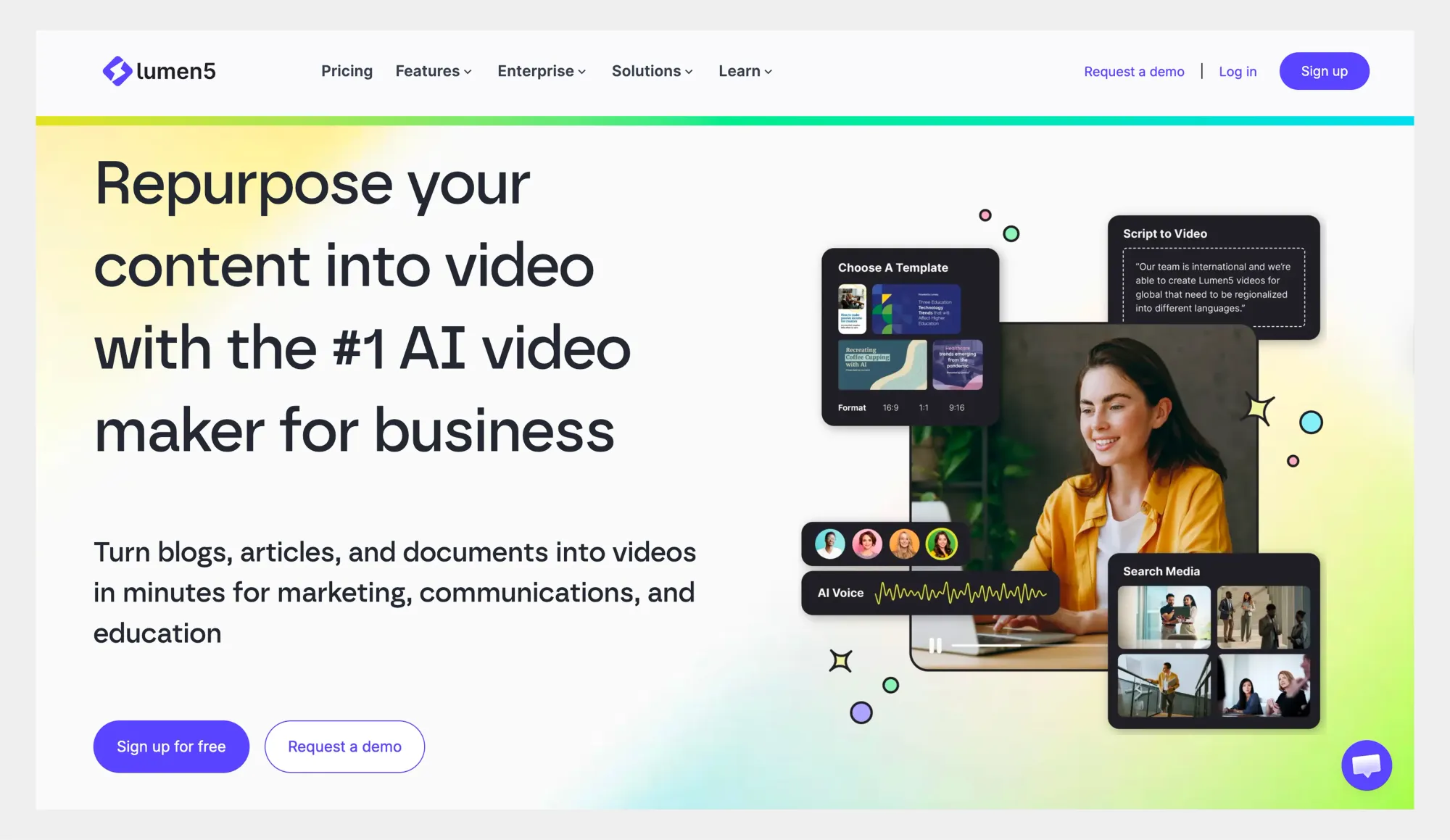
Lumen5 is an AI-powered video creation platform built to help users produce engaging content in minutes, even without prior editing experience. Its strength lies in accessibility: the platform combines creation and editing features into a single environment capable of producing intros, promotional clips, educational videos, and social media content.
The tool is especially known for speed and ease of use in short-form production, making it a practical option for teams prioritizing efficiency.
Pros
• Beginner-friendly interface
• Strong template ecosystem
• Cloud-based with no downloads required
Potential considerations
• Free plan limits users to five videos per month with a watermark.
• Advanced capabilities typically require higher-tier subscriptions.
Best for: Marketing teams that need fast, branded social videos without a steep learning curve.
3. Vimeo
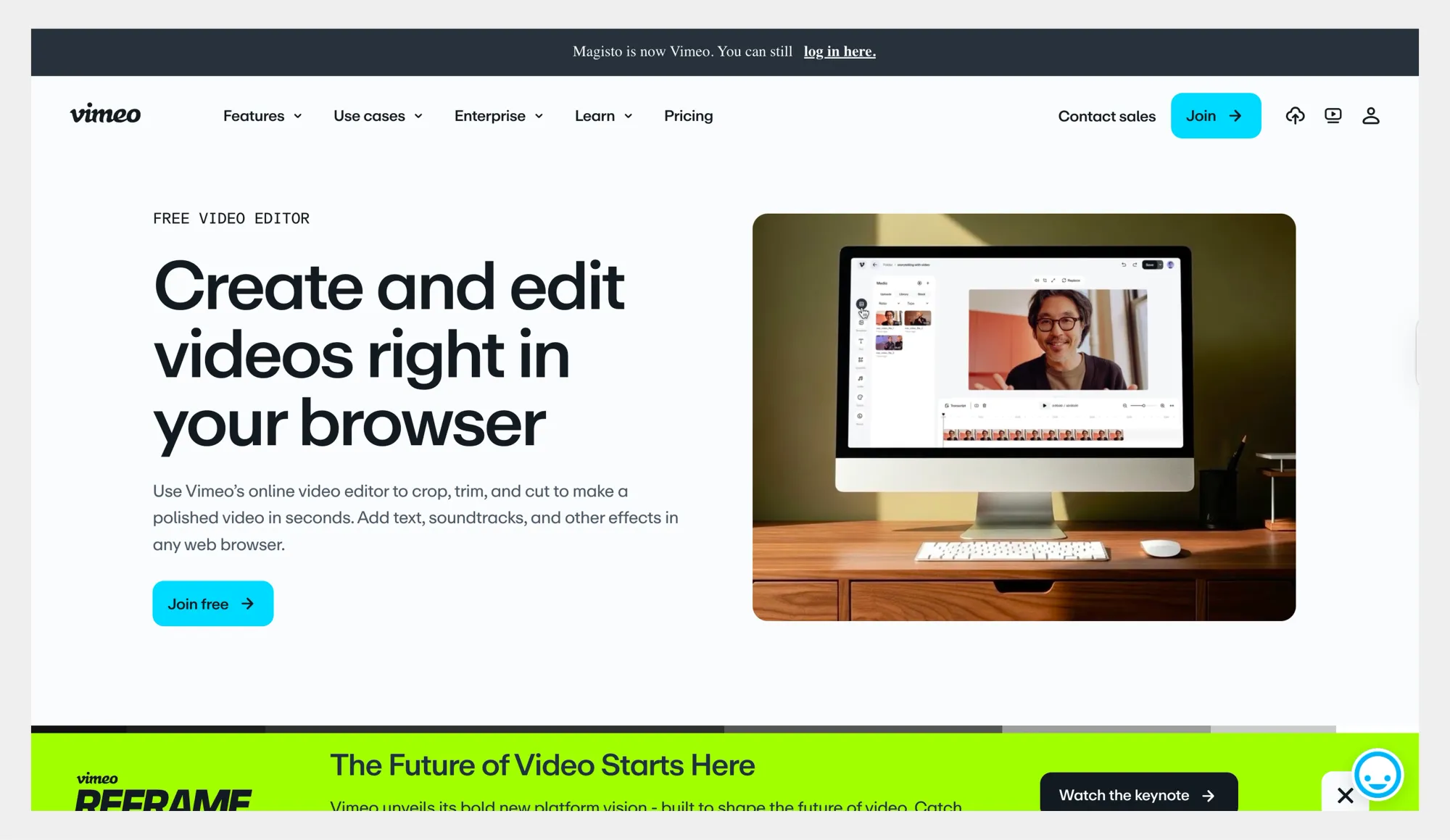
Vimeo focuses heavily on automation, using AI to streamline editing so businesses can produce polished videos without extensive technical expertise. AI-powered platforms like Magisto automate processes such as editing and content assembly, enabling faster production cycles.
This makes the platform particularly appealing to small teams that want professional-looking output without building a full production stack.
Pros
• Strong automation reduces manual editing
• Suitable for high-volume marketing workflows
• Designed for ease rather than complexity
Potential considerations
• May offer less granular creative control compared to advanced editors
• Better suited for marketing-style videos than cinematic production
Best for: Businesses seeking simplified, automated video creation.
4. Synthesia
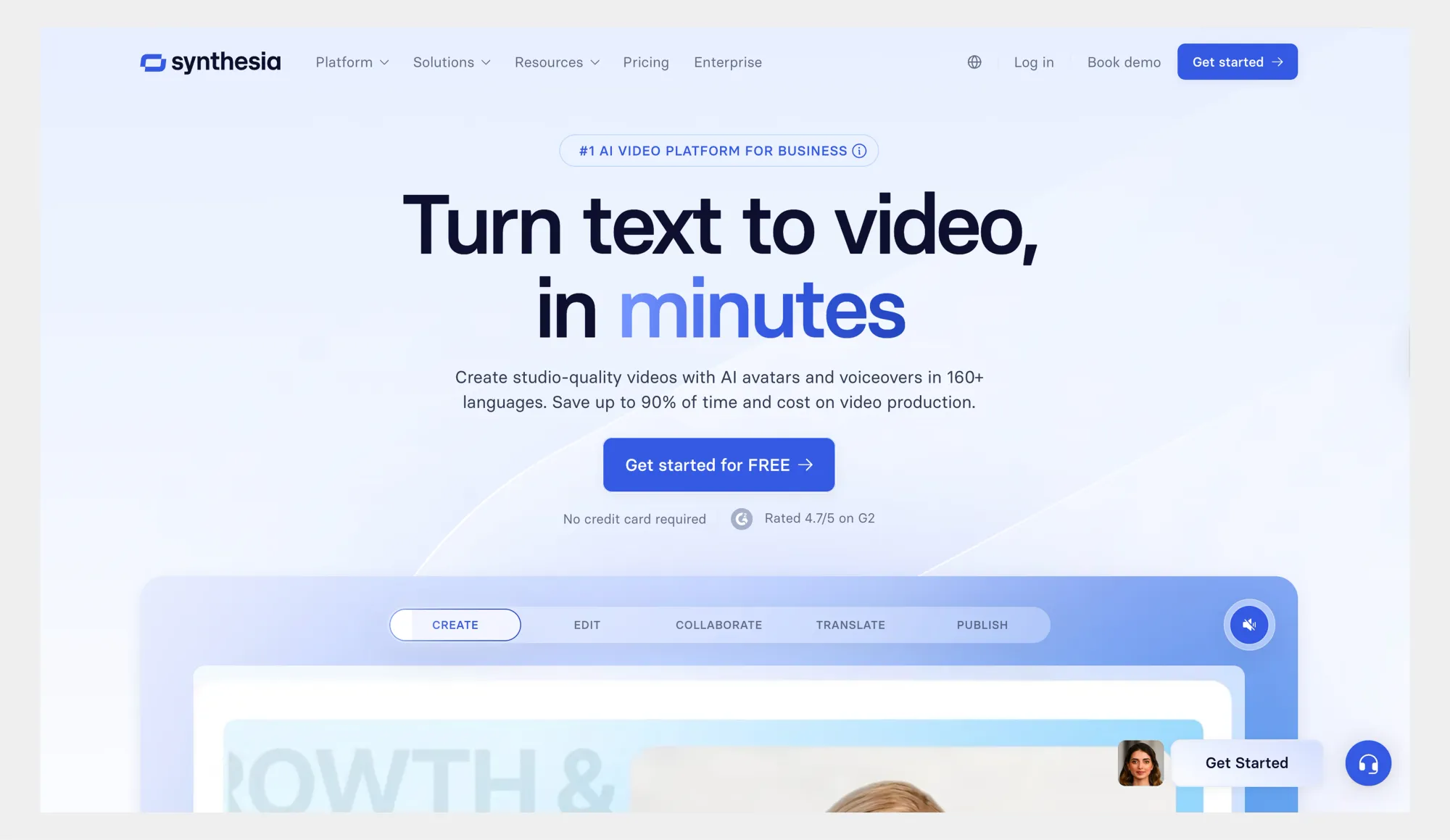
Synthesia has built its reputation around AI-generated presenters. The platform allows users to create studio-quality videos from scripts, documents, or URLs in minutes. It also supports AI avatars and voiceovers in 140+ languages, making it especially powerful for global communication.
Because it eliminates the need for cameras or studios, Synthesia is widely used for training, explainers, and internal communications.
Pros
• Highly scalable multilingual video creation
• Customizable branded visuals
• Integrates with existing systems like LMS platforms
Potential considerations
• Avatar-style videos may feel less organic for certain social formats
• Pricing typically starts around $30/month, depending on features.
Best for: Enterprises producing structured, presenter-led content at scale.
5. Invideo
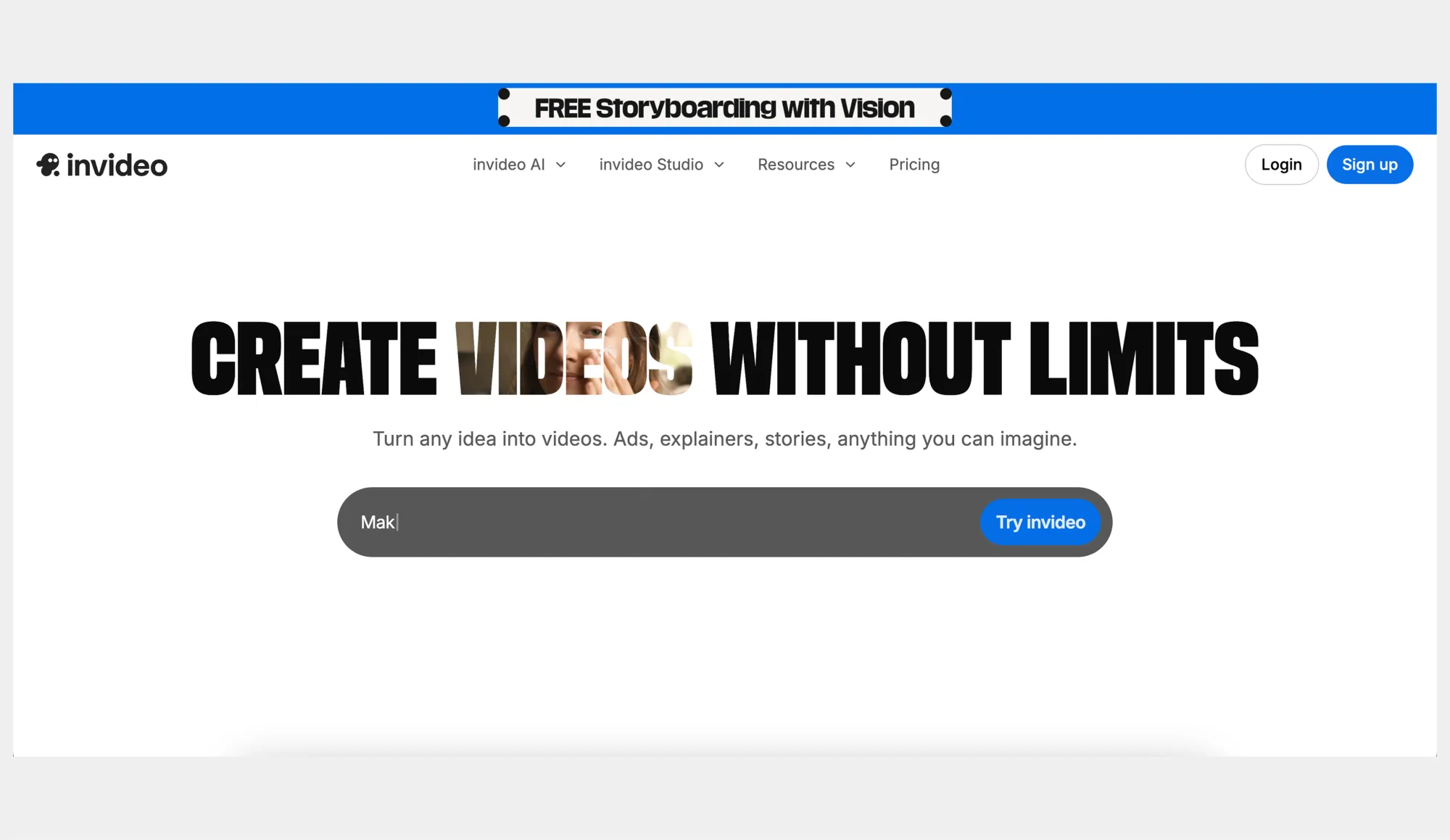
Invideo is a text-to-video AI platform designed to help creators and marketing teams turn scripts, blog posts, or simple prompts into polished social media videos in minutes. The platform emphasizes speed and scalability, making it well-suited for high-volume content production across platforms like Instagram, YouTube Shorts, Facebook, and LinkedIn.
Users can input text, select a style, and let the AI automatically generate visuals, transitions, voiceovers, and subtitles. This significantly reduces production time while maintaining brand consistency.
Invideo also supports collaborative workflows and cloud-based editing, allowing teams to iterate quickly without specialized video editing skills. Its balance of automation and manual control makes it accessible to beginners while still flexible enough for experienced marketers.
Pros
• Powerful text-to-video AI generation
• Built-in stock media, voiceovers, and subtitles
• Ideal for fast, high-volume content creation
Potential considerations
• Advanced customization can be limited compared to professional editors
• Free plan includes watermarks and export limits
Pricing: Free plan available; paid plans typically start around $28/month and scale based on export quality and usage.
Best for: Content marketers, agencies, and social media teams that need to rapidly convert text-based ideas into engaging videos at scale.
6. Pictory
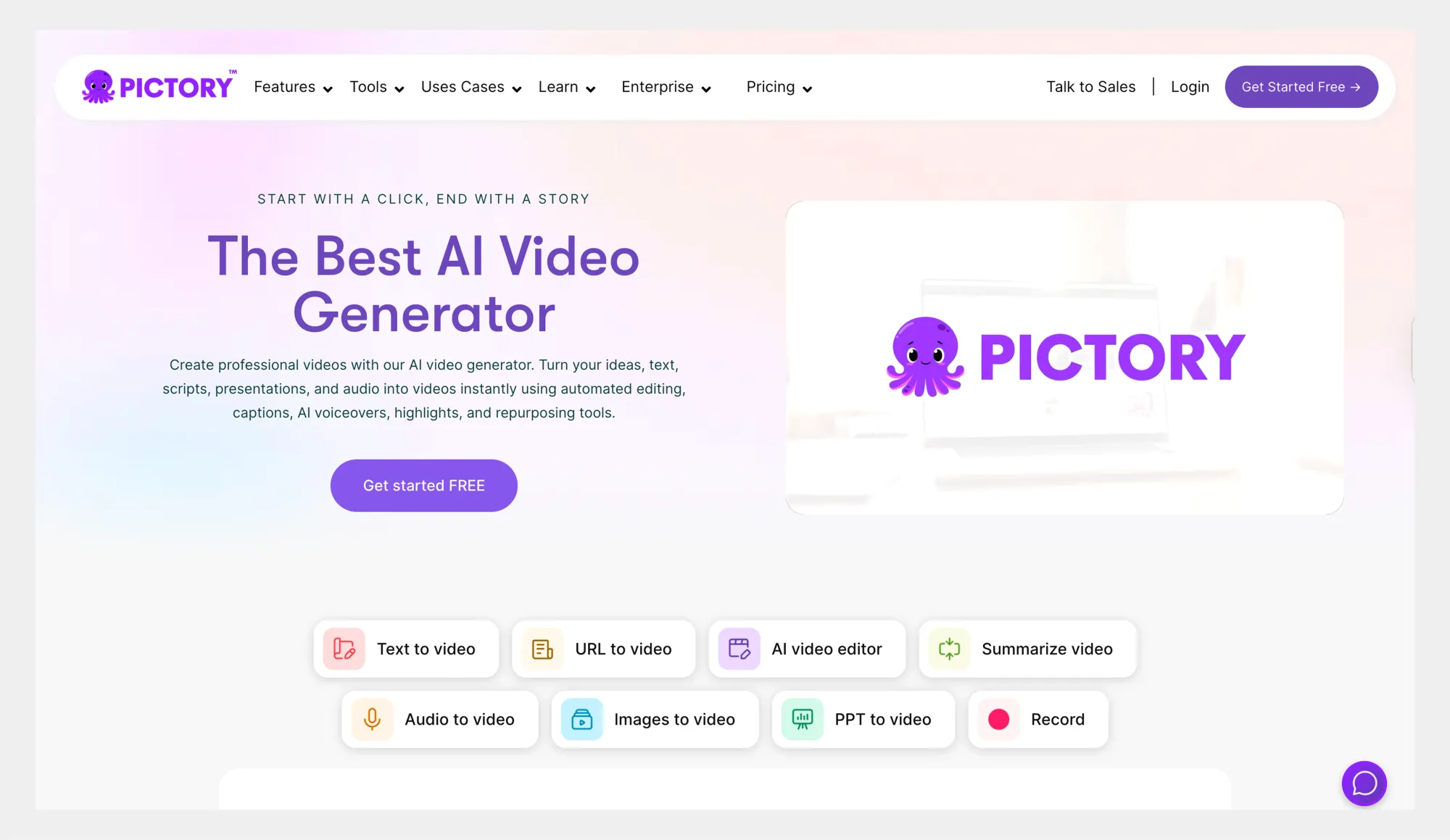
Pictory is designed to transform written assets into videos quickly, converting blog posts, URLs, and product pages into engaging visual content with just a few clicks. Its drag-and-drop interface and text-based editing make it approachable even for non-technical users.
The platform is often recognized for repurposing long-form content into short, social-ready videos, a major advantage for teams looking to maximize existing assets.
Pros
• Beginner-friendly editing experience
• Strong content repurposing capabilities
• Built-in templates and tutorials
Potential considerations
• Limited customization compared to advanced tools.
• Plans typically range from about $20 to $79 per month, depending on usage.
Best for: Content marketers focused on turning written material into scalable video output.
Key features to look for in AI tools
With so many platforms entering the market, choosing the right AI video solution can quickly become overwhelming. The best tools don’t just automate editing, they support smarter storytelling, scale with your workflow, and help your content perform better over time. As you evaluate options, focusing on a core set of capabilities can make the decision far clearer and future-proof your production strategy.
Digital storytelling capabilities
A strong video is about narrative structure, pacing, and emotional pull. Modern platforms like Async are pushing this further with intelligence layers that analyze viewer behavior and automatically surface the moments most likely to capture attention.
For example, engagement-focused AI can detect drop-off points, recommend tighter edits, and highlight segments worth repurposing into short-form clips. Instead of guessing what might resonate, teams can lean on performance signals to guide creative decisions, a major shift from traditional editing workflows.
Why it matters: Story-driven videos consistently outperform purely promotional ones, and tools that actively support narrative optimization help ensure your content isn’t just produced, it’s remembered.
Automation and scalability
One of AI’s biggest advantages is its ability to handle repetitive production tasks without compromising quality. Features like automatic transcription, subtitle generation, silence removal, clip extraction, and format resizing dramatically reduce manual workload.
But scalability goes beyond saving time. The right platform should allow you to increase output without needing to proportionally grow your team. Whether you’re publishing daily social videos or running multi-channel campaigns, automation ensures consistency while preventing creative bottlenecks.
What to look for:
• Batch editing capabilities
• Multi-format exports for different platforms
• Workflow templates
• Cloud-based collaboration
These features signal that a tool is built for long-term growth, not just short-term convenience.
User-friendly interfaces
AI should simplify production, not introduce a steep learning curve. Intuitive dashboards, drag-and-drop timelines, and guided workflows allow teams to start creating almost immediately, even without deep technical expertise.
This accessibility has a strategic impact: when tools are easy to use, more stakeholders can participate in content creation, from marketers to product teams, accelerating experimentation and output.
A good rule of thumb: if your team spends more time learning the software than producing videos, the platform is likely slowing you down.
Built-in analytics and performance insights
Publishing a video is only half the equation, understanding how it performs is what drives continuous improvement. Advanced AI platforms now integrate analytics directly into the editing environment, enabling faster feedback loops.
Look for tools that provide insights, such as:
• Viewer retention trends
• Engagement spikes
• Watch-time patterns
• Content fatigue signals
When these metrics are embedded into the workflow, teams can iterate quickly instead of waiting for post-campaign reports.
Cross-platform optimization
Every social channel has its own formatting rules, audience behaviors, and algorithmic preferences. Manually adapting videos for each platform can quickly drain resources.
AI tools that automatically optimize aspect ratios, trim videos for short-form feeds, and adjust captions help ensure your content feels native wherever it appears, whether that’s vertical, square, or widescreen.
This capability is especially valuable for brands pursuing omnichannel strategies, where consistency and speed are equally critical.
Collaboration and workflow management
As video production becomes more central to marketing, it rarely remains a one-person effort. Built-in collaboration features, such as shared workspaces, comment threads, approval flows, and role permissions, keep projects moving without endless file transfers.
Centralized workflows also reduce version confusion and make it easier to maintain brand consistency across campaigns.
Bottom line: The best AI platforms don’t just help you create videos, they help your entire team create them together, faster and with fewer friction points.
Social media engagement strategies using AI tools
Here’s the part most teams miss: AI doesn’t “boost engagement” by sprinkling magic on your videos. It boosts engagement by helping you make better creative decisions faster, the kind that align with how platforms actually rank and recommend content.
And those platforms are absolutely recommendation-first now. Meta openly explains that Instagram Feed Recommendations rely on AI systems that predict what you’ll care about and rank content accordingly. Meta’s engineering team has also shared how Instagram scaled to 1,000+ ML models powering recommendations. Translation: you’re competing in a machine-learning environment, so using AI to iterate and optimize isn’t optional anymore.
Below are the engagement strategies where AI gives you an edge, including a few that are surprisingly underused.
Creating shareable content
“Shareable” content usually has two things in common: it’s immediately clear what it is, and it creates an emotion people want to pass on (humor, surprise, “this is so me,” etc.). AI tools help you get there faster by tightening structure and reducing the clutter that makes people scroll past.
What that looks like in practice:
• Hook tightening: AI can flag slow intros, remove dead space, and suggest a faster first 1-2 seconds.
• Clarity upgrades: Auto-captions and smart reframes make the message easier to consume with sound off.
• Repurposing at scale: AI can turn one long recording into multiple platform-native clips without starting from scratch.
This matters because video keeps growing as a core marketing format, HubSpot’s marketing stats rollups consistently show high adoption of AI for content/media production, and growing reliance on AI in everyday workflows.
Personalization and targeting
Personalization isn’t just “using someone’s name.” It’s matching format + angle + pacing to a specific audience segment, and doing it at a scale humans can’t realistically maintain manually.
McKinsey has repeatedly highlighted how generative AI can drive major productivity and economic impact in marketing, including estimates that genAI could lift marketing productivity by 5-15% of total marketing spend. Their personalization-focused work also frames AI as the enabler for scaling tailored experiences as consumer expectations rise.
Practical, not-obvious ways to apply that to social video:
• Create multiple intros (same core video, different first 3 seconds) tailored to different audiences.
• Generate variant captions that speak to different intent levels (curious vs ready-to-buy).
• Adapt the story arc (problem-first vs outcome-first) depending on the channel.
Analyzing engagement metrics
Most teams look at likes and views. High-performing teams look at where attention spikes and drops, then adjust the edit.
If you’re using AI tools well, you should be able to answer questions like:
• Where do viewers rewatch?
• Which phrases or visuals correlate with completion?
• What point in the video causes the biggest drop-off?
And because the algorithms are recommendation-heavy, this kind of retention-aware editing is directly tied to distribution. Meta’s own transparency pages emphasize predictive ranking for recommended content, the system is constantly estimating what a person is likely to engage with.
A simple (but effective) AI-assisted loop:
• Identify top-performing segments → replicate their pacing and structure
• Detect drop-off points → shorten, re-order, or add context right before them
• Re-export as new variants → test again
Optimizing timing and distribution
Timing isn’t about posting at a “perfect” hour once. It’s about being consistent when your audience is most responsive, so your video gets early signals.
Sprout Social’s TikTok timing research (based on their data) gives directional guidance on higher-engagement windows and reinforces that timing varies by industry and audience.
AI helps here in a non-obvious way: it can align your posting schedule with format type (e.g., educational clips at one time window, entertainment clips at another) based on performance patterns, not guesses.
Scaling experimentation without creative burnout
This is where AI is quietly changing the game: you can test more ideas without turning your team into an assembly line.
Instead of making five totally different videos, you can generate controlled variations:
• 3 hooks
• 2 caption styles
• 2 thumbnail frames
• 2 lengths (e.g., 18s vs 28s)
That’s a ton of learning from one source asset, and it’s exactly how teams adapt to trend cycles.
McKinsey’s broader AI research shows that value tends to come when organizations move beyond pilots and into scaled operating models with the right practices. This experimentation loop is one of the most practical “scale” moves you can make.
Aligning with recommendation systems
This is the strategy people rarely say out loud: you’re not just creating for humans, you’re creating for ranking systems designed to predict what humans will enjoy.
Two useful anchors from Meta:
• Instagram recommendations are driven by AI ranking systems, making predictions about what you’ll care about.
• Instagram’s recommendation stack operates at massive scale (1,000+ models), which helps explain why small creative tweaks can change outcomes.
So the goal becomes: reduce friction, increase clarity, and earn retention early, and AI tools are great at helping you operationalize that consistently.
Future of AI in social media video production
If 2024-2025 was the era of “AI can help me edit faster,” 2026 is shaping up to be the era of “AI helps me decide what to make, how to package it, and why it’ll work.” Platforms are becoming more recommendation-driven and more sensitive to authenticity at the same time, which sounds contradictory until you realize the common thread: people want real, and algorithms want signals that prove it.
Here are the trends most likely to define AI-powered social video in 2026, with some practical “what to do with this” takeaways so it doesn’t feel like fortune-telling.
Authentic beats polished, and AI helps you prove the “realness”
TikTok’s Next 2026 forecast points to a clear shift: audiences are craving unfiltered stories and behind-the-scenes moments, where brands show the process and the people, not just the final glossy output.
What this means for your video workflow:
• AI will increasingly be used to edit faster without overproducing: tighter hooks, clean captions, smarter pacing, while keeping the “human” feel.
• “BTS at scale” becomes a thing: record once, then let AI create multiple cuts (short, shorter, shortest) for different placements.
Trend forecasting becomes AI-assisted (and way more structured)
TikTok explicitly notes that its 2026 trend signals are “powered by AI and grounded in human instinct,” which is basically the future in one sentence: AI finds the patterns; humans pick the story.
How teams will use this in 2026:
• Faster “trend-to-asset” cycles (spot → script → cut → publish within the same day)
• More micro-format experimentation (same idea, 5 different hooks)
• Content planning that looks more like a testing roadmap than a monthly calendar
Platforms will reward originality and punish “mass-produced sameness”
This is the less-fun side of scale: if your AI workflow produces content that feels repetitive, platforms are getting stricter about it.
YouTube updated its monetization policies to clarify that repetitive or mass-produced (“inauthentic”) content is ineligible, and they renamed/clarified the policy to reflect what “inauthentic” looks like today.
The smart move in 2026:
• Use AI to speed up production, but keep your “originality fingerprints” obvious: your POV, your voice, your examples, your real footage.
• Build variation into your system (different hooks, pacing, captions), not copy-paste outputs.
Content provenance becomes part of brand trust
As AI-generated media gets more common, proving where content came from will matter more, especially for brands.
The C2PA standard (Content Credentials) is designed to help establish the origin and edits of digital content. The broader Content Authenticity Initiative is pushing adoption of these credentials across the industry.
Why it matters for social video:
• Trust becomes a competitive advantage.
• Brands that can show transparency about how content was made may stand out in a feed full of “AI-ish” sameness.
Recommendation systems will keep getting “smarter,” so retention editing matters even more
Meta has talked about how Instagram has scaled its recommendation system to 1,000+ ML models, which is a good reminder that tiny creative details can meaningfully change distribution.
2026 implication: editing will look more like “retention design.”
• Shorter time to payoff
• Cleaner context (so viewers don’t get lost)
• Better “watch signals” (replays, completions, shares)
A quick “2026-ready” checklist you can actually use
• Capture more real footage (BTS, process, drafts) and use AI to package it fast.
• Systemize experimentation (hooks, captions, lengths) so scale doesn’t become sameness.
• Optimize for retention, not just aesthetics.
• Add authenticity signals (real examples, real voice, clear POV), so AI helps you move faster without looking mass-produced.
Keep a lightweight trend workflow (Async’s trends posts can be your internal “radar” link).
Final thoughts
AI is no longer just an efficiency tool, it’s becoming the strategic layer behind modern video production. From accelerating editing workflows to enabling smarter experimentation and deeper audience insights, the technology is fundamentally changing how teams approach social media content. But as powerful as these tools are, the real advantage doesn’t come from automation alone. It comes from pairing AI-driven speed with human creativity, perspective, and storytelling.
Finding the best AI-driven tool for scalable social media video production ultimately means choosing a platform that supports both, helping you produce more without losing originality, and scale your strategy without sacrificing quality. As social platforms continue evolving toward recommendation-first ecosystems, the teams that win will be the ones building intelligent, adaptable production systems today.
The future of video is about using AI to unlock creative capacity at a scale that simply wasn’t possible before.
FAQs
What makes an AI tool the best for video production?
The best AI video tools go beyond basic editing, they support a complete production workflow while helping you create content faster and more strategically. Look for platforms that combine automation with intelligent features like engagement insights, performance analytics, and cross-platform optimization. Scalability is especially important; the right tool should allow you to increase output without dramatically expanding your team or budget. Just as critical is usability, if a platform is intuitive, your team can focus less on learning software and more on producing high-impact videos that align with your broader content strategy.
How do AI-driven tools enhance social media engagement?
AI-driven tools improve engagement by helping you make data-informed creative decisions. Many platforms analyze viewer behavior to identify patterns such as drop-off points, replay segments, and watch-time trends, allowing teams to refine videos for stronger retention. AI also enables faster testing of multiple variations, whether that’s different hooks, formats, or captions, so you can quickly learn what resonates with your audience. Over time, this iterative approach helps build a more predictable performance engine rather than relying on one-off viral moments.
Can these tools accommodate large-scale projects?
Yes, scalability is one of the primary reasons organizations adopt AI video platforms. Automated workflows such as batch editing, subtitle generation, format conversion, and clip extraction allow teams to produce significantly more content without proportionally increasing resources. Cloud-based environments often support collaboration as well, enabling distributed teams to work on projects simultaneously. Whether you’re publishing across multiple social channels or running ongoing campaigns, AI tools help maintain consistency while reducing production bottlenecks, a key requirement for sustainable growth.
What are the costs associated with using AI video editing software?
Pricing varies widely depending on capabilities, usage limits, and enterprise needs. Many entry-level tools start around a monthly subscription model, while advanced platforms with deeper automation, analytics, or collaboration features may cost more. When evaluating cost, it’s helpful to consider the broader operational savings, including reduced editing time, fewer outsourced projects, and faster turnaround. In many cases, the efficiency gains alone can offset the subscription price, making AI video tools a strategic investment rather than just another software expense.
How do you choose the right AI video tool for your business needs?
Start by defining your production goals. If your priority is scaling social media output, look for tools with strong automation and multi-format capabilities. If engagement is the focus, prioritize platforms that provide performance insights and storytelling support. Ease of use, integration options, and collaboration features should also factor into the decision, especially for growing teams. Ultimately, the right platform fits your current workflow while remaining flexible enough to support your long-term content strategy as video continues to dominate digital communication.