If you’re wondering how to make Instagram reels go viral, the formula is simple: grab attention in the first 1-2 seconds, keep your video short and loopable, use clear on-screen text or captions, and create content that people want to share with others. Reels that perform best usually trigger curiosity, emotion, or relatability, and they’re optimized for silent viewing and fast consumption.
But here’s where most people get stuck: they either overthink the content or underestimate how important structure and pacing are. Going viral on Instagram isn’t just about posting consistently, it’s about understanding how the algorithm measures engagement. Watch time, replays, shares, and saves matter far more than likes. That’s why even simple videos can outperform highly edited ones if they hook viewers quickly and keep them watching until the end.
Right now, we’re also seeing a major shift toward AI-generated reels, from surreal storytelling formats like AI “fruit dramas” to fully generated videos that don’t require filming at all. These formats are exploding because they’re fast to produce, highly engaging, and easy to scale.
In this guide, we’ll break down exactly what works today: proven tips and tricks, the types of reels that consistently go viral, and how to use AI to create high-performing content faster, even if you don’t want to be on camera.
Why some Instagram reels go viral (and others don’t)
Not all reels are created equal, and it’s not random when something goes viral. Instagram’s algorithm is designed to push content that keeps people watching and interacting, so the reels that perform best usually follow a few key patterns.
First, it all starts with watch time. If people watch your reel all the way through (or even better, watch it twice), Instagram sees it as valuable and starts pushing it to more users. That’s why short, loopable videos often outperform longer ones.
Then comes engagement quality. Likes are nice, but what really matters is:
• Shares (sending it to friends)
• Saves (coming back to it later)
• Comments (especially longer ones)
These signals tell Instagram your content is worth spreading.
Another big factor is the hook. The first 1-2 seconds decide everything. If your video doesn’t instantly grab attention, most people will scroll past without a second thought. Viral reels often start with something unexpected, relatable, or curiosity-driven, like:
• “Wait for it…”
• “I didn’t expect this to happen”
• “POV: you realize…”
There’s also the element of emotion and relatability. Content that makes people laugh, feel seen, or get curious is far more likely to be shared. And shares are one of the strongest drivers of virality.
Finally, successful reels are easy to consume. That means clear visuals, quick pacing, and often text overlays so people can understand the video even without sound.
Once you understand these patterns, going viral on Instagram stops feeling like luck and starts feeling like a repeatable strategy.
How to make Instagram reels go viral: tips and tricks
If you want to know how to make Instagram reels go viral, the biggest shift is this: virality is less about “hacking the algorithm” and more about creating a reel that earns strong signals fast. Instagram has repeatedly said ranking is influenced by signals like how likely someone is to watch, like, comment, share, or tap through on a piece of content. In other words, the algorithm is watching for evidence that your reel is genuinely interesting, not just present on the platform.
That means a viral reel usually does two jobs at once. First, it gets attention immediately. Second, it gives the viewer a reason to stay until the end, replay it, save it, or send it to someone else. That second part is where many creators lose momentum. Reels are not judged only by whether people click. They are judged by whether people care enough to keep going. Instagram’s own creator guidance also emphasizes engaging, original content and warns that unoriginal or non-recommendable content can limit distribution.
Here are the tactics that matter most right now, including a few that are less obvious but very important.
Start with a stronger hook than you think you need
The first seconds carry more weight than most creators realize. If your opening frame looks slow, generic, or confusing, people scroll before the reel has a chance to build momentum. Strong hooks work because they create an “open loop” in the brain, the viewer feels like they need the payoff. This is why formats like “wait for the ending,” “POV,” “I tried this so you don’t have to,” and mini-drama storytelling work so well: they create immediate tension. Instagram also advises creators to make a good first impression and produce content people want to watch on repeat.
A useful mindset shift here: your hook should not just introduce the topic. It should create a tiny emotional reaction. Surprise, curiosity, recognition, or even mild confusion can all work better than a slow setup.
Optimize for shares, not just likes
One of the less obvious truths about viral reels is that a reel with average likes can still spread if it gets shared heavily in DMs. Buffer notes that shares, especially private shares, are a strong signal for Explore visibility. That matters because shared content is often the content that feels most relatable, useful, funny, or weird enough to send to a friend.
So instead of asking, “Will people like this?”, ask:
• Will someone send this to a friend?
• Will someone save this because it is useful?
• Will someone rewatch this to catch the punchline or detail?
That framing usually leads to better reel ideas than chasing aesthetics alone.
Keep it short enough to finish, but satisfying enough to replay
Instagram has expanded recommendation eligibility, so longer reels can still be shown to non-followers, but shorter videos generally still perform better for retention. Buffer’s 2026 guide points to 30 to 90 seconds as the ideal range for engagement, and Instagram’s own creator update confirms that reels up to 3 minutes are now eligible for recommendation to non-followers. Those two facts together tell you something important: just because you can post longer reels does not mean longer is better for virality.
The interesting takeaway is that length is not really the metric, completion is. A 12-second reel with a weak payoff will lose to a 35-second reel with tension, pacing, and a reason to stay. Viral reels often feel “complete” while still ending in a way that loops cleanly, which increases accidental rewatches. Some creators accelerate early traction by leveraging niche established Instagram accounts in their specific niche with existing audiences.
Originality matters more than many creators think
This one is easy to underestimate. Instagram has been explicit that when it finds identical or near-identical content, it prefers recommending the original version rather than reposts. It has also been said that unoriginal content can limit distribution. That means low-effort reposting, obvious recycling, or watermark-heavy reused content can quietly reduce your chances of being pushed more widely.
That does not mean every idea must be brand new. It means your execution should feel native and original. A trend with your own voice, angle, edit style, caption structure, or storytelling twist usually has a better shot than simply copying what already worked for someone else.
Make your reel understandable without sound
This is one of the most practical improvements you can make. A large share of social video is consumed silently, especially on mobile, which is why captions, text overlays, and clear visual storytelling matter so much. Wistia reports that caption use in videos rose 572% since 2021, showing how central accessibility and silent-viewing optimization have become. HubSpot also highlights silent video behavior as a major reality in current social video consumption.
This matters for more than accessibility. It affects retention. If someone lands on your reel in a quiet place, on public transport, or during a work break, they still need to understand the setup instantly. Reels that depend fully on audio are easier to abandon.
Use trends strategically, not obediently
Trending audio and formats still matter, but they work best when they support the idea instead of replacing it. Buffer notes that Instagram pays attention to audio tracks that are taking off, which can improve your chances of reaching new viewers. But the real opportunity is not just using the trend, it is using the trend in a way that feels specific to your niche or personality.
That is usually where virality gets more durable. Anyone can copy a trend. Fewer creators can adapt it so it feels like their content.
What the data suggests creators should focus on
Recent benchmark studies show that Instagram is getting more competitive, which makes quality signals even more important. Socialinsider’s 2026 benchmark, based on 35 million Instagram posts, found that Instagram engagement tightened in 2025, while brands increased Reel posting volume by 33% year over year. Buffer’s 2026 engagement study found that Reels get 36% more reach than carousels, even though carousels tend to earn slightly more engagement.
That tells us something very useful:
• Reels are still a strong discovery format.
• More creators are posting them, so weak reels get buried faster.
• Reach alone is not enough; you need retention and sharing behavior to convert visibility into virality.
So yes, go after reach, but build for watchability.
Use performance signals as creative feedback
One of the smartest things you can do is treat analytics as story feedback, not just reporting. If one reel gets more shares, that usually means the topic or framing felt socially relevant. If one gets more replays, the structure or ending probably created curiosity. If one gets more saves, it likely delivered practical value. Hootsuite’s benchmarking guidance stresses looking at which topics, formats, and posting times consistently drive interaction so you can double down on what works.
That is how creators stop guessing and start building repeatable growth.
Types of reels that go viral
If you’ve ever wondered why some reels explode while others barely move, it often comes down to format, not just content. Certain types of reels are naturally more shareable, rewatchable, and engaging because they tap into how people consume content on Instagram.
The good news? You don’t need to reinvent the wheel. Most viral reels fall into a few proven categories, you just need to adapt them to your style or niche.
Here are the formats that consistently perform
Relatable / POV content
This is one of the easiest ways to go viral on Instagram.
Relatable reels work because people see themselves in the content and feel the urge to share it with someone else. That “this is so me” reaction is exactly what drives shares.
Examples:
• “POV: you said ‘just one episode’ at 11 pm.”
• “When you open Instagram for 5 minutes and it’s suddenly 2 hours later”
• “POV: your life starts feeling like a movie”
Why it works:
• High shareability
• Emotional connection
• Quick to understand
Educational quick tips
Short, useful content performs extremely well, especially when it delivers value fast.
Think:
• “3 things I wish I knew before…”
• “Stop doing this if you want to grow on Instagram”
• “One trick to instantly improve your reels”
Why it works:
• People save it for later
• Feels actionable
• Builds authority quickly
Storytelling / mini drama
This is where things get interesting.
Reels that tell a short story, especially with tension or a twis, tend to keep people watching until the end. And that’s exactly what the algorithm loves.
Examples:
• “This is how I accidentally went viral…”
• “I tested this trend and didn’t expect this result”
• Short “drama-style” narratives
Why it works:
• Creates curiosity loops
• Boosts watch time
• Often leads to replays
Trend-based / meme reels
Trends are still one of the fastest ways to go viral, but only if you move quickly.
This includes:
• Trending sounds
• Popular formats
• Viral edits
Why it works:
• Already proven format
• Lower friction for viewers
• Instagram often boosts trending content
But: copying trends exactly won’t get you far anymore. The reels that perform best usually add a twist or niche-specific angle.
Transformation / before-and-after
People LOVE progress and contrast.
Examples:
• Room makeovers
• Glow-ups
• Editing transformations
• “Before vs after editing”
Why it works:
• Visual satisfaction
• Strong retention (people wait for the reveal)
• Easy to loop
Fast-cut, visually dynamic reels
These are highly edited, fast-paced reels that constantly change visuals to keep attention.
Examples:
• Travel edits
• Fashion transitions
• Aesthetic lifestyle clips
Why it works:
• Keeps dopamine high
• Prevents drop-off
• Feels polished and engaging
Weird, unexpected, or curiosity-driven content
This is where a lot of newer viral formats are coming from.
Content that feels slightly “off,” unusual, or unpredictable tends to stop the scroll immediately.
Examples:
• Strange AI-generated stories
• Unexpected plot twists
• Random but intriguing visuals
Why it works:
• Triggers curiosity instantly
• Makes people watch “just to see what happens”
• Often gets shared because it’s unusual
What all viral reel types have in common
Even though these formats look different, they all share a few key traits:
• They grab attention instantly
• They create curiosity or emotion
• They are easy to understand quickly
• They give a reason to watch until the end
• They are highly shareable
Once you recognize these patterns, you can start combining formats (for example: relatable + storytelling, or educational + trend-based) to create even stronger reels.
The rise of AI reels (and why they’re blowing up)
If you’ve been scrolling Instagram lately, you’ve probably noticed something… different.
Reels are getting weirder, more unpredictable, and honestly, a bit chaotic, from AI-generated “fruit dramas” with emotional storylines to surreal mini-movies that feel like they came out of nowhere. And the crazy part? These AI-generated reels are pulling in millions of views.
So what’s actually going on?
We’re in the middle of a shift where creators are no longer limited by filming, locations, or even reality. With AI, you can generate entire scenes, characters, and stories in minutes. That opens the door to a completely new type of content, one that’s faster, more experimental, and often more attention-grabbing than traditional reels.
Here’s why AI reels are blowing up right now
• Curiosity-driven content: AI content often looks unusual or unexpected, which immediately stops the scroll. When something feels slightly “off” or different, people instinctively want to understand it.
• Unpredictability keeps people watching: Unlike traditional content, AI reels can take surprising turns. This creates mini “curiosity loops” that push viewers to watch until the end.
• Low effort, high output: Instead of filming, editing, and sourcing assets manually, creators can generate content much faster. That means more experiments, more uploads, and more chances to hit something viral.
• Perfect for storytelling formats: AI makes it easy to create characters, scenes, and narratives, which is why formats like short dramas, POV stories, and episodic content are growing so fast.
The result? A new category of content that’s built for virality from the ground up, fast to produce, easy to scale, and highly engaging.
How AI tools make viral reels easier
Let’s be real for a second. One of the biggest reasons people struggle to go viral on Instagram isn’t creativity, it’s execution.
Filming takes time. Editing takes time. Finding the right visuals, recording voiceovers, adding captions… it all adds up. And by the time your reel is ready, the trend you wanted to jump on is already gone.
That’s exactly why more creators are shifting toward AI-powered workflows.
Instead of doing everything manually, AI tools now handle a huge part of the process, making it faster and, honestly, way less overwhelming to create content consistently, even if you don’t want to be on camera.
Here’s how
AI clips speed up content creation
Turning ideas into actual reels used to require filming or sourcing footage. Now, creators can generate or repurpose content into short-form videos in minutes.
For example, instead of recording everything from scratch, you can:
• Turn long-form content into short clips
• Generate visuals for storytelling formats
• Test multiple versions of the same idea quickly
This makes it much easier to post consistently and experiment with what works.
AI subtitles improve retention and reach
A huge portion of users watch reels without sound. If your video relies only on audio, you’re losing viewers instantly.
That’s why captions and text overlays are no longer optional, they’re part of what makes a reel watchable.
With AI subtitles, you can:
• Automatically generate captions
• Make your content easier to follow
• Increase watch time and completion rate
More retention = more reach
AI voiceovers remove the need for recording
Not everyone wants to record their voice, and that’s okay.
AI voice generation makes it possible to:
• Add narration without recording
• Create consistent voiceovers across videos
• Experiment with different tones and styles
This is especially powerful for storytelling and educational reels.
Repurposing content becomes effortless
Another major advantage of AI is how easy it makes repurposing.
Instead of creating something new every time, you can:
• Turn one idea into multiple reels
• Adapt content for different formats
• Scale your output without burning out
This is one of the biggest differences between creators who go viral once and those who do it consistently.
The biggest shift here is simple: instead of spending hours creating a single reel, you can now focus on testing ideas quickly and scaling what works.
And that’s exactly how viral creators think.
Create viral AI reels in one workflow
One of the biggest advantages of using AI for content creation is speed. But that only works if your workflow is simple. If you’re still jumping between tools, you’re slowing yourself down.
With Async, you can generate and edit everything in one place, without breaking your creative flow. Here’s how to create an AI-generated reel step by step
Step 1: Open the video editor
Start by opening Async’s video editor and creating a new project. This is where your entire reel will come together.
Step 2: Go to “Generate new content”
On the left panel, click “Generate new content” to explore the available AI tools inside your workspace.
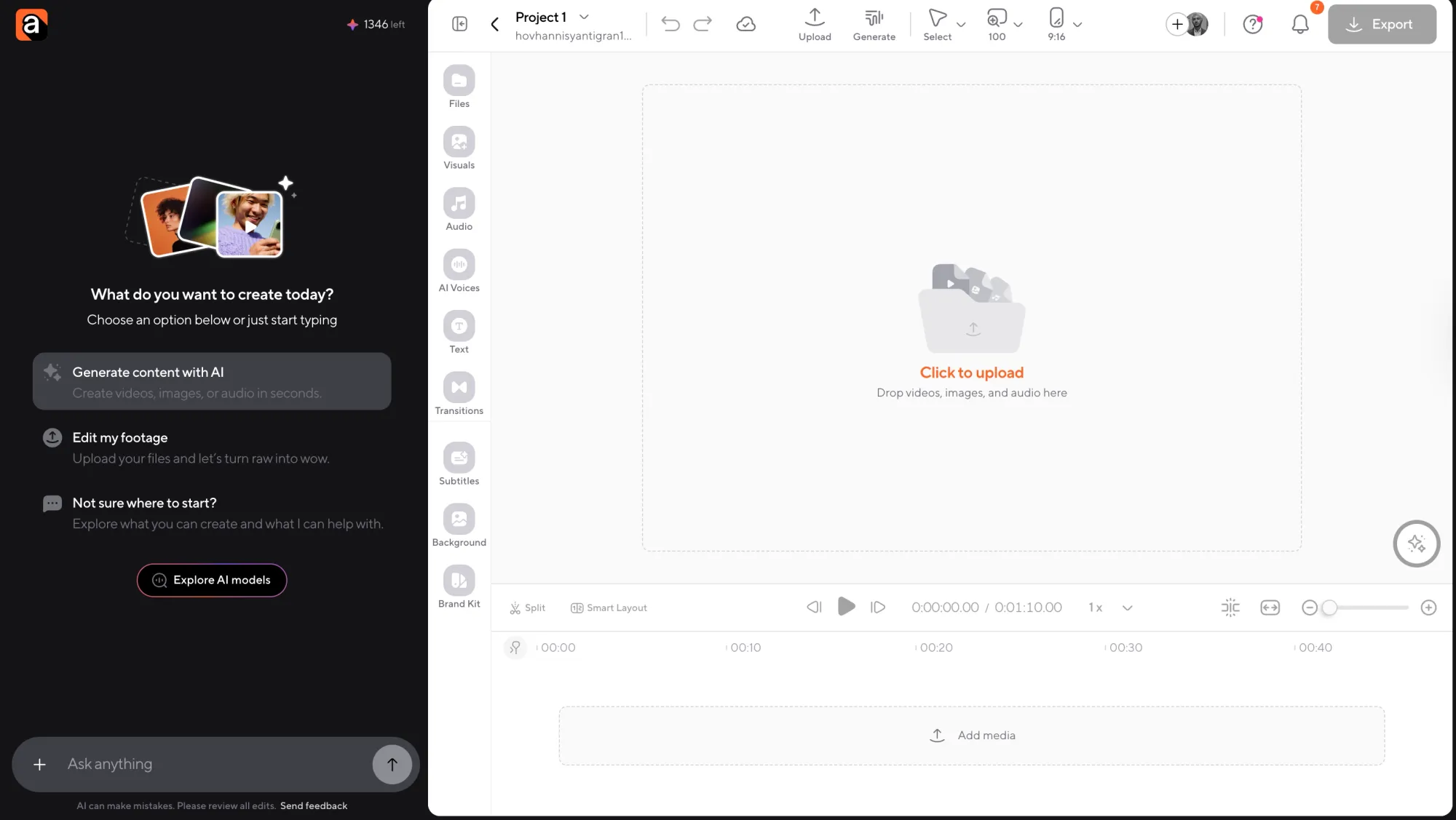
Step 3: Browse available AI models
You’ll see access to 100+ AI models for generating videos, images, and more, all directly inside the editor.
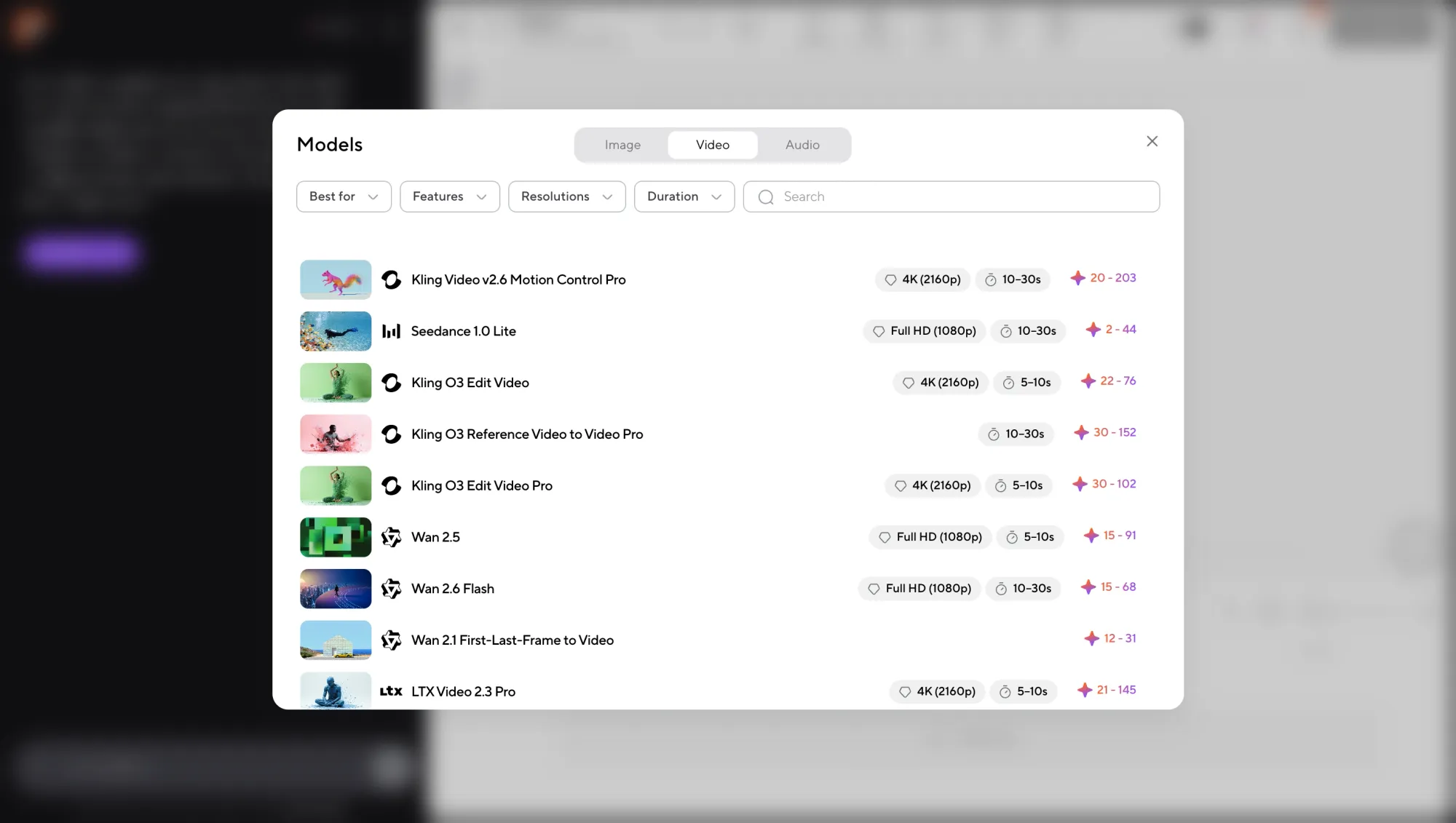
Step 4: Choose what you want to generate
Select the type of content you need:
• video clips
• images
• visual elements for your reel
Once you choose a model and input your idea, the AI will generate the content for you.
Step 5: Add it to your timeline and export
Bring your generated assets into the timeline, make quick edits if needed, and export your reel when it’s ready.
That’s it. No switching tools, no complicated setup, just a faster way to go from idea to finished reel in one workflow.
Common mistakes that stop reels from going viral
Sometimes it’s not what you’re doing… It’s what you’re missing.
Even good ideas can flop if they’re not executed properly.
Weak or delayed hooks: If your reel doesn’t grab attention instantly, most people will scroll before it even starts. Don’t “build up” too slowly, lead with the most interesting part.
• Too long or slow intros: The first few seconds should feel dynamic and clear. If viewers are confused or bored early on, retention drops fast.
• No captions or text overlays: A huge portion of users watch without sound. If your reel isn’t understandable visually, you’re losing viewers immediately.
• Ignoring trends completely: You don’t need to follow every trend, but ignoring them entirely can limit reach. Trends help your content feel relevant and discoverable.
• Over-editing or under-editing: Too many effects can feel overwhelming, while too little structure can feel boring. The goal is clean, engaging, and easy to follow.
• No clear payoff or ending: Viral reels usually deliver something: a punchline, a reveal, a tip, or a twist. If your video just… ends, people won’t rewatch or share it.
Avoiding these mistakes alone can significantly improve your performance, even without changing your content idea.
Ready to go viral? Let’s make it easier
Going viral on Instagram isn’t about luck, it’s about understanding what works and testing it consistently.
The more you experiment with hooks, formats, and ideas, the better your chances of hitting something that clicks. And with the rise of AI-generated content, it’s now easier than ever to create, test, and scale reels without spending hours on each one.
Instead of juggling multiple tools or overthinking every step, you can focus on what actually matters: ideas, storytelling, and execution.
If you want to create AI-generated reels faster, especially the kind built for curiosity, storytelling, and high engagement, using a workflow where everything happens in one place can make a huge difference. With Async, you can generate videos, images, voiceovers, and more using 100+ AI models directly inside the editor, making it easier to go from idea to finished reel without breaking your flow.
The key is simple: start, test, improve, repeat.
That’s how viral creators grow.
FAQs
How do you go viral on Instagram reels?
To go viral on Instagram reels, focus on strong hooks, high watch time, and shareable content. Your reel should grab attention within the first 1-2 seconds, keep viewers watching until the end, and give them a reason to share or save it. Consistency and testing different formats also play a big role.
Is 20,000 views in 2 days viral on Instagram?
It depends on your account size. For smaller accounts, 20,000 views in 2 days can be considered viral because it means your content reached far beyond your followers. For larger accounts, it may be a solid performance but not necessarily viral.
How long should Instagram reels be to go viral?
Shorter reels (around 7-30 seconds) tend to perform best because they’re easier to watch fully and rewatch. However, the most important factor is completion rate, not just length. A longer reel can still go viral if it keeps viewers engaged until the end.
Can AI-generated reels go viral?
Yes, AI-generated reels can absolutely go viral. In fact, many trending formats today use AI visuals, storytelling, and voiceovers. These reels often perform well because they’re unique, fast to produce, and highly engaging.
Do hashtags still matter for Reels?
Hashtags still help with discoverability, but they’re not the main factor anymore. Instagram prioritizes content quality, watch time, and engagement signals. Use a few relevant hashtags, but focus more on the content itself.
How often should I post Reels?
Posting 3-5 times per week is a good starting point for growth. The key is consistency and testing different formats. The more you post, the more data you get on what works, which increases your chances of going viral.