
Everyone is talking about generative AI. But here’s the question most people don’t stop to ask: if generative AI is just AI, why does it feel like a completely different technology?
Let’s clear something up right away: generative AI isn’t replacing AI. It’s part of it. But it behaves so differently that the distinction between AI vs generative AI is worth understanding.
In this article, we’ll take a closer look at what sets generative AI apart, break down how it differs from traditional AI systems, and explore where it fits within the broader world of artificial intelligence.
What is generative AI vs AI?
In simple terms, AI refers to the broad field of technology that allows machines to analyze data, recognize patterns, and make decisions. Generative AI is a specific type of AI designed to create new content, such as text, images, audio, or video, based on patterns it has learned from existing data.
So when people talk about generative AI vs AI, they’re really comparing a specialized branch to the entire field. Most AI systems focus on prediction or analysis, while generative AI focuses on producing something new.
AI vs generative AI
Before diving deeper into how these systems work, it helps to look at the core differences side by side.
The comparison below summarizes the main ideas behind generative AI vs AI and how they relate to predictive systems.
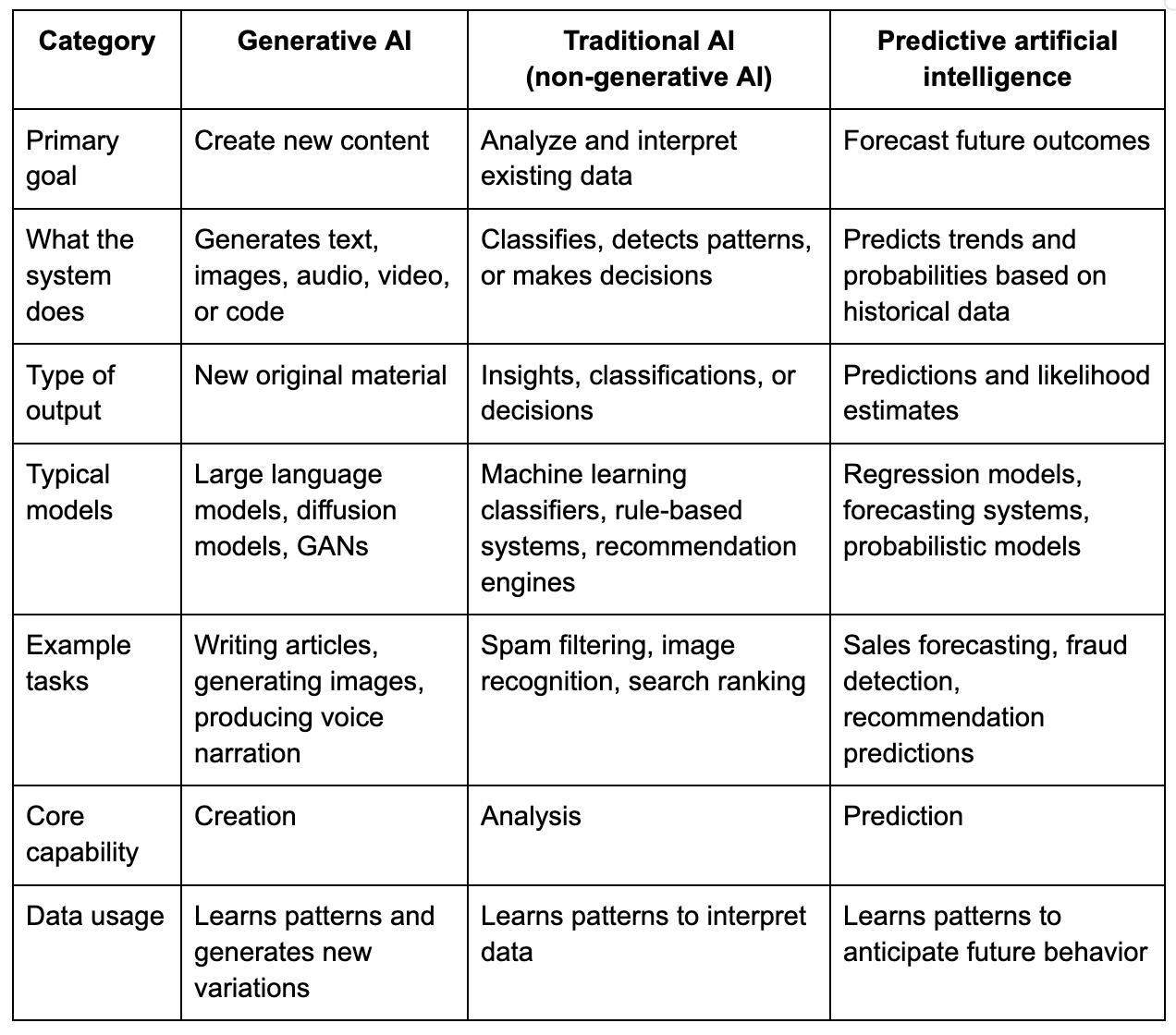
But let’s have a closer look at it:
Generative vs non generative AI
Here’s the quick answer:
The difference between generative vs non generative AI comes down to what the system is designed to do. Generative AI creates new content, while non generative AI focuses on analyzing data, recognizing patterns, and making predictions or decisions based on existing information.
In other words, the discussion around generative AI vs AI often highlights two different capabilities within artificial intelligence. Some AI systems help you understand data, while others generate something entirely new from it.
Generative AI
Generative AI refers to systems that produce new outputs such as text, images, audio, video, or code. These models learn patterns from massive datasets and then use those patterns to generate original material that didn’t previously exist.
This is why conversations about gen AI vs AI often center around creativity. Tools powered by generative AI can write articles, design images, create voice narration, or produce video scripts. Large language models, image generators, and AI voice synthesis tools are all examples of generative AI systems.
At its core, generative AI focuses on creation. Instead of simply analyzing data, it generates new variations that resemble the data it learned from.
AI
Traditional AI, sometimes described as non generative AI, focuses on analyzing information rather than producing new content. These systems examine existing data to identify patterns, classify information, detect anomalies, or predict future outcomes.
For example, recommendation engines, fraud detection systems, and many search algorithms fall into this category. They rely on predictive models that analyze large datasets and determine likely outcomes.
When people compare generative AI vs AI, what they are often describing is the difference between systems that create new material and systems that interpret or predict based on existing data.
Generative AI vs predictive AI
What about generative AI vs predictive AI?
Generative AI creates new content from learned patterns, while predictive AI uses historical data to forecast what is likely to happen next.
Predictive AI, often referred to as predictive artificial intelligence, has been widely used long before the rise of generative AI tools. It focuses on identifying trends in data and estimating probabilities for future events.
Again, here’s a more detailed breakdown:
Generative AI
Generative AI models learn from large datasets and generate new outputs that resemble the patterns they observed. For example, a language model can generate paragraphs of text, while an image model can create entirely new visuals based on prompts.
These systems rely on advanced neural networks that capture complex relationships between words, sounds, or pixels. The goal is not simply to predict the next outcome in a dataset but to generate coherent new content.
This is why generative AI powers tools used for writing, design, video creation, voice synthesis, and creative production.
Predictive artificial intelligence
Predictive artificial intelligence focuses on forecasting outcomes based on historical data. Instead of generating new material, these systems analyze past behavior to estimate future results.
Businesses commonly use predictive AI for tasks such as demand forecasting, risk assessment, recommendation systems, and fraud detection. For example, predictive AI can estimate which customers are likely to make a purchase or detect suspicious financial transactions.
While predictive AI is designed to anticipate outcomes, generative AI is designed to create outputs. Understanding this difference helps clarify how these two approaches serve very different roles within modern artificial intelligence systems.
Here’s a quick timeline showing how different types of AI emerged over time.
A mini-history lesson: what came first?
Before generative AI started writing articles, creating images, or producing voices, most artificial intelligence systems were built to analyze information and make predictions.
In other words, predictive and analytical AI came first, and generative systems appeared much later as computing power, data, and neural network research advanced.
Generative AI may feel like a sudden revolution, but it actually sits on top of decades of earlier AI research. The field of artificial intelligence began in the mid-20th century, while the technologies behind modern generative models only started to emerge in the 2010s.
• Quick answer
Traditional AI focused first on recognizing patterns, classifying data, and predicting outcomes. Generative AI arrived much later, when advances in deep learning made it possible for machines to create new content rather than just analyze existing information.
Timeline: how AI evolved into generative AI
1950 – The idea of machine intelligence
Alan Turing proposes the famous Turing Test, suggesting that machines could demonstrate intelligence if their responses were indistinguishable from humans. This idea helped shape early thinking about artificial intelligence.
1956 – Artificial intelligence becomes a field
The term “Artificial Intelligence” is officially introduced at the Dartmouth Conference, marking the birth of AI as a research discipline.
1960s – Early AI systems and chatbots
Researchers begin building early programs that simulate conversation and reasoning. One famous example is ELIZA, an early chatbot that mimicked a therapist using simple rules.
1980s–1990s – Machine learning and neural networks grow
AI research shifts toward machine learning models that can learn patterns from data. Techniques like neural networks and probabilistic models begin shaping modern AI systems.
2006 – Deep learning resurgence
Researchers revive neural network research using large datasets and powerful GPUs, launching the deep learning era that powers modern AI systems.
2014 – The first major generative breakthrough
Researchers introduce Generative Adversarial Networks (GANs), a technique that allows neural networks to generate realistic images and other data. This becomes a major milestone in generative AI research.
2017 – Transformer models change everything
The transformer architecture dramatically improves how machines process language and sequences, paving the way for modern generative language models.
2018–2022 – Large generative models appear
Large language models based on transformers begin generating long passages of text and code, demonstrating that AI systems can produce coherent content at scale.
2023–present – The generative AI boom
Generative AI tools become widely accessible, enabling people to generate text, images, video, and audio with simple prompts. What began as research technology quickly becomes a mainstream computing interface.
What this timeline tells us
If you zoom out, the sequence becomes clear.
AI began as a field focused on reasoning and prediction. Machine learning then gave computers the ability to learn from data. Deep learning expanded that capability with powerful neural networks. And finally, generative AI emerged as the stage where machines could create entirely new content.
So historically speaking, generative AI didn’t replace AI. It evolved from it.
Real-world examples of generative AI vs AI
Understanding the difference between generative AI and traditional AI becomes much easier when you look at how these systems are used in real products. Some AI tools analyze information and make predictions, while others generate entirely new content such as text, images, or voice.
Here are several real-world examples that highlight the difference.
Generative AI examples
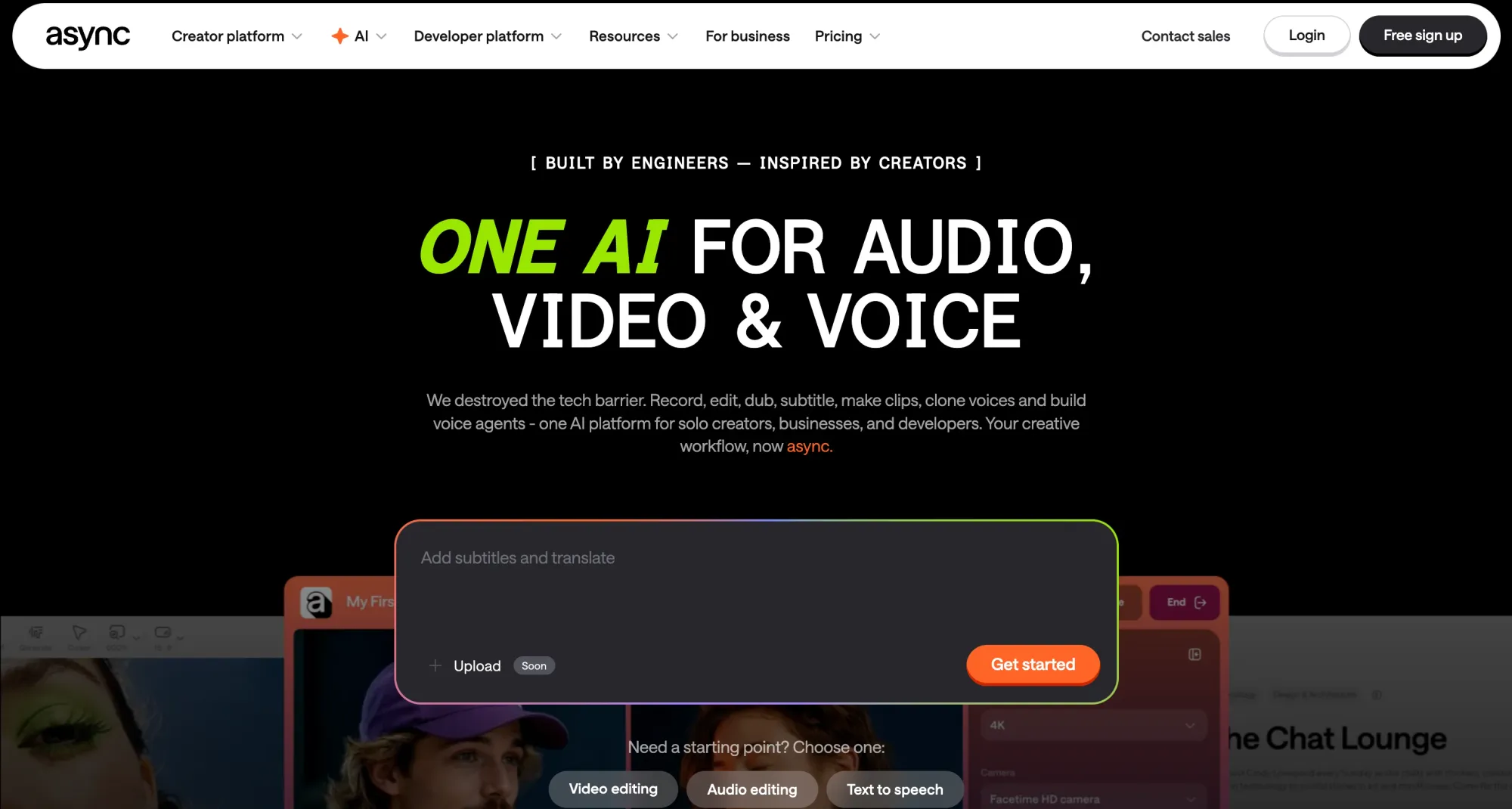
Async with AI voice generation for audio and video content
Platforms like Async use generative AI to produce realistic speech from text. Instead of analyzing existing recordings, the system generates completely new audio using trained voice models. Creators, marketers, and businesses use these tools to produce podcasts, voiceovers, and multilingual content without recording new narration.
Open AI/ChatGPT with AI text generation for writing and coding
Large language models like ChatGPT generate text based on prompts. These systems can write emails, summarize documents, draft articles, or generate code. The model learns patterns from large datasets and produces original text responses rather than simply retrieving existing information.

Midjourney / DALL-E with AI image generation for design and creative work
Image generation tools allow users to create new visuals from simple descriptions. Designers and marketers can generate illustrations, concept art, or marketing graphics by entering a prompt. These systems rely on generative models trained on large image datasets to produce entirely new images.

Traditional AI examples
Mastercard / PayPal with Fraud detection systems in banking
Financial institutions use AI models to analyze transaction patterns and detect suspicious activity. These systems evaluate thousands of signals in real time to identify potential fraud. Instead of generating new content, they analyze existing financial data and flag anomalies.
Netflix / Spotify with Recommendation engines for entertainment platforms
Streaming platforms rely on AI to recommend movies, shows, or music based on user behavior. These systems analyze past activity, viewing history, and user similarities to predict what someone might want to watch or listen to next.

Google Maps / Waze with Navigation and traffic prediction systems
Navigation apps use AI to analyze traffic patterns, road data, and historical travel times. The system predicts the fastest route and estimates arrival times based on current conditions. This type of AI focuses on prediction and analysis rather than generating new content.
Now let’s also quickly cover the final question you might have:
What is agentic AI vs generative AI?
Here’s the quick answer: generative AI creates content, while agentic AI takes action. Generative AI focuses on producing outputs like text, images, audio, or video. Agentic AI, on the other hand, is designed to make decisions, plan steps, and carry out tasks autonomously.
In other words, generative AI generates information, while agentic AI can use information to complete goals.
Generative AI
Generative AI refers to systems that create new content based on patterns learned from large datasets. These models can produce text, images, music, code, or voice from prompts given by users.
For example, a generative AI system might write an article, generate an illustration, or create a synthetic voice narration. Tools like language models, image generators, and AI voice platforms fall into this category. The system responds to prompts and produces outputs, but it typically does not decide what tasks to perform on its own.
Generative AI is therefore focused on creation. It generates results when asked, but it does not independently plan or execute complex actions.
Agentic AI
Agentic AI refers to AI systems designed to act as autonomous agents. Instead of simply generating content in response to prompts, these systems can plan tasks, make decisions, and take multiple steps to achieve a specific goal.
An agentic AI system might research information, write code, test it, and refine the results automatically. In other cases, it could manage workflows, automate business tasks, or coordinate multiple tools to complete an objective.
The defining feature of agentic AI is autonomy. Rather than waiting for a prompt and producing an output, it operates more like a digital agent that can reason through problems and carry out actions over time.
Key difference
The main difference between generative AI and agentic AI comes down to their role.
Generative AI produces content when prompted. Agentic AI uses reasoning and decision-making to pursue goals and complete tasks.
In many emerging systems, the two approaches are combined. Generative AI produces the content or responses, while agentic AI manages the process of deciding what actions to take next.
The future of generative AI
Generative AI is still in its early stages, but its trajectory is already reshaping how people create, communicate, and build products. Researchers and industry leaders expect generative systems to become more multimodal, capable of generating text, audio, video, and interactive experiences together in a single workflow.
For creators and businesses, this shift means the barrier between imagination and production is getting smaller every year. And the easiest way to understand what generative AI can do is simply to try it yourself.
If you want to see how generative AI can produce realistic voices and audio from text, you can explore tools like Async and experience how AI-powered voice generation is changing the way content gets created.
FAQ
What is the difference between AI and generative AI?
Artificial intelligence (AI) is a broad field that includes systems designed to analyze data, recognize patterns, and make decisions. Generative AI is a subset of AI focused on creating new content such as text, images, audio, or video based on patterns learned from training data.
Is generative AI a type of AI?
Yes. Generative AI is a specialized branch of artificial intelligence. While many AI systems analyze data or predict outcomes, generative AI focuses specifically on producing new outputs, including written text, images, code, audio, and video.
What is generative AI vs predictive AI?
Generative AI creates new content based on patterns it learned from large datasets. Predictive AI, often called predictive artificial intelligence, analyzes historical data to forecast what is likely to happen next, such as predicting demand, user behavior, or potential risks.
What is agentic AI vs generative AI?
Generative AI produces content such as text, images, or audio when prompted. Agentic AI refers to systems that can plan actions, make decisions, and complete tasks autonomously to achieve a goal. In many modern systems, generative AI produces outputs while agentic AI manages the workflow.
What are examples of generative AI?
Common examples of generative AI include language models that generate text, image generation systems that create visuals from prompts, and AI voice tools that produce speech from text. These systems generate entirely new outputs rather than simply analyzing existing information.
Why has generative AI become so popular?
Generative AI became widely popular due to advances in deep learning, large datasets, and powerful computing hardware. These improvements made it possible for models to generate realistic text, images, and audio, turning generative AI into practical tools for creators, businesses, and developers.