Most B2B teams aren’t struggling to create content. They’re struggling to make it work. Content gets published, shared, and sometimes even ranked, but it rarely translates into pipeline, sales conversations, or real business impact. That gap usually comes down to one thing: the absence of a clear B2B content marketing strategy.
A strong B2B content marketing strategy connects audience insight, business goals, content formats, distribution, and measurement into one system. It ensures that every piece of content has a role, reaches the right people, and contributes to revenue, not just visibility. In this guide, we’ll break down how B2B content marketing actually works today, what separates high-performing strategies from average ones, and how to build a system that scales.
What is a B2B content marketing strategy?
Here’s the quick answer:
A B2B content marketing strategy is the system behind your content, not just the content itself. It defines who you’re targeting, what problems you’re solving, which formats you’ll use, how you’ll distribute them, and how you’ll measure impact.
A more detailed answer:
A B2B content marketing strategy is a structured approach to creating, distributing, and measuring content that supports business goals across the full customer lifecycle. Instead of focusing on individual assets, it focuses on how content works together to influence awareness, consideration, and buying decisions.
Many teams create content consistently but still see limited results. The issue is not volume; it’s alignment. Without a clear audience, defined problems, and a distribution plan, content stays disconnected from outcomes.
A strong B2B content marketing strategy aligns five core elements: audience, business goals, formats, distribution, and measurement. Each one shapes the others, turning content into a coordinated system rather than isolated efforts.
When these elements work together, content becomes a driver of pipeline, sales conversations, and long-term growth.
Why B2B content marketing still matters in 2026
Here’s the quick answer:
B2B content marketing still matters in 2026 because your buyers are more independent, trust drives decisions, and content influences every stage of the buying process. As AI increases content volume, differentiation now comes from expertise, credibility, and distribution, not just output.
A more detailed answer:
Content is also evolving. Video is becoming more central, while blogs still deliver strong ROI when supported by distribution and repurposing, as highlighted by HubSpot marketing statistics. Content no longer works in isolation. It works as part of a system.
AI is raising the baseline. It is easier than ever to produce content, which means volume alone is not enough. HubSpot also notes that differentiation now comes from original thinking and a clear point of view.
At the same time, discovery is shifting. Semrush reports that traffic from AI-driven platforms like ChatGPT is growing, which changes how your content gets found and evaluated. If you want results, you need a B2B content marketing strategy that turns content into a competitive advantage.
How does content marketing actually work for small B2B software companies?
Here’s the quick answer:
For small B2B software companies, content marketing works when it is tightly focused on a specific problem, consistently distributed, and directly connected to sales conversations. It rarely works as a volume play. Instead, it works as a long-term system that builds trust, captures demand, and supports conversion.
A more detailed answer:
If you look at how content marketing actually plays out for small B2B SaaS teams, the pattern is very different from what most guides suggest. It is not about publishing constantly or covering every topic. It is about focus, consistency, and distribution.
Here are three real patterns that come up repeatedly:
1. Target a specific niche instead of broad topics
One of the strongest patterns is that small teams succeed when they go deep on a very specific problem instead of trying to cover a broad space.
For example, instead of writing about “marketing” or even “B2B marketing,” a company focuses on something like onboarding optimization for SaaS or CRM workflows for sales teams. Over time, they build a library of highly relevant content that speaks directly to a specific audience.
This works because:
• The content is easier to rank
• It attracts more qualified traffic
• It aligns closely with the product
Instead of competing broadly, they become the go-to resource in a narrow category.
2. Distribution matters more than creation
Small B2B teams that get results tend to spend as much time distributing content as creating it. That includes:
• Sharing posts on LinkedIn multiple times
• Repurposing one article into several formats
• Engaging in relevant communities and conversations
• Sending content directly to prospects or users
In many cases, a single strong piece of content is reused and reshared for weeks or even months.
3. Content works best when tied to real conversations
The most effective content often comes directly from customer interactions, sales calls, or product questions.
Instead of guessing what to write about, teams:
• Turn common objections into articles
• Explain features through real use cases
• Break down problems they see repeatedly in demos or onboarding
The core elements of a high-performing B2B content marketing strategy
A successful B2B content marketing strategy is focused, consistent, and tied to business outcomes. It targets a clear audience, solves specific problems, and connects content to the pipeline, not just traffic.
Most high-performing B2B content marketing strategies follow the same core structure, even if execution differs. To understand how this works in practice, let’s break down the core elements that make it effective.
Clear business goals
Every piece of content should support a defined objective. Content typically maps to five core areas:
• Brand awareness, to reach new audiences
• Demand generation, to capture and nurture interest
• Sales enablement, to support conversations and objections
• Customer education, to improve onboarding and usage
• Retention and expansion, to drive long-term value
When content is tied to these outcomes, it becomes easier to justify investment and align with revenue.
Audience and buying group insight
Understanding your audience goes beyond basic personas. In B2B, decisions are rarely made by one person, and your content needs to reflect that.
A strong B2B content marketing strategy considers the following:
- Different buyer roles
- Hidden stakeholders and internal influencers
- The jobs your audience is trying to get done
- Common objections and information needs
Research from LinkedIn and Edelman shows that B2B buying decisions often involve multiple stakeholders, and thought leadership plays a key role in influencing those groups. That means the closer your content matches real buying dynamics, the more effective your B2B content marketing strategy becomes.
Instead of targeting one decision-maker, you create content that answers different concerns across the group, from strategic value to technical validation.
Funnel and journey coverage
Content should support the full buying journey, not just attract attention at the top.
A strong B2B content marketing strategy aligns content with each stage:
• Awareness: define the problem
• Consideration: explore solutions
• Decision: address objections
• Post-purchase: support adoption and expansion
Most teams focus too much on awareness and miss the stages that drive results. Real impact comes from covering the full journey, especially where content can support your sales process and help buyers make confident decisions.
Channel strategy
Creating content is only half the work. Distribution is what determines whether it performs.
A strong B2B content marketing strategy uses a mix of channels:
• Owned (website, blog)
• Organic search
• AI search and answer engines
• Social platforms
• Partnerships
• Paid amplification
Measurement model
Measuring content performance requires going beyond surface-level metrics. Instead of focusing on pageviews, a strong B2B content marketing strategy tracks:
• Qualified organic traffic
• Assisted conversions
• Demo influence
• Content-influenced pipeline
• Sales usage
• Retention and activation signals
These metrics connect content to real business outcomes, not just visibility. When measurement is tied to pipeline and revenue, it becomes easier to understand what works, double down on it, and improve results over time.
How to build a B2B content marketing strategy step by step
To build a B2B content marketing strategy or refine your content marketing strategy for B2B, start with clear revenue goals; define your audience and their problems, create focused content around those problems, assign formats by funnel stage, plan distribution before production, repurpose content across channels, and continuously measure and improve performance.
1. Start with revenue and pipeline goals
Your content should start with a business objective, not an idea. Define what you want the content to drive, whether that is pipeline, demos, or expansion.
2. Define ICP, buying committee, and pain points
Go beyond basic personas. Identify your ideal customer profile, understand the different roles involved in the decision, and map their main problems, objections, and questions.
3. Build topic clusters around business problems
Focus on problems first, then keywords. Instead of chasing isolated keywords, build clusters around core challenges your audience faces.
4. Assign formats by funnel stage
Different stages require different formats. Use educational content to attract attention, comparison content to guide evaluation, and proof-driven content to support decisions. After conversion, product and onboarding content help customers get value and stay engaged.
5. Create a distribution plan before production
Distribution should be part of the plan, not an afterthought. Decide where your content will live and how it will be shared before creating it.
6. Repurpose every core asset
One idea should lead to multiple outputs. A single piece of content can be turned into social posts, short videos, or audio formats using tools like Video Editor and AI text-to-speech. This increases reach without requiring new ideas every time.
7. Measure, prune, and update
Content needs continuous improvement. Track performance, identify what drives results, and update or remove content that no longer performs.
Final B2B content marketing strategy checklist
Use this b2b content marketing strategy checklist to make sure your strategy is complete:
• Revenue and pipeline goals defined
• ICP and buying group identified
• Core problems and topic clusters mapped
• Content aligned to funnel stages
• Distribution planned before production
• Repurposing is built into each core asset
• Content supports sales conversations
• Clear CTA aligned to intent and stage
• KPIs tied to the pipeline and performance
Best content types to include in your B2B content marketing strategy
Here’s the quick answer:
The best content types for a B2B content marketing strategy are those that match buyer intent across the funnel. This typically includes blog posts, research, case studies, comparison pages, videos, and product education content, supported by strong distribution and repurposing.
A more detailed answer:
Different formats serve different roles, and the goal is not to use all of them, but to use the right ones at the right stage.
• Blog posts: still a core format for attracting and educating your audience, especially when built around real problems
• Research and original data: builds authority and gives you something unique to say
• Case studies: provide proof and help reduce risk during decision-making
• Comparison pages: support buyers evaluating options and alternatives
• Webinars and podcasts: allow deeper exploration of topics and direct engagement
• Newsletters: keep your audience engaged over time
• Short-form video: helps simplify complex ideas and expand reach
• Product education content: supports onboarding, adoption, and retention
• Templates, tools, and calculators: create practical value and drive conversions
Blog content still plays an important role, but it works best when paired with richer formats and consistent distribution. For example, one article can be turned into multiple formats, especially when creating video content at scale, making it easier to reach your audience across multiple channels.
B2B content marketing examples to learn from
Strong B2B content marketing examples are built around real problems, consistent distribution, and clear positioning. They do not rely on volume. They work because they function as systems.
To make this practical, it helps to look at how real companies approach content.
Example 1 - HubSpot turning education into a growth engine
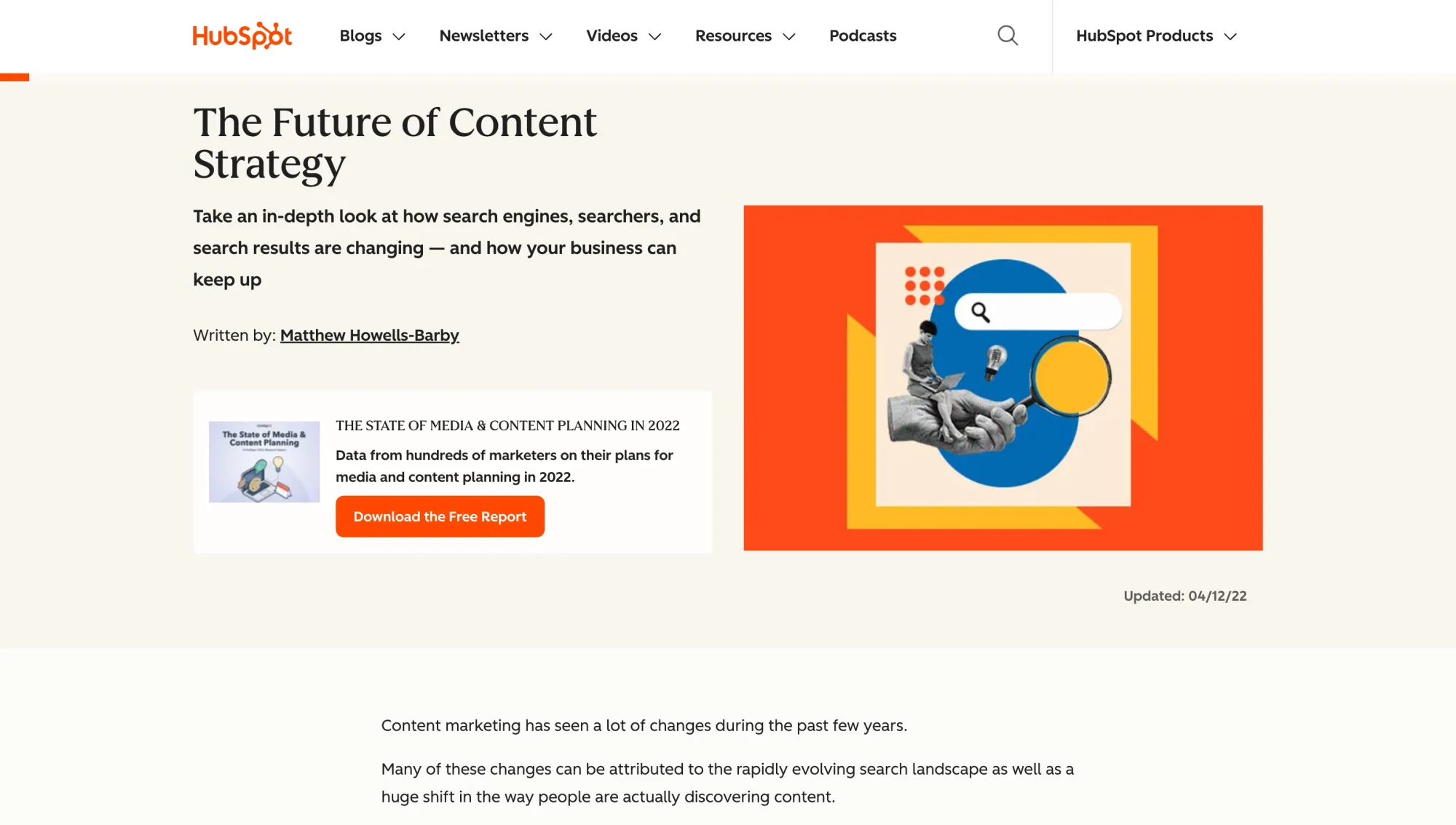
HubSpot focuses heavily on educational content tied to real problems. You’ll notice their blog is built around clear topics, updated regularly, and supported by templates and tools. Their content does not sit in isolation. It feeds search, supports lead generation, and is reused across formats.
Example 2 - Salesforce: building a multimedia content system
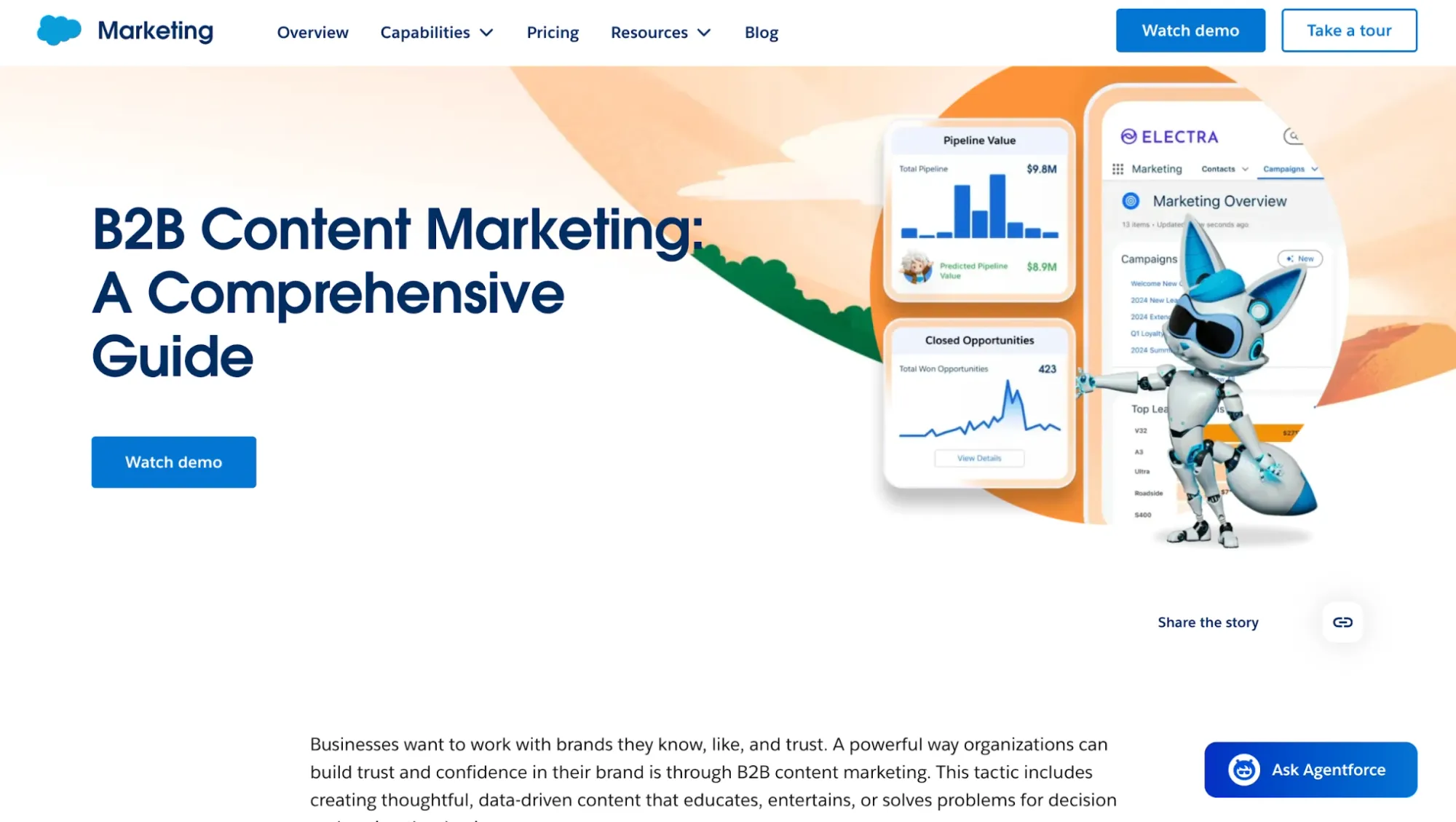
Salesforce integrates multiple formats into a single, connected system. Instead of relying on one channel, they use video, live sessions, blog content, and newsletters together. This keeps them visible across touchpoints while giving sales content they can reuse in conversations.
Example 3 - Notion: using product-led content to drive adoption
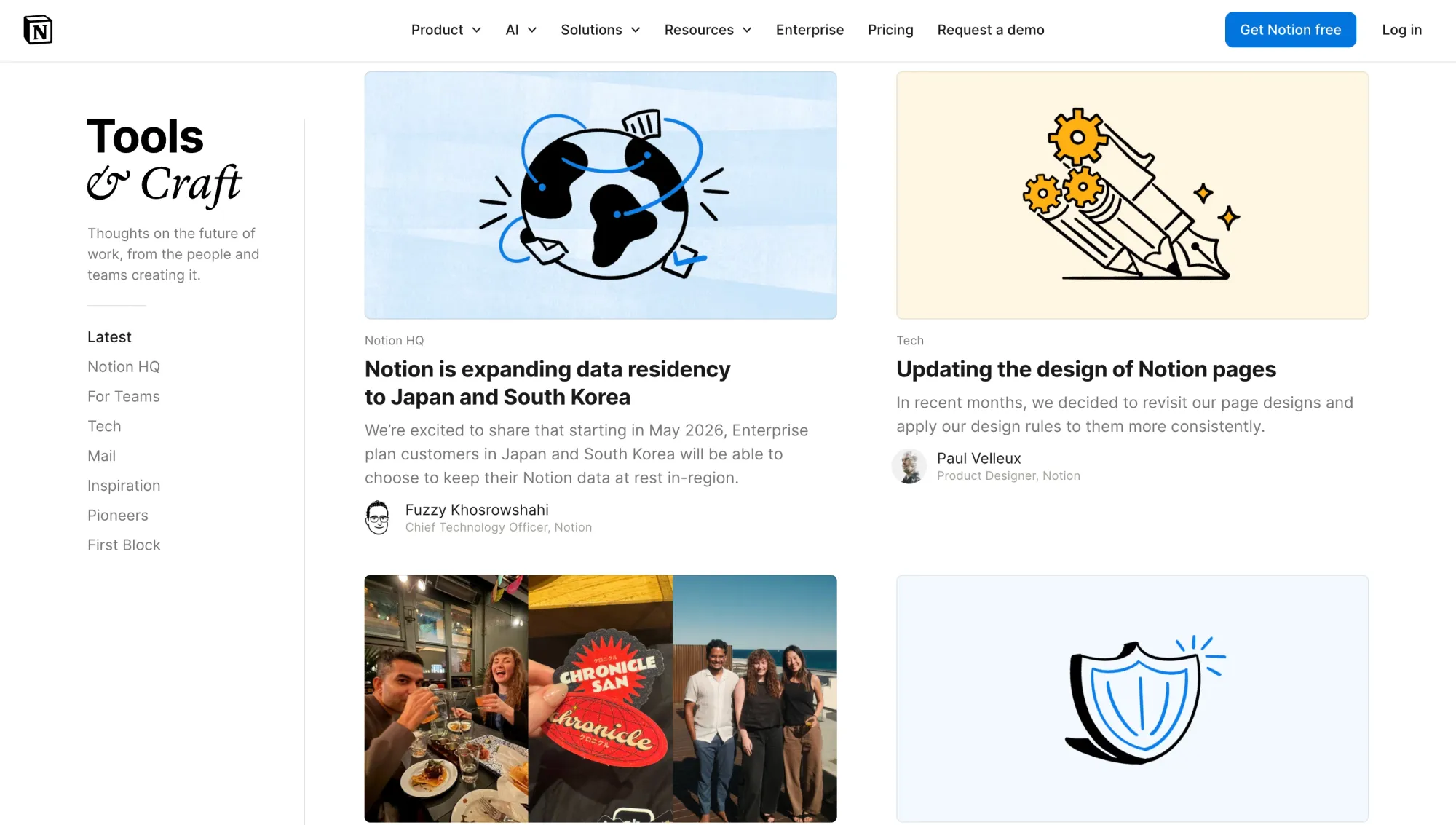
Notion focuses on showing how the product works in real scenarios. Their content includes tutorials, templates, and customer use cases that make the product easy to understand. This reduces friction and helps users move from interest to adoption more quickly.
Using Async to get more mileage out of your content
Modern B2B teams do not need more content. They need to get more value from what they already create. This is where Async helps you turn all of this into something you can actually execute.
Turn one idea into a multi-format campaign
Use Async to turn a webinar, interview, podcast, or expert conversation into:
• Blog-supporting clips
• Social videos
• Audiograms
• Repurposed promotional assets
• Short-form educational content
Speed up production without losing quality
Talk about reducing friction in:
• Recording
• Editing
• Voice/video workflows
• Repurposing
• Publishing-ready assets
Support thought leadership at scale
Use Async to help teams create:
• Founder videos
• Customer story clips
• Expert explainers
• Podcast/video content for demand gen
• Reusable multimedia assets for blogs and landing pages
Make content more reusable across channels
Tie this back to the idea that one asset should feed search, social, email, and sales enablement.
This section will work especially well because LinkedIn’s benchmark says video is central to B2B trust-building, and Wyzowl’s 2026 stats show video remains widely used and important across marketing programs.
How to measure success
Here’s the quick answer:
You measure B2B content marketing success by connecting content to revenue and pipeline while using awareness, engagement, and efficiency metrics as leading indicators to guide decisions.
A more detailed answer:
Effective B2B content teams focus on how content contributes to the pipeline, supports sales, and drives revenue over time.
At the same time, research shows many teams still struggle with unclear goals and weak attribution, which makes it difficult to prove impact, a challenge highlighted in recent B2B content marketing research by the Content Marketing Institute. You can solve this by structuring measurement across three layers: revenue and pipeline, leading indicators, and efficiency.
Awareness metrics
These metrics show if your content is reaching the right audience, but they do not indicate success on their own.
Focus on:
• impressions and non-branded clicks
• brand search growth over time
• share of voice across priority topics
• citations, mentions, and backlinks
Use these signals to understand visibility trends and identify which topics or campaigns are gaining traction.
Engagement metrics
Engagement shows if your content is actually being consumed and understood.
Focus on:
• time on page compared to expected reading time
• scroll depth on key pages
• newsletter signups and micro-conversions
• video completion rate and watch time
Strong engagement usually signals good topic fit and clarity, while low engagement highlights where content needs improvement.
Conversion metrics
This is where content connects directly to business outcomes.
Focus on:
• demo assists and content touchpoints before conversion
• MQL and SQL assists
• content-influenced opportunities and pipeline
• trial starts and trial-to-paid conversions
Analyze which content types consistently appear in successful deals and prioritize creating and updating those formats.
Efficiency metrics
Efficiency determines how well your content strategy scales over time.
Focus on:
• cost per asset and per opportunity influenced
• time to publish from idea to live
• repurposing yield per core asset
• performance gains from content updates
Improving efficiency allows you to increase impact without increasing effort or budget.
Final takeaway: build a system, not a content calendar
The goal is not to publish more content. It is to build something that actually works.
Most B2B teams do not struggle with ideas. They struggle with consistency, distribution, and turning content into real business impact. A content calendar alone does not solve that.
What works is a system. One that connects clear goals, real audience problems, the right formats, and consistent distribution. One that builds trust over time and supports both marketing and sales.
In today’s environment, where content is easier to produce than ever, the advantage comes from how you think, how you position, and how well your content is used.
That is where tools like Async fit in. Not to create more content, but to help you turn ideas into structured, scalable output. For example, having a clear workflow inside a video editor makes it easier to stay consistent and build a content system that actually drives results.
FAQ
What is a B2B content marketing strategy?
A B2B content marketing strategy is a structured plan for creating and distributing content that supports business goals. It defines your audience, their problems, the formats you use, and how content contributes to pipeline, sales, and long-term growth.
Why is content marketing important in B2B?
B2B buyers research independently before talking to sales. Content shapes how they understand their problem, evaluate solutions, and build trust. A strong content strategy ensures your company is part of that process from early discovery to final decision.
What are the best B2B content marketing examples?
The most effective examples focus on real problems, not broad topics. These include in-depth blog content, case studies, comparison pages, and educational videos. The common factor is relevance, clear positioning, and consistent distribution across channels.
Which content formats work best for B2B marketing?
The best formats depend on the stage of the buyer journey. Blog posts attract attention, case studies build trust, comparison pages support decisions, and video helps simplify complex ideas. Combining formats creates stronger coverage and better results.
How do you measure B2B content marketing success?
Success is measured by how content influences pipeline and revenue. Key metrics include content-influenced opportunities, demo assists, and conversions, supported by engagement and visibility indicators that help you understand what is driving results.
What is the difference between B2B content marketing and B2B demand generation?
Content marketing focuses on creating and distributing valuable content, while demand generation focuses on capturing and converting interest. Content supports demand generation by educating buyers, building trust, and driving qualified traffic into conversion paths.
How can AI help with a B2B content marketing strategy?
AI helps speed up content creation, repurposing, and formatting. It allows teams to turn one idea into multiple outputs and maintain consistency across channels. It is especially useful when you want to improve video performance with subtitles and make content more accessible and engaging.
How often should B2B companies publish content?
Consistency matters more than frequency. Publishing regularly based on a clear strategy is more effective than posting often without direction. Many teams see better results by focusing on fewer, higher-quality pieces supported by strong distribution and repurposing.