Nobody has ever clicked on a video about the fall of Constantinople to see the narrator's face.
That is the whole business case for a faceless history channel. To start one, pick a narrow historical angle you can cover repeatedly, research each episode from archives and academic sources, write a story-shaped script, record or generate narration, and build the visuals from maps, timelines, public-domain artwork, and clearly labeled illustrations. No camera, ever. The story does the job a presenter would.
This guide covers the history-specific half of that. If you are still weighing up the format itself, start with our broader guide on how to start a faceless YouTube channel, then come back for the research, scripting, and visual workflow history demands.
And we will not do this in the abstract. One question runs through the whole article, from first search to finished video: what did an ordinary Roman eat in a day? The answer turns out to involve a city of a million people who mostly could not cook.
Why history works as a faceless YouTube niche
History suits narration-led video better than almost any other niche because the subject is already the star.
A few structural reasons it fits:
- The topic carries the video. Attention sits on the events, not the personality delivering them.
- The genre's visual language is documentary anyway: archival images, maps and slow moves over artwork.
- Many historical subjects stay relevant for years, so a well-researched episode keeps earning views.
- One subject splits into many episodes. Roman daily life alone gives you food, housing, work, entertainment, medicine, and law.
- Maps, timelines, illustrations, and a steady voice can carry twenty minutes without a single piece of on-camera footage.
What history does not give you is easy money. Good episodes take real research hours, and YouTube pays attention to whether your content is original.
Choose a clear history niche
History is a library, not a niche. You need a repeatable angle that tells a viewer what the next ten videos will be about.
Some angles that work as channel-level positioning:
- Ancient civilizations: Rome, Egypt, Mesopotamia, the Indus Valley
- Military history, from a single war, era, or branch
- Royal and dynastic history
- Everyday life in the past, where our running example sits
- Forgotten or overshadowed events
- Biographies of one type of figure: engineers, spies, explorers
- Cultural history: food, clothing, music, religion
- Local or regional history
- Historical mysteries and unresolved questions
The test: can you list twenty episode titles in your angle without repeating yourself? "Everyday life in ancient Rome" passes easily. "Everything that ever happened" does not. The same logic applies if you would rather start a faceless true crime YouTube channel, the other storytelling-led niche where narration and archival visuals do the work.
Narrow angles also help viewers decide whether to subscribe. Someone who enjoys an episode about Roman food will almost certainly watch one about Roman apartment blocks, and that predictability is what turns views into a channel. Our guide on how to get more subscribers on YouTube goes deeper into that.
Find history topics people actually want to watch
The best history topics are specific questions, not broad subjects. Research demand before you research the history, using free tools:
- YouTube autocomplete. Type "ancient Rome" into the search bar. The suggestions reflect real queries.
- Competitor channels. Sort an established history channel by most popular and see which questions outperform the rest.
- Google Trends. Compare two phrasings of the same topic to see which language people actually use.
- Search suggestions. Google's "People also ask" boxes are full of episode titles.
- Comments under existing history videos. The richest source. Viewers ask follow-up questions constantly, and those are pre-validated demand.
Then narrow until you have an episode rather than a category:
Each right-hand title promises one answer, which is the promise a viewer clicks on.
Research historical topics properly
Your research decides whether the episode is worth making. Work from sources in roughly this order of reliability:
- Museum and archive collections. National archives, the Library of Congress, the British Museum, and university digital collections publish cataloged material with provenance attached.
- Academic books and papers. University press books and peer-reviewed journals give you interpretation from people who read the primary sources in the original language.
- Government and institutional archives. Census, military, parliamentary, and municipal records.
- Reputable history publications. Good for orientation and for finding the specialists to read next.
- Primary sources where appropriate. Letters, inscriptions, recipes, legal texts, read alongside scholarly commentary rather than instead of it.
As you take notes, sort every claim into one of three buckets:
- Documented fact. Supported by surviving evidence. Roman bakeries existed in Pompeii, and we have the ovens.
- Interpretation. A reasonable reading of incomplete evidence. How often ordinary Romans ate meat is inferred from bone deposits, prices, and literary references, not counted.
- Disputed or popular claim. Widely repeated, weakly supported. The story that Romans vomited during feasts to keep eating belongs here, and the vomitorium was an amphitheater exit passage, not a room for that.
Say which bucket you are in while narrating. "We know," "the evidence suggests," and "this is often repeated but poorly supported" are three different phrases, and using them correctly builds the trust that keeps a history audience. Keep a source list per episode for your description and your fact-check pass.
Write a history script that people will actually finish
Use a simple six-part frame:
Hook → historical context → central question or conflict → events → why it mattered → conclusion
The failure mode for history scripts is the encyclopedia voice: a flat run of dates and names with nothing at stake. Fix it by giving the episode a question that stays open until the end.
Here is our running example turned into an episode angle:
Research finding: Most Romans lived in insulae, apartment blocks that usually had no kitchen because of the fire risk. Cooked food came from street vendors and thermopolia, counter-service shops, around 80 of which have been identified in Pompeii alone.
Episode angle: Ancient Rome ran on street food because most Romans could not cook at home.
Hook: "If you lived in ancient Rome, there is a good chance you had never cooked a hot meal in your life." Context: What an insula was and who lived in one. Question: So where did a million people get dinner? Events: A day of eating, from the light breakfast through the counter-service lunch to the evening cena, with the class divides running through it. Why it mattered: Food supply and public order were the same problem to a Roman emperor. Conclusion: Return to the hook and answer it plainly.
That angle came out of the research. It was not decided first and then decorated with facts, which is the order that produces errors.
Create narration without appearing on camera
Narration is the presence in a faceless history video, so it carries more weight here than in most niches. Record it yourself or generate it with an AI voice. Both work, and both live or die on the same details.
- Pronunciation. Historical names and places trip up a recorded reader and an AI voice equally. Check them first, and when generating narration, listen back for names and respell them phonetically in the script where needed.
- Pacing. History needs more air than most explainer content. Give a date or a hard concept a beat afterward so it lands.
- Tone. Interested and measured. You are telling someone something remarkable, not selling it. Overheated delivery makes accurate content sound unreliable.
- Consistency. Same voice, same speaking rate, same intro rhythm every episode. That is what makes a faceless channel feel like a channel.
Avoid clickbait narration in this genre specifically. History viewers are unusually willing to fact-check you in the comments, and one sensationalized claim undermines an otherwise solid episode.
Build visuals for a faceless history video
Visuals are where a history channel earns its production value, and where most beginners run into rights problems. Your palette:
- Public-domain archive material released by archives and museums under open licenses
- Maps, static or animated, showing where events happened and how borders moved
- Timelines, especially when an episode jumps between periods
- Historical photographs and artwork: paintings, engravings, mosaics, frescoes, manuscript illustrations
- Documents: letters, ledgers, inscriptions, and receipts shown on screen while you quote them
- Animation: moving arrows, highlighted routes, diagrams of buildings or machinery
- Atmospheric B-roll of ruins, landscapes, museum objects, and reenactment sites
- AI-generated reconstructions for moments where no image survives
Two rules matter more than the rest.
AI-generated historical scenes are illustrations, not evidence. If you generate an image of a Roman street food counter, say so on screen. A small persistent label such as "illustrative reconstruction" is enough. Presenting a generated image as archival material is the fastest way to lose a history audience.
Old does not mean free. Copyright in the original work and rights in the reproduction are separate questions, and both vary by country and institution. A photograph of a 1,900-year-old mosaic may carry rights belonging to the photographer or the museum. Check the license on the specific file you download, keep a record of it, and prefer collections that state their terms clearly.
Edit your history video
History editing is about keeping long explanatory stretches visually alive without turning them into a slideshow.
- Bring maps and timelines in at the moment the narration needs them, then take them out.
- Add slow pans and pushes to still images so the frame is never truly static.
- Change B-roll roughly every eight to twelve seconds during explanation-heavy passages.
- Caption dates and place names. Viewers retain them better when read than when heard.
- Highlight names and locations on the map as they are mentioned rather than all at once.
- Keep music restrained and sound effects sparing. Score the mood; do not compete with the narration.
Our roundup of the best video editing software for YouTube covers the wider field of tools.
Create a history video with Async
Once the research is done and the script is written, Async handles production: narration, visuals, B-roll, and the edit in one chat-driven AI video editor. Here is the running example taken through it.
1. Start from the episode brief.
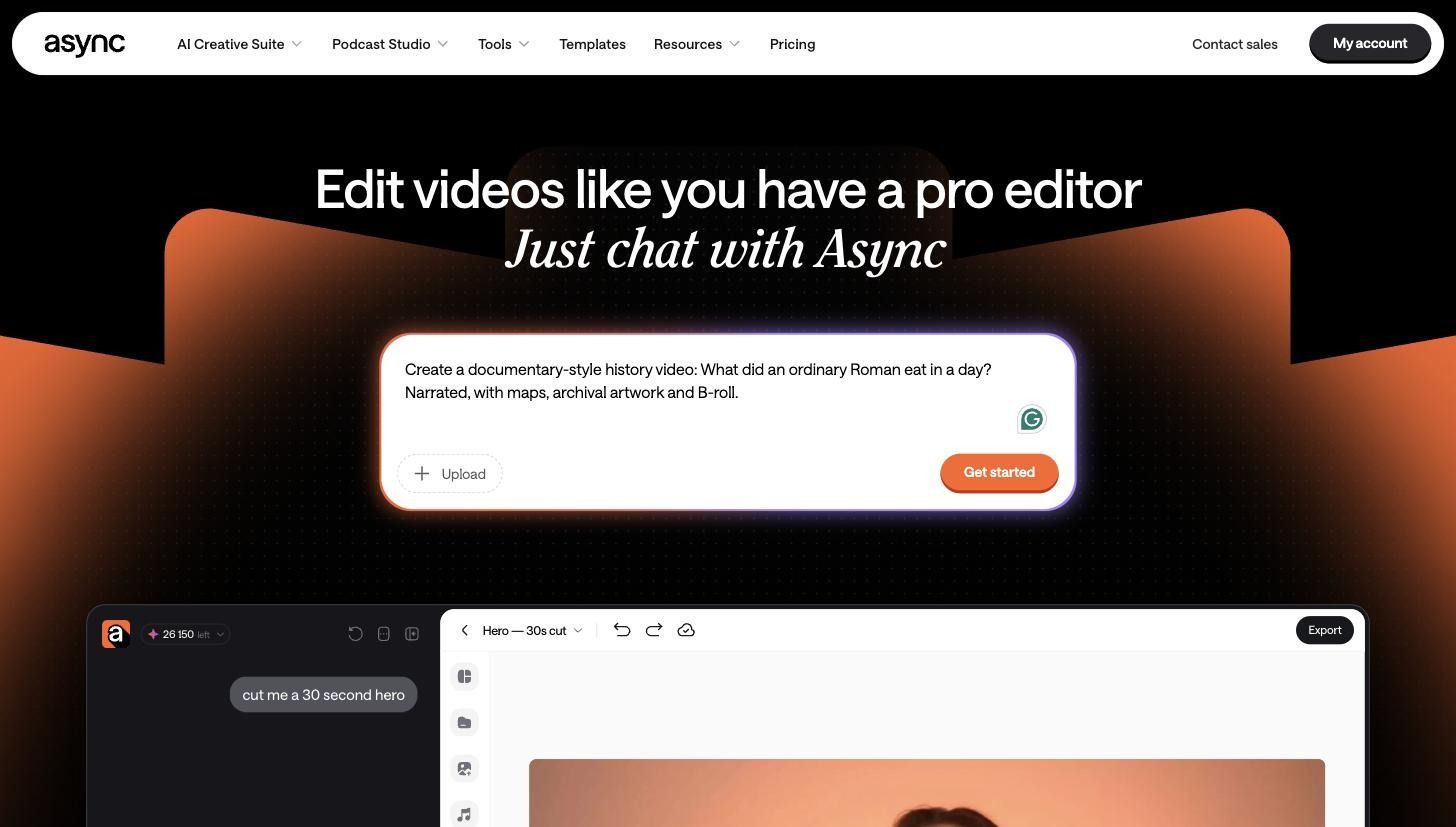
On the Async homepage, describe the video you want. For our example: "Create a documentary-style history video: What did an ordinary Roman eat in a day? Narrated, with maps, archival artwork and B-roll."
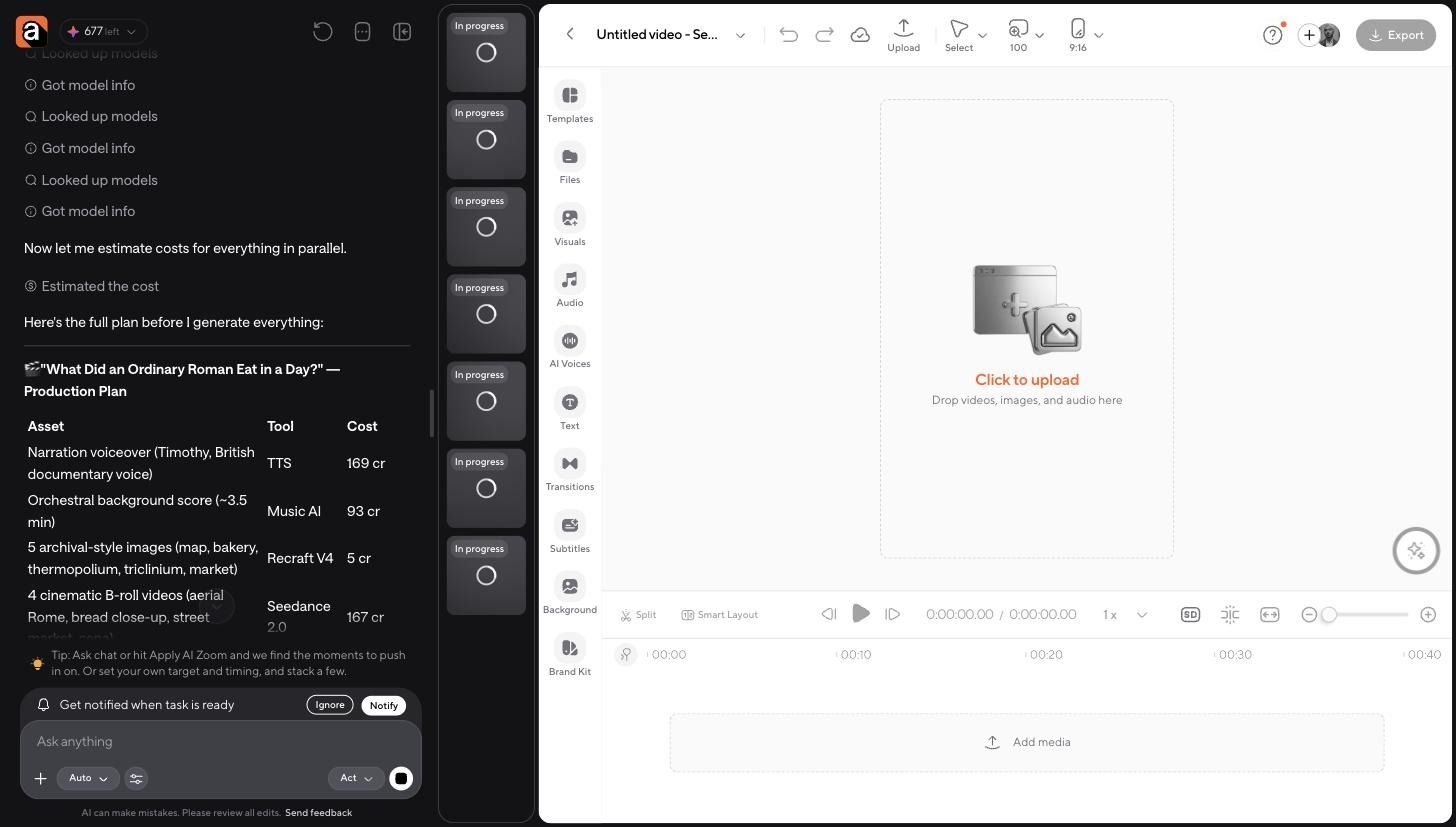
2. Async plans the build before it makes anything.
It shows the full production plan first: a documentary-register voiceover, an orchestral bed, archival-style images including a map of the empire, a bakery, a thermopolium, a triclinium and a market, plus cinematic B-roll.
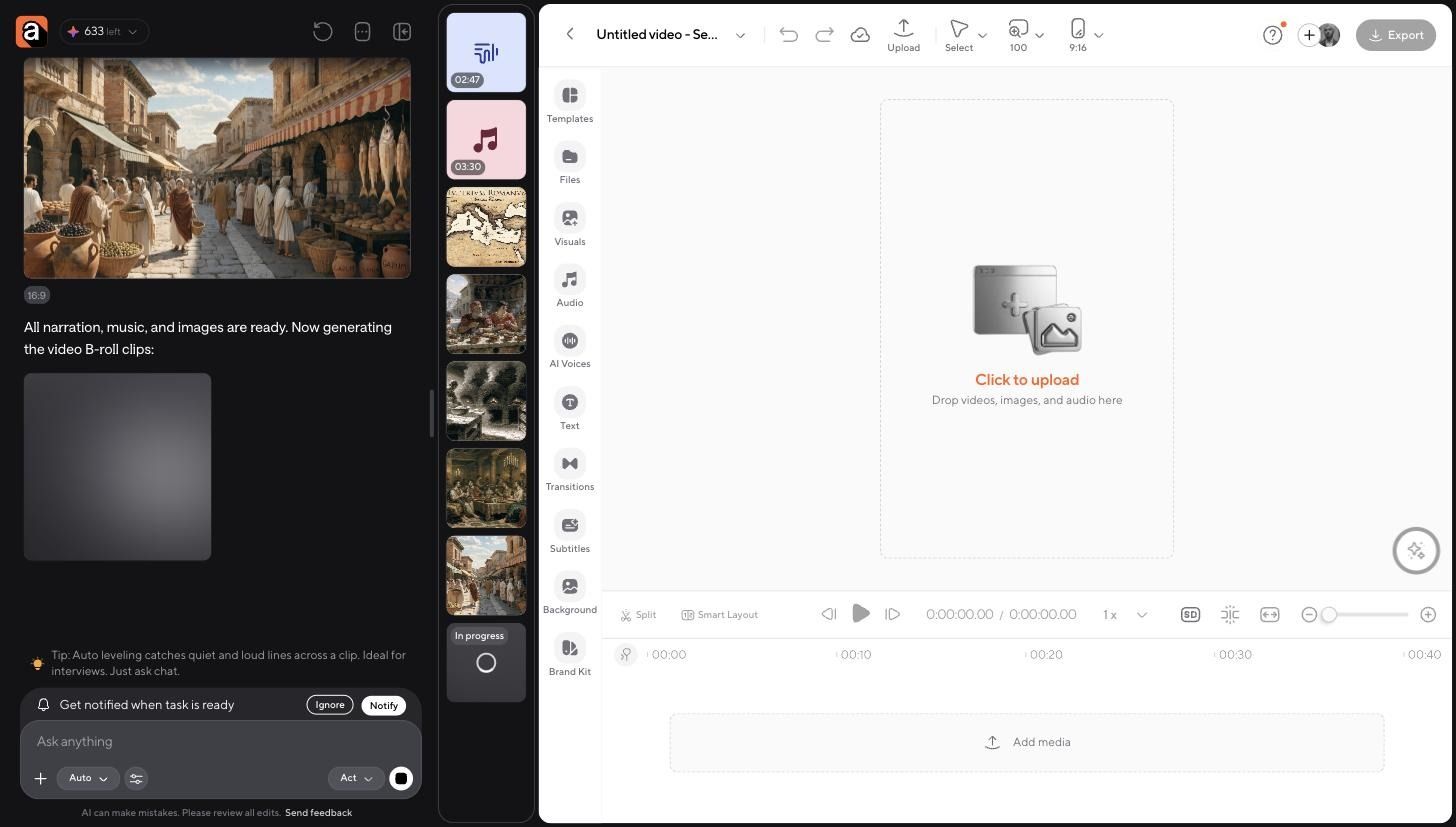
3. Narration, music, images and B-roll are generated.
Each asset appears in the panel as it finishes.
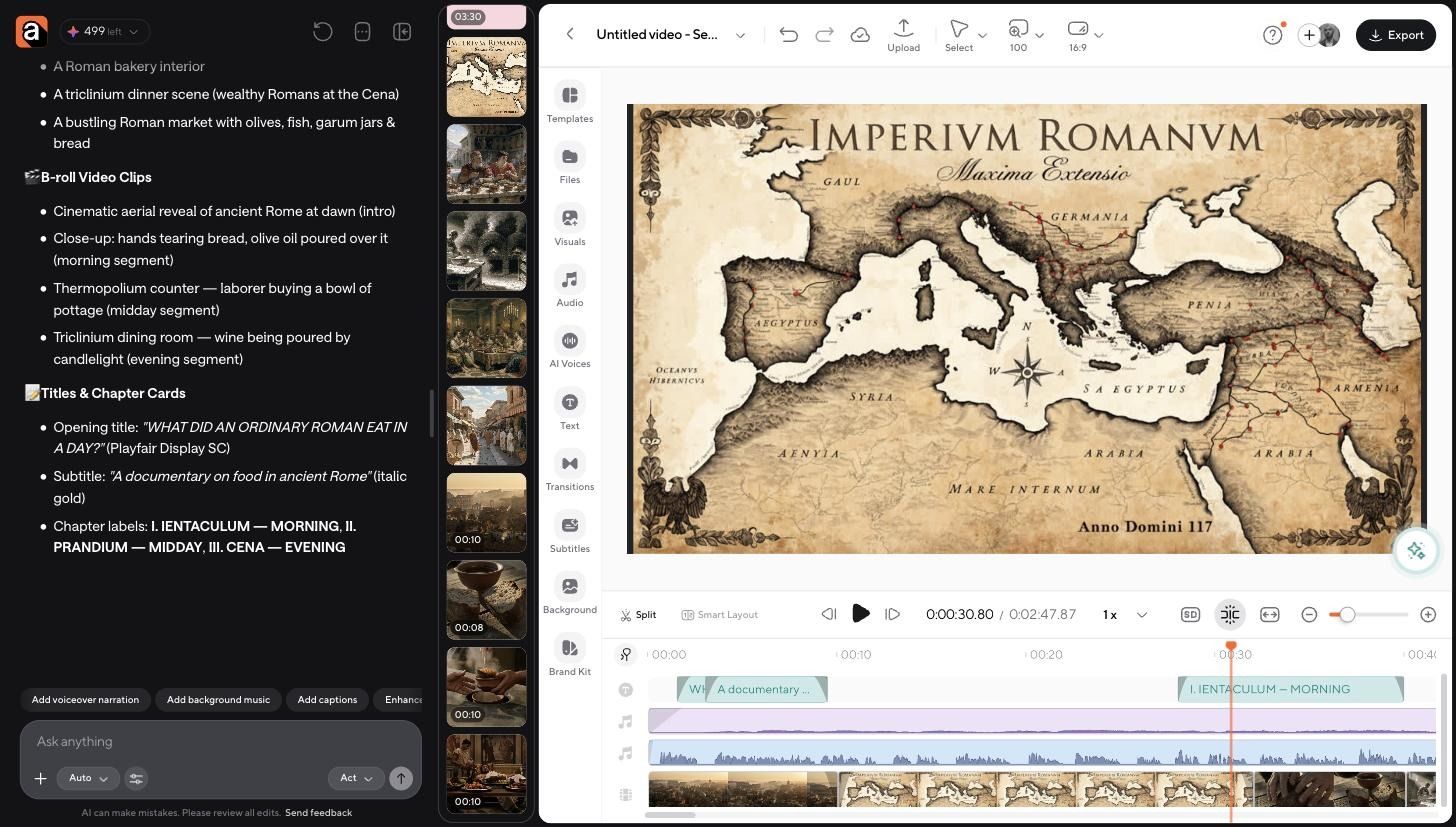
4. Async builds the timeline.
It lays down the narration, syncs the visuals to the narration segments, adds the music bed, and drops in the title card and chapter labels, here following the Roman meal structure: ientaculum, prandium, cena.
5. Refine by chatting, then export.
Swap a generated scene for an archival image you sourced yourself, drop in your own map, adjust pacing, add dated captions, or change the voice. You can upload your own files at any point, which is how your researched archival material gets in.
One boundary matters here: Async is a production tool, not a source of historical truth. Your research decides what is accurate; Async turns that researched story into a finished video. Treat every generated visual as an illustration, review it before it ships, and label anything that could be mistaken for archival material.
Build a repeatable publishing workflow
A history channel scales on process. Here's the flow:
Topic research → source check → script → narration → visuals → edit → fact-check → publish
The fact-check step sits after the edit deliberately. Errors creep in during scripting and visual selection too, and catching a mislabelled map before publication is far cheaper than after.
Templates help with the parts that should look the same every time: your intro, map style, caption design, and thumbnail layout.
What you cannot template is substance. YouTube's monetization policies require content to be original and authentic, and its inauthentic content policy makes repetitive or mass-produced content ineligible for monetization. The reused content rules also cover material repurposed from elsewhere without significant original commentary, substantive modification, or educational value. A channel generating near-identical scripts on rotating topics fails that test. One doing real research with an original angle does not.
By the way, if your videos keep getting stuck under 500 views, we’ve also made a video showing you how to boost engagement:
Can a faceless history channel make money?
Yes, through the same routes open to any channel, though none are guaranteed and none are quick.
- YouTube Partner Program. Ad revenue, once you meet the eligibility thresholds and clear the originality requirements above.
- Sponsorships. History audiences appeal to book publishers, learning platforms, and travel brands.
- Channel memberships. Extended cuts, source lists, and early access suit this genre well.
- Affiliate links. Books and courses tied to the episode topic were genuinely relevant.
- Your own products. A newsletter, a course, a map poster, or a companion podcast.
Two conditions apply throughout. Monetized content has to be original, and you need the commercial rights to every visual and audio element you use, including music, archival images, and stock footage. Sorting that out before you publish is much easier than after a claim.
FAQs
Can a history YouTube channel be faceless?
Yes, and the format suits history unusually well. Narration, maps, archival imagery and documentary-style visuals carry the video, so no on-camera presenter is needed.
How do you start a history YouTube channel?
Choose a narrow historical angle, research each episode from archives and academic sources, write a story-shaped script, record or generate narration, build visuals from maps and archival material, then edit, fact-check, and publish consistently.
What are the best faceless history YouTube channel ideas?
Everyday life in the past, military history, ancient civilizations, royal history, forgotten events, historical mysteries, cultural and food history, biographies, and local history all work. Pick one you can make twenty episodes about.
Where can you find visuals for history videos?
Museum and archive digital collections, national archives, university libraries, open-access image repositories, stock B-roll of historical sites, and your own maps, timelines and illustrations.
Can you use historical photos in YouTube videos?
Only when the license allows it. The age of the original does not automatically mean the file is free to use, because reproductions can carry separate rights, and rules differ by country. Check the terms on each specific file and keep a record.
Can AI generate visuals for history videos?
Yes, for reconstructions and illustrative scenes where no image survives. Label them clearly as illustrations, never present them as archival evidence, and confirm you have the commercial rights to use them.
Can faceless history channels be monetized?
Yes, through the YouTube Partner Program, sponsorships, memberships, affiliates, and your own products, provided the content is original and authentic and you hold commercial rights to the assets you use.
How do you make history videos interesting without appearing on camera?
Build each episode around one open question, use visual movement rather than static images, bring in maps and timelines when the narration needs them, caption dates and names, and keep narration measured rather than sensational.