
Picture it. A comedian is halfway through a story about the worst first date of his life. He stops, laughs, and starts telling you about the linen pants he has been living in all summer. You keep listening. You might even remember the URL.
That moment is the whole pitch for podcast advertising. It is also why brands spent 23% more on podcast ads in Q2 2026 than a year earlier, according to Magellan AI. The catch is that a great podcast ad and a wasted budget look almost identical on a media plan. This guide shows you how to tell them apart: what to buy, what it costs, what to say, and how to know it worked.
What is podcast advertising?
Podcast advertising is paid promotion that appears within or around podcast episodes. Ads may be read by the host or supplied as pre-recorded creative and can either stay permanently embedded in an episode or be dynamically inserted for specific audiences or campaign periods. Brands buy it directly from shows, through podcast networks, or on self-serve and programmatic platforms.
Here is the short version of how a campaign runs:
Brand picks an audience → selects shows or targeting → buys ad placements → host reads the ad, or it is inserted → results are tracked through impressions, promo codes, vanity URLs, conversions, or brand lift.
How does podcast advertising work?
Every campaign follows roughly the same path:
- Define the objective. Awareness, signups, purchases, or app installs. Pick one.
- Choose podcasts or audiences. Match shows to the people you want to reach.
- Pick an ad format. Host-read, pre-recorded, or a deeper sponsorship.
- Agree on placement and pricing. Pre-roll, mid-roll, or post-roll, usually priced per thousand impressions (CPM).
- Create the ad. A script, talking points, or a produced audio spot.
- Launch. The ad runs in new episodes, back-catalog episodes, or both.
- Track performance. Delivery, response, and lift.
- Optimize or scale. Keep the shows that work and cut the ones that don't.
Here is each step in detail.
Types of podcast ads
There are three main podcast ad formats: host-read ads, pre-recorded ads, and integrated sponsorships. They differ in who delivers the message and how easily it scales.
Host-read ads
The host delivers your message in their own voice, usually from a brief or a list of talking points. Good hosts add a story or a joke, so the ad sounds like part of the show. Acast puts typical host reads at 60 to 120 seconds. You are paying for the host's relationship with the audience.
Pre-recorded ads
Your brand produces the spot, often with a voice actor and music, and supplies the same file to every show. Pre-recorded ads usually run 15 to 30 seconds. They keep your messaging exact, scale easily across hundreds of shows, and are the standard unit for programmatic buying.
Sponsorships and integrated segments
Here, the brand goes deeper than a single ad break. Examples include "presented by" episode sponsorships, a recurring branded segment, a custom episode built around a theme, or a fully branded podcast series. They cost more but build a stronger brand association.
Pre-roll vs mid-roll vs post-roll
Mid-roll is usually the most valuable slot, pre-roll offers the widest exposure, and post-roll is the cheapest.
Rates are covered below, since pricing varies by show and deal.
Baked-in ads vs. dynamic ad insertion
This decides whether your ad lives forever or for one campaign.
Baked-in ads are recorded into the episode audio file. Every listener hears it, today or three years from now.
Dynamic ad insertion (DAI) places ads into open slots at the moment of download or playback. Campaign rules decide what plays, based on dates, location, audience, or show category. Old episodes can carry current ads, and creative can change mid-campaign.
Choose baked-in for evergreen messages that earn long-tail listens, like a host endorsing a product they love. Choose dynamic for launches, seasonal offers, or geo-targeting. Host reads can be dynamically inserted too, so you don't have to pick between authenticity and control.
How much does podcast advertising cost?
Most podcast ads are priced on a CPM basis, and published 2026 rates mostly fall between about $12 and $40+ per thousand impressions. Programmatic and pre-recorded ads sit at the low end. Host-read ads on niche business shows sit at the top.
What is podcast CPM?
CPM means cost per mille, or cost per 1,000 impressions (downloads or ad plays) delivered. The formula is simple:
\text{Cost} = \frac{\text{Impressions}}{1{,}000} \times \text{CPM}
Example: 50,000 impressions × $30 CPM = $1,500. This is an illustration, not a guaranteed rate. Your actual price depends on the show and the deal.
Published podcast ad rates in 2026
These are starting or reference rates, not universal prices. Verify current numbers with any seller before you budget.
What affects podcast advertising rates
- Audience size: Bigger shows cost more overall, not always per thousand.
- Niche: Hard-to-reach audiences, like founders, cost more.
- Format: Host-read costs more than produced spots.
- Placement: Mid-roll carries a premium over pre-roll and post-roll.
- Targeting: Each added layer raises the rate.
- Exclusivity: Locking out competitors costs extra.
- Campaign duration: Longer commitments can earn better rates.
- Buying route: Direct deals, networks, and programmatic platforms price differently.
Budget for extras outside the CPM, like production, reuse rights, and minimum spends. Acast's self-serve platform starts at $250, while its managed campaigns typically need $10,000 to $15,000.
How to choose the right podcast to advertise on
The right podcast is the one whose listeners look like your buyers, not the biggest one you can afford. A bookkeeping show can sell accounting software better than a chart-topping comedy show. Check six points:
- Audience fit: Does the listener profile overlap with your customer? Ask for demographics, not just downloads.
- Topic relevance: Does the show naturally connect to your product?
- Engagement: A smaller engaged audience often beats a giant mismatched one.
- Geography: Essential for local and regional campaigns and for products that only ship to certain countries.
- Brand fit: Would this host endorsing you feel believable to their listeners?
- Verified audience data: Ask whether downloads follow IAB Tech Lab guidelines.
Host-read vs. pre-recorded: Which should you choose?
Neither format is always better. Host-read ads tend to drive stronger response: Magellan AI's Q2 2026 analysis found a median response rate of 3.22% for host-read ads versus 2.09% for produced ads. But pre-recorded ads win on control and scale.
Many brands run both.
How to create a podcast advertising strategy
Here is a seven-step plan for a first campaign.
1. Define one objective
Awareness, signups, purchases, trials, or app installs. The goal decides your format, CTA, and metrics.
2. Define the audience
Describe who should hear the ad: job, life stage, interests, location.
3. Choose 3 to 5 relevant shows to test
Don't spread a first budget across dozens of random podcasts. A focused test gives you clean data.
4. Choose format and placement
Decide on host-read or produced, pre-roll, mid-roll, or post-roll, and baked-in or dynamic.
5. Create the ad around one message
Don't cram an entire landing page into 30 to 60 seconds. One problem, one promise, one reason to act.
6. Give listeners one clear action
Use a memorable vanity URL, a promo code, a free trial, or a "search for us" prompt that is easy to say out loud.
7. Track results, then iterate
Set up tracking before launch. Then cut weak shows, renew strong ones, and expand into similar podcasts.
What makes a good podcast ad?
A good podcast ad sounds like the show it lives in and asks for one thing. Listeners can't click or see a product shot, so every second counts. Strong ads have:
- Immediate context: Why is this brand showing up here, on this show?
- One problem: One that the listener recognizes.
- One promise: What changes if they try the product?
- Natural language: Words people say out loud, not brochure copy.
- Credibility: A personal experience, a specific detail, or proof.
- A memorable brand mention: Said clearly, ideally twice.
- A clear CTA: One URL or code, repeated at the end.
For host-read ads, the best brief is often talking points rather than a script. Compare these two openings for a fictional meal-kit brand:
The second lets the host sound like themselves, which is why you bought a host read. Fix the claims and offer; leave the rest flexible.
Podcast advertising examples
Three recent campaigns, three ways to buy.
Quince on The Weekly Show with Jon Stewart (host-read direct response)
Apparel brand Quince was the biggest podcast advertiser in Q2 2026 with an estimated $19 million in spend, per Magellan AI data. On The Weekly Show with Jon Stewart, Stewart reads the ads in his own words, riffing on linen pants with his usual sarcasm, and sends listeners to a show-specific vanity URL, quince.com/tws.
The lesson: Give hosts freedom and give every show its own URL.
AT&T and P1 with Matt & Tommy (branded awareness)
In Q4 2025, AT&T worked with Acast and the Formula 1 podcast P1 with Matt & Tommy to promote its Oracle Red Bull Racing partnership. The hosts recorded a live episode at the AT&T Garage in Austin during the US Grand Prix, simulcast in audio and video. One Instagram Reel reached 2.9 million views, and a TikTok hit 2.2 million.
The lesson: A sponsorship can be content, and video travels far beyond the podcast feed.
Origin Energy on Spotify Ad Exchange (programmatic)
In Q4 2025, Australian energy retailer Origin Energy bought audio and podcast inventory programmatically through Spotify Ad Exchange. It targeted "movers" going through big life changes, paired audio with digital out-of-home ads, and retargeted exposed listeners. Spotify reports a 78% ROI uplift against audio and DOOH marketing mix modeling benchmarks.
The lesson: Programmatic buying targets the audience, not the show, and is best judged with modeling, not last-click data.
Podcast advertising platforms and networks
There are three main ways to buy podcast ads.
Spotify opened its podcast inventory to Spotify Ads Manager and Spotify Ad Exchange buyers in July 2025, and Acast's self-serve platform starts at $250. Both are useful low-risk test environments.
How to measure podcast advertising
Podcast ads are measured on two levels: delivery (did the ad run to real listeners?) and impact (did it change behavior or perception?). The IAB Tech Lab Podcast Technical Measurement Guidelines, now at version 2.3 and updated in September 2026, set standard rules for counting downloads, audiences, and ad delivery across both audio and video podcasts.
Use this checklist to cover both levels:
- Impressions and ad delivery: IAB-compliant counts of ads served.
- Reach: How many unique listeners heard it.
- Frequency: How often each listener heard it.
- Promo code use: Redemptions per show.
- Vanity URL traffic: Visits to show-specific URLs.
- Conversions: Pixel attribution matches listener devices to purchases.
- CPA or CAC: Cost per acquisition or customer, where measurable.
- Brand lift: Awareness or consideration, exposed vs. unexposed.
- Search lift: Growth in branded search during the flight.
Don't judge every podcast campaign only by last-click attribution. Listeners often hear an ad while driving, then search for the brand later on another device.
How to measure podcast advertising ROI
The basic podcast advertising ROI formula compares what you spent with the value of the customers it brought in:
\text{ROI} = \frac{\text{Attributed revenue or customer value} - \text{Spend}}{\text{Spend}}
For example, $10,000 in spend that brings 200 customers worth $90 each in lifetime value produces $18,000 in value, an ROI of 80%.
For awareness campaigns, direct-response numbers alone undercount impact. Combine signals:
- Promo codes and dedicated URLs for direct, show-level attribution
- Post-purchase surveys asking "Where did you hear about us?"
- Branded search lift during and after the campaign
- Geo lift tests comparing regions with and without ads
- Brand lift studies measuring changes in awareness and consideration
Podcast advertising benchmarks: 2026 snapshot
Magellan's Q2 2026 benchmark analyzed 94,823 podcast episodes.
Turn your podcast campaign into more than an audio ad
In the AT&T example, the biggest numbers came from clips, not the episode. Most top shows now record video, so your sponsorship often comes with footage of the host read, interviews, or a live activation.
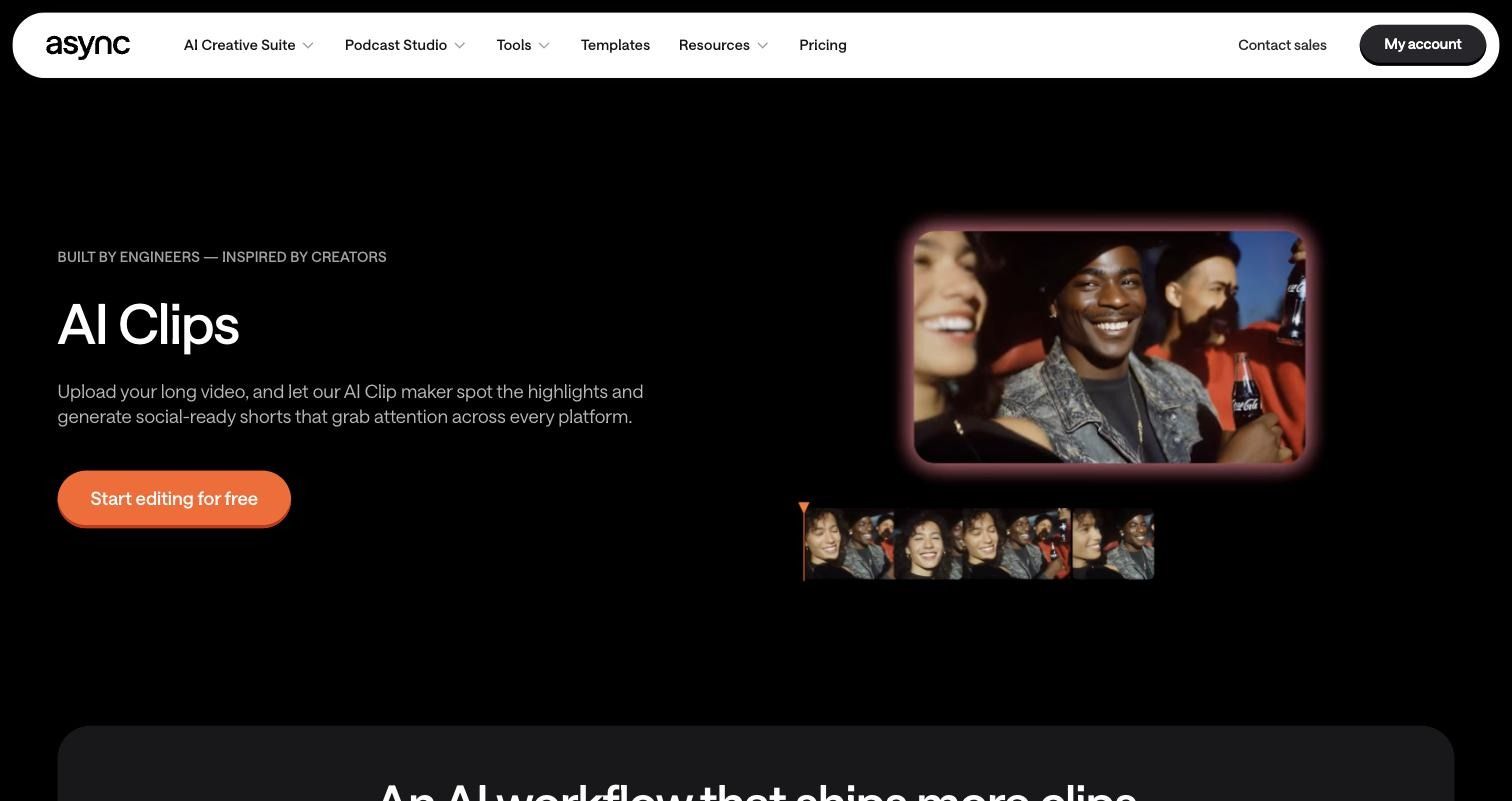
If your rights agreement allows reuse, that material can become TikToks, Reels, Shorts, and paid social ads. With Async, you can turn podcast episodes into social clips automatically. AI Clips finds the strongest moments in a long recording and formats them for each platform. You can then polish them in the AI video editor or the social media video editor, adding captions and branding.
One podcast buy, many channels. For more, see our guide to content repurposing.
FAQ
What is podcast advertising?
Podcast advertising is paid promotion that runs within or around podcast episodes. Ads are either read by the host in their own voice or supplied as pre-recorded spots. They can be baked into an episode permanently or dynamically inserted for specific audiences, locations, and campaign dates. Brands buy them directly, through networks, or programmatically.
How does podcast advertising work?
A brand sets one objective, picks shows or audience targeting, and buys pre-roll, mid-roll, or post-roll placements, usually priced per thousand impressions. It then supplies talking points or a produced spot. Once the ads run, results are tracked through impressions, promo codes, vanity URLs, conversions, and brand lift, and the plan is adjusted.
How much does podcast advertising cost?
Most podcast ads are sold on a CPM basis. Published 2026 rates run from about $12 for programmatic inventory to $40+ for host reads on business and finance shows. As an example, 50,000 impressions at a $30 CPM cost $1,500. Production, exclusivity, and minimum spends can add to the total.
What is a typical podcast advertising CPM?
Acast publishes starting rates of $25 to $40 CPM for host-read sponsorships and $15 to $30 for pre-recorded ads bought across a network in 2026. Libsyn's rate table puts programmatic at $12 to $15. Niche B2B shows can exceed $40, so always confirm current rates with the seller.
Are podcast ads effective?
They can be when the show fits the buyer. Magellan AI found a 2.23% median response rate across podcast campaigns in the first half of 2026, rising to 3.22% for host-read ads. Results still depend on audience match, creative quality, the offer, and how well the campaign is tracked.
How long should a podcast ad be?
Pre-recorded spots usually run 15 to 30 seconds, while host reads typically run 60 to 120 seconds. Shorter ads work well for awareness and repeated exposure. Longer reads suit products that need explanation or a personal story. Whatever the length, stick to one message and one clear call to action.
What is the difference between host-read and pre-recorded podcast ads?
Host-read ads are delivered by the show's host in their own voice, often with personal stories, which builds trust. Pre-recorded ads are produced by the advertiser and play identically on every show. Host reads usually drive stronger responses, while pre-recorded ads offer tighter message control, easier scaling, and more precise targeting.
What is dynamic ad insertion?
Dynamic ad insertion (DAI) places ads into open slots in an episode at download or playback, based on campaign rules like date, location, or audience. It lets back-catalog episodes carry current ads, supports geographic and audience targeting, and allows advertisers to pause, swap, or update creative in the middle of a campaign.
How do you advertise on a podcast?
You can contact a show directly through its media kit, buy across many shows through a podcast network, or use a self-serve or programmatic platform such as Spotify Ads Manager or the Acast ad platform. Start by defining your audience, then shortlist three to five shows that match it.
How do you measure podcast advertising ROI?
Compare your total spend with the revenue or customer value the campaign drives. Track direct response with promo codes, vanity URLs, pixel attribution, and post-purchase surveys. For awareness campaigns, add brand lift, branded search lift, and geo lift tests, since last-click attribution alone usually undercounts podcast impact.
Where can you buy podcast ads?
You can buy podcast ads directly from podcasters, from networks and publishers like Acast, iHeart, and SiriusXM Podcast Network, or through self-serve and programmatic platforms like Spotify Ads Manager, Spotify Ad Exchange, and the Libsyn AdvertiseCast marketplace. Direct deals suit niche fit, networks suit scale, and platforms suit targeting and testing.
How many podcasts should you test in a campaign?
Start with three to five well-matched shows. That gives each one enough budget and frequency to produce a readable result. Spreading a first budget across dozens of podcasts makes it hard to tell what worked. Once the test ends, renew the winners, drop the weak shows, and expand into similar podcasts.