Somewhere right now, a toddler is pointing at a screen and demanding the bus song. Again. For the eleventh time today. Their parent gave up negotiating hours ago, and the channel behind that song just picked up another replay.
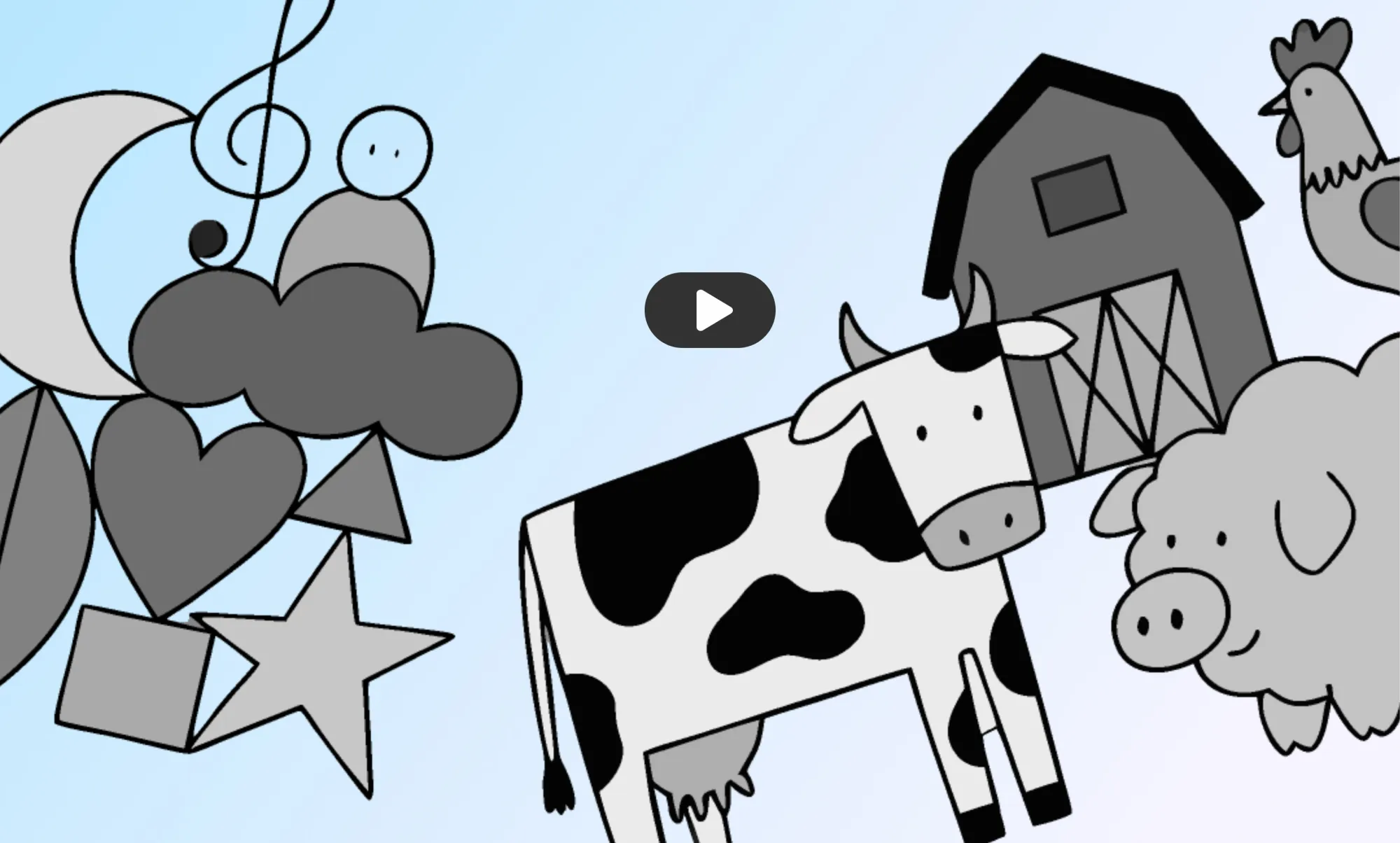
Kids don’t get bored of a good song. They get attached to it. And the creator behind the cartoon cow and the singing moon? Nobody knows what they look like, and nobody needs to.
If you’re hunting for faceless YouTube channel ideas that don’t involve reading Reddit threads over stock footage, this one deserves a look. Here’s the full workflow, from first idea to upload, including how to turn your songs and visuals into finished videos in Async.
Can you start a faceless nursery rhymes YouTube channel?
Yes. You can start a faceless nursery rhymes YouTube channel without ever appearing on camera, because the videos are built from animated characters, illustrations, AI-generated scenes, music, and voiceovers. The audience is there for the song and the characters, not the person who made them.
But “faceless” doesn’t mean fully automated or repetitive. YouTube demonetizes mass-produced content, and kids’ content gets an extra quality review. The channels that last run like a tiny animation studio: original characters, a consistent world, and a human checking every frame.
If you want the broader picture first, our guide on how to start a faceless YouTube channel covers the general setup. This guide stays focused on nursery rhymes.
Step 1: Choose a clear channel concept
Your concept answers one question: why would a parent pick your “Twinkle Twinkle” over the hundreds already on YouTube? Pick a lane you can sustain for 100 videos, not 10:
- Classic nursery rhymes with your own characters and art style
- Original educational songs built around a learning goal
- Counting songs for numbers and simple math
- Alphabet songs for letters, phonics, and first words
- Animal songs with sounds and baby animals
- Bedtime songs with slow tempos and soft colors
- Multilingual rhymes that teach simple words in two languages
Whatever you choose, build a recognizable world: two or three recurring characters (a curious duckling, a sleepy bear, a bus with opinions), a fixed color palette, and a consistent art style. When a toddler recognizes your character in a thumbnail, you’ve won the click.
Write a one-page “series bible” first: character names, personalities, setting, palette, voice, and target age range. You’ll reuse it every time you prompt an AI tool, and it keeps video 40 looking like it belongs next to video 1.
Step 2: Plan your first 10 videos
Planning 10 videos upfront gives you a repeatable format: same characters, same style, similar length, but a different topic, setting, and story each time. Here’s a starter list:
- Counting song (counting ducks, apples, or stars from 1 to 10)
- ABC song (each letter paired with an object your characters find)
- Colors song (a rainbow appears and each color gets a verse)
- Animal sounds (a farm or zoo visit with sound effects)
- Bedtime rhyme (your characters winding down for the night)
- Movement song (clap, jump, spin, with on-screen actions to copy)
- Vehicles song (buses, trains, fire trucks, and their sounds)
- Weather song (sun, rain, wind, snow, and what to wear)
- Good habits song (brushing teeth, washing hands, sharing)
- Original character song (an introduction to your main character)
Each one has a different visual world and story, even though the characters stay the same. That variety keeps you on the right side of YouTube’s monetization rules.
Step 3: Write or adapt the rhyme
Before you open any AI tool, write a short brief for each video. Ten minutes here saves hours of regenerating scenes. Define:
- Topic: counting farm animals, for example
- Age range: toddlers need slower tempos and simpler words than preschoolers
- Chorus: the hook kids will sing back
- Verses: one new idea, number, or animal each
- Repeated action: a clap, jump, or sound kids can copy
- Visual moments: what happens on screen during each line
- Ending: a clear close, like characters waving goodbye
A simple song sheet might look like this:
A note on rights
Many traditional rhymes, like “Twinkle Twinkle Little Star” or “Humpty Dumpty,” are old enough to be in the public domain. But specific recordings, modern arrangements, added verses, and other channels’ characters can still be protected. Verify each song’s status, write your own arrangement, and record your own vocals.
Step 4: Create the audio and visuals
This is where AI does the heavy lifting. You need:
- Voice or song (the lead vocal)
- Background music
- Sound effects (quacks, splashes, claps)
- Characters in multiple poses and expressions
- Backgrounds (the farm, the bedroom, the rainy street)
- Animated scenes for each line of the song
AI speeds up almost all of it. Use image generators for character concepts and illustrations, video generators to animate scenes, and AI music and voice tools to draft vocals and backing tracks. An AI nursery rhyme generator can help brainstorm lyrics, though you’ll want to rewrite the output in your channel’s voice. If you’re new to the process, our guide on how to make AI videos walks through the basics.
Two rules matter more than any tool choice:
Consistency. AI tools drift. Your duck has orange feet in scene one and yellow feet in scene four. Lock in reference images, reuse the style prompts from your series bible, and regenerate anything off-model.
Human review. Watch every clip at full size. Look for extra fingers, melting faces, garbled text, and anything confusing or unsettling for a small child. If it would make a parent frown, cut it. Also confirm that every AI tool’s license allows commercial use on YouTube.
Step 5: Build the nursery rhyme video in Async
Once your song and clips are ready, it’s time to turn a folder of assets into a video. This is where Async’s AI video editor comes in. You can edit by chatting (“trim scene three so it ends on the word splash”) or jump into the timeline for frame-level control.
1. Import your scenes and clips
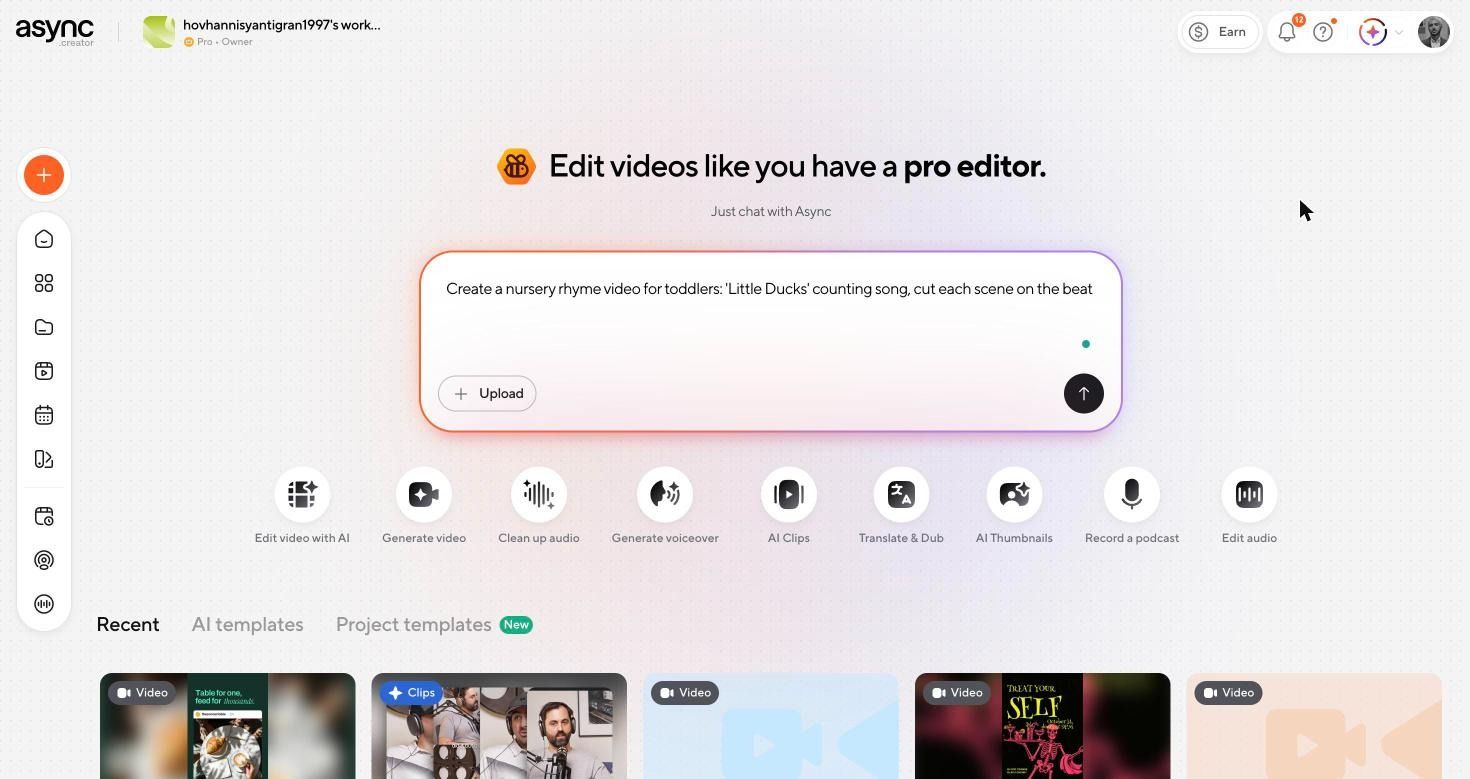
Click the orange + button, and under Videos, choose Landscape video 16:9, the format for a standard YouTube upload. Then click to upload or add media and drop in your scenes, music, vocals, and sound effects. Name files by song section (verse1_duck, chorus_swim) to stay organized.
2. Arrange them to match the song
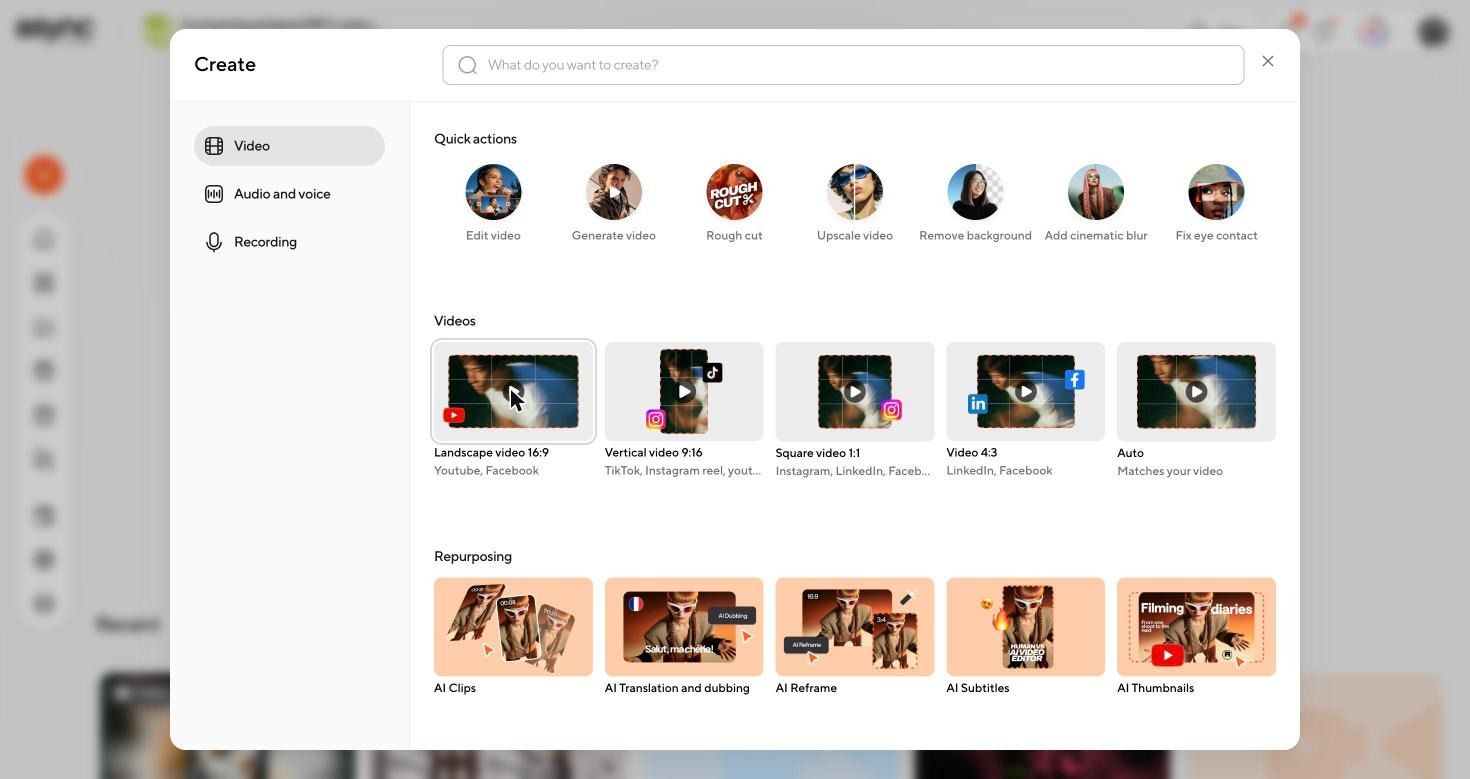
Drag clips onto the timeline in lyric order. Your song sheet from Step 3 is the storyboard, and the song sits on its own audio track above the scenes.
3. Trim each scene to the beat and lyrics
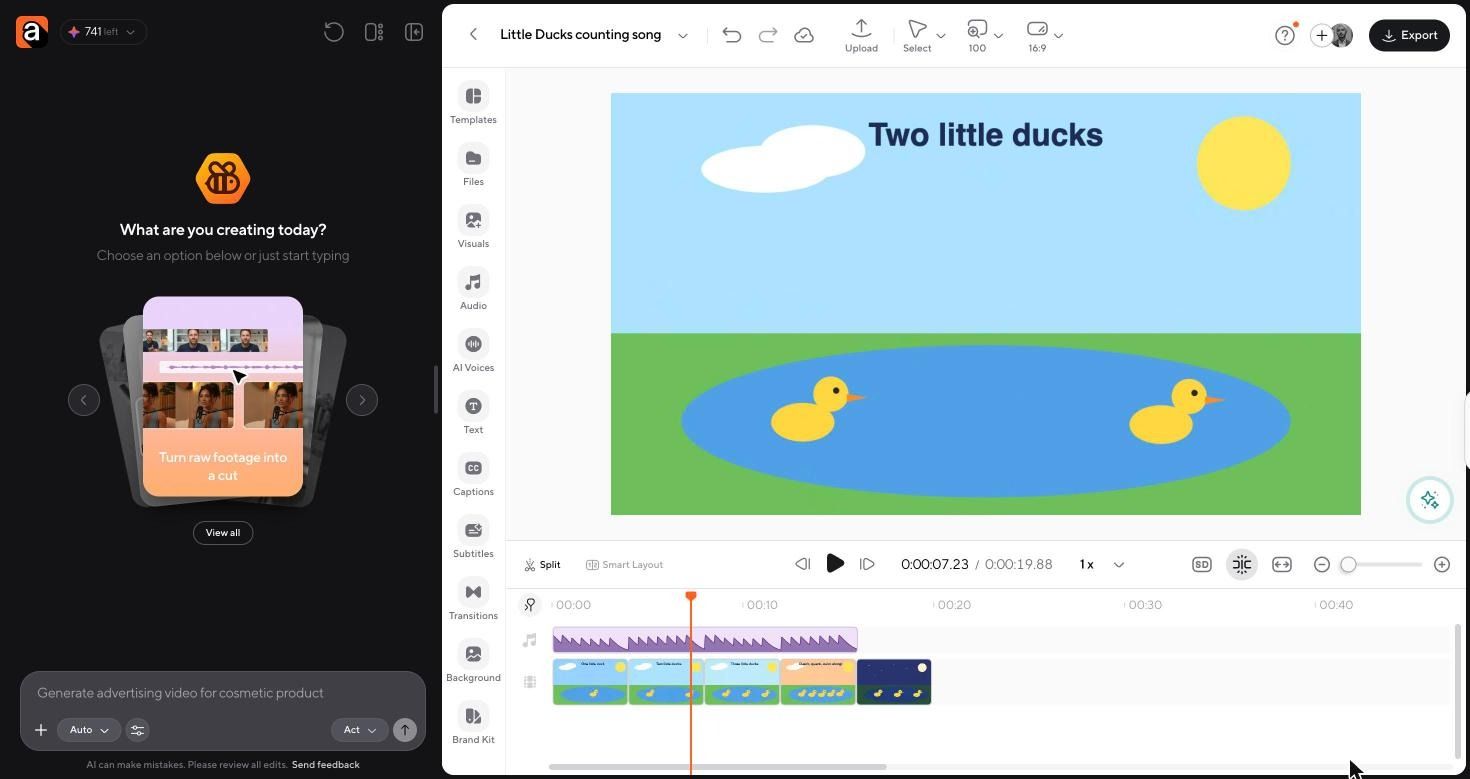
Use Split and Trim so each clip changes on the beat or as a new lyric starts. Cuts that land on the music feel natural to toddlers. Cuts mid-word feel jarring. You can also select a clip and tell Async in chat what to change, instead of nudging handles by hand.
4. Add the final audio track
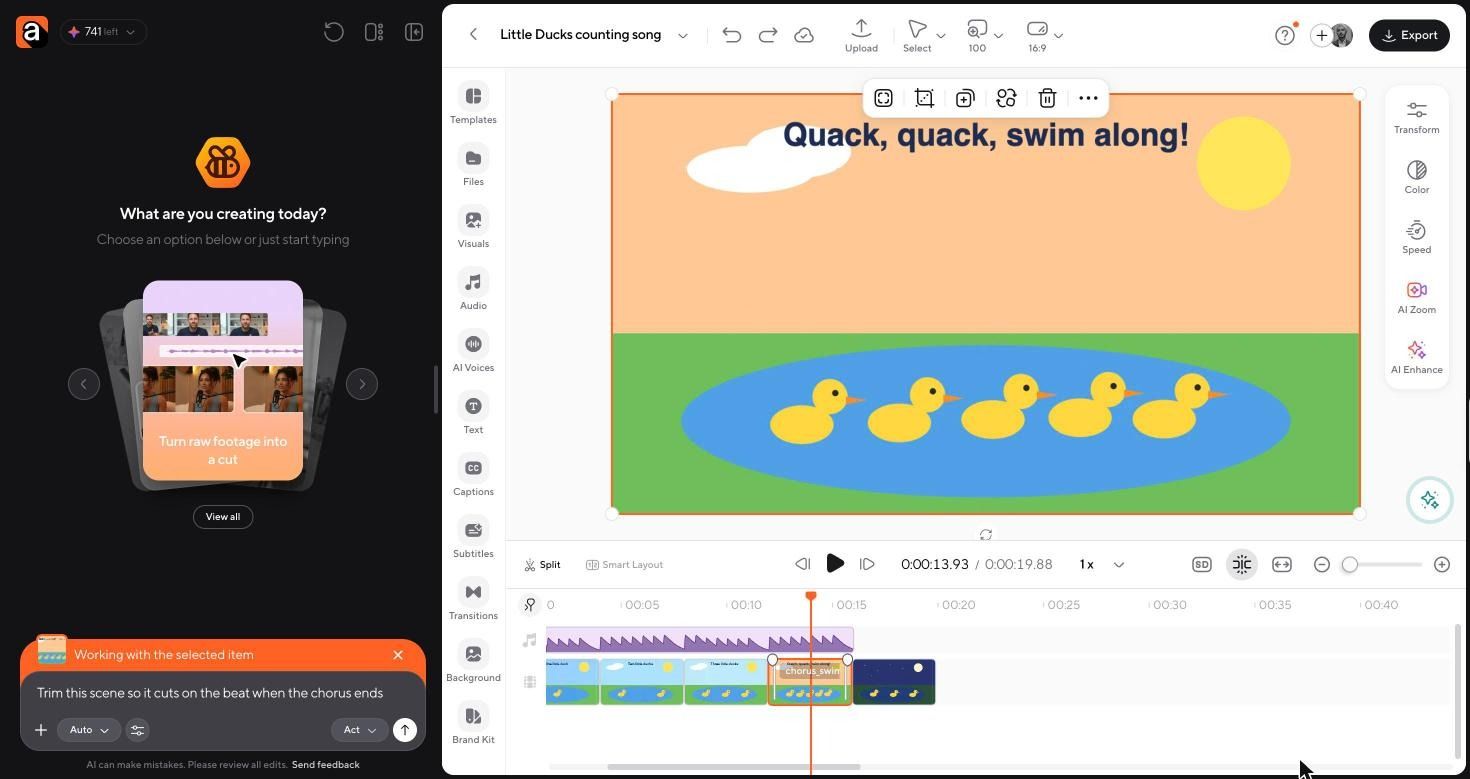
Drop in your finished song and line it up with the first scene. Mute any audio baked into generated clips, and put sound effects on their own track.
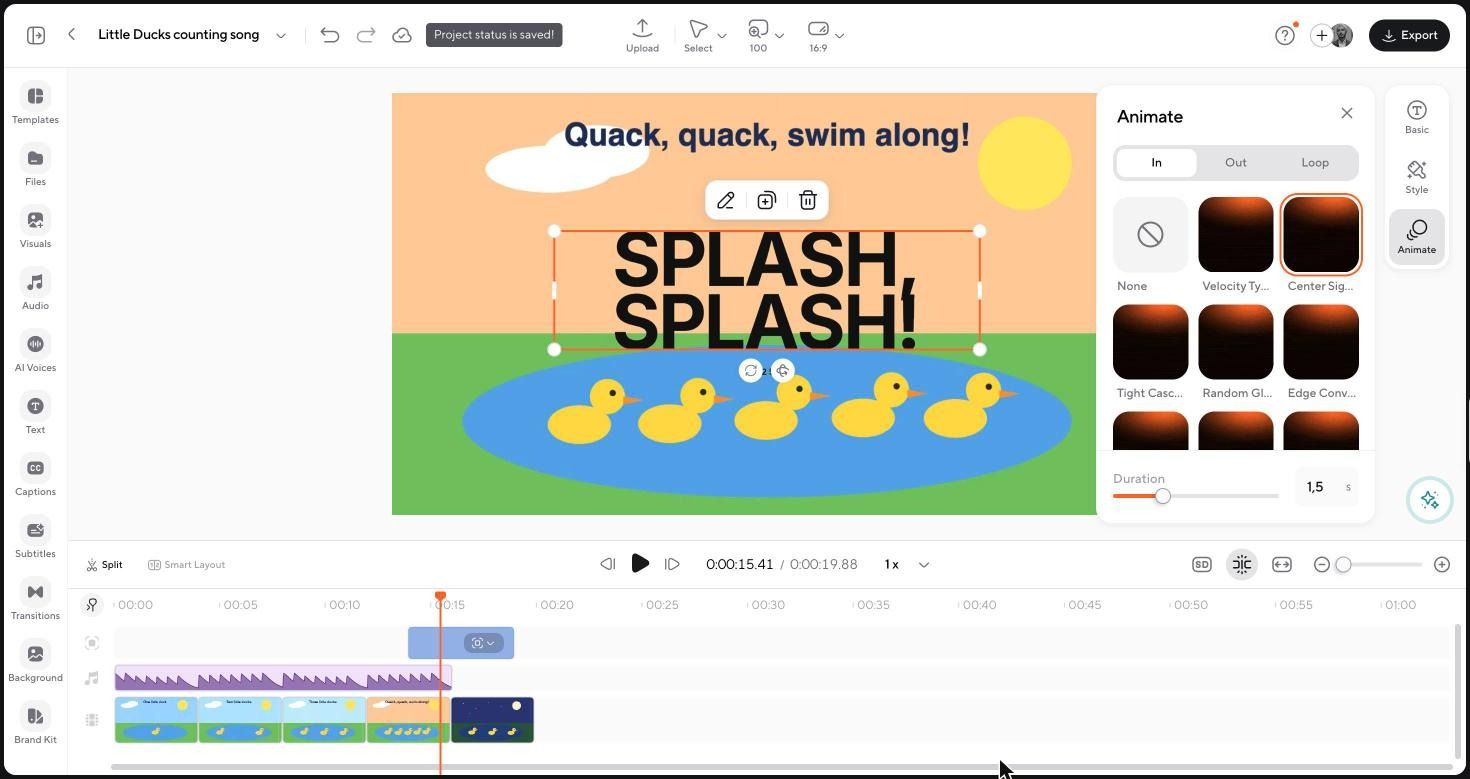
5. Add text or lyrics if useful
On-screen lyrics help with sing-alongs and early reading. Open the Text panel to add a heading or pick a preset, then use Animate to make words pop in. If your track has vocals, Async’s AI Subtitles can generate captions from it. Keep fonts large, round, and high contrast. For counting and alphabet songs, big numbers or letters popping in on the beat work better than full lyric lines.
6. Add transitions or supporting visuals
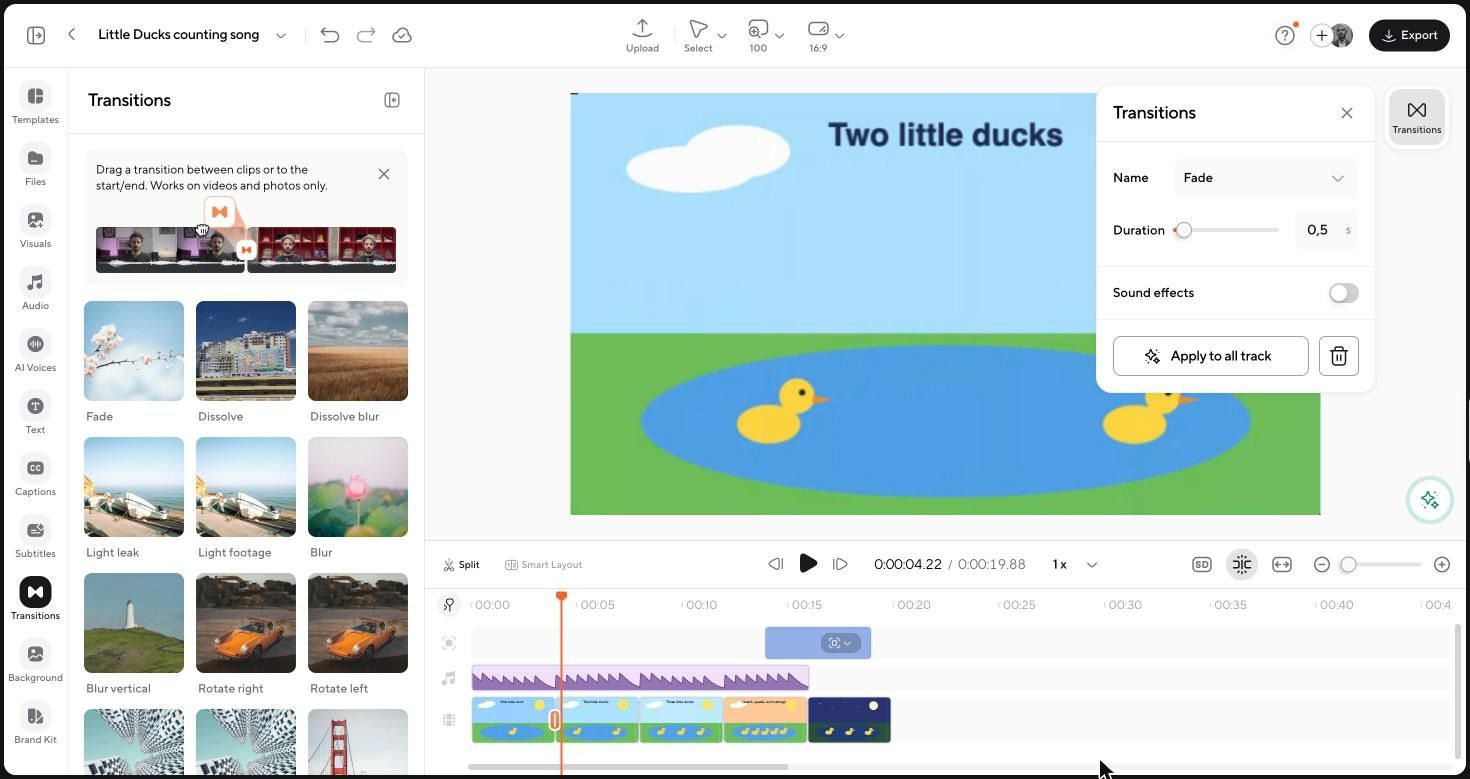
Open Transitions and drag one between two clips. Gentle options like Fade or Dissolve suit young viewers, and Apply to all track keeps every cut consistent. If a lyric needs a visual you don’t have (a star for “goodnight”), Async’s AI B-Roll can fill the gap.
7. Check pacing and scene changes
Watch the full video with the sound up and ask:
- Does each scene stay up long enough for a young child to follow?
- Do visuals match the lyric at that moment?
- Is any frame glitchy or off-model?
Then rewatch on a phone.
8. Export the final YouTube version
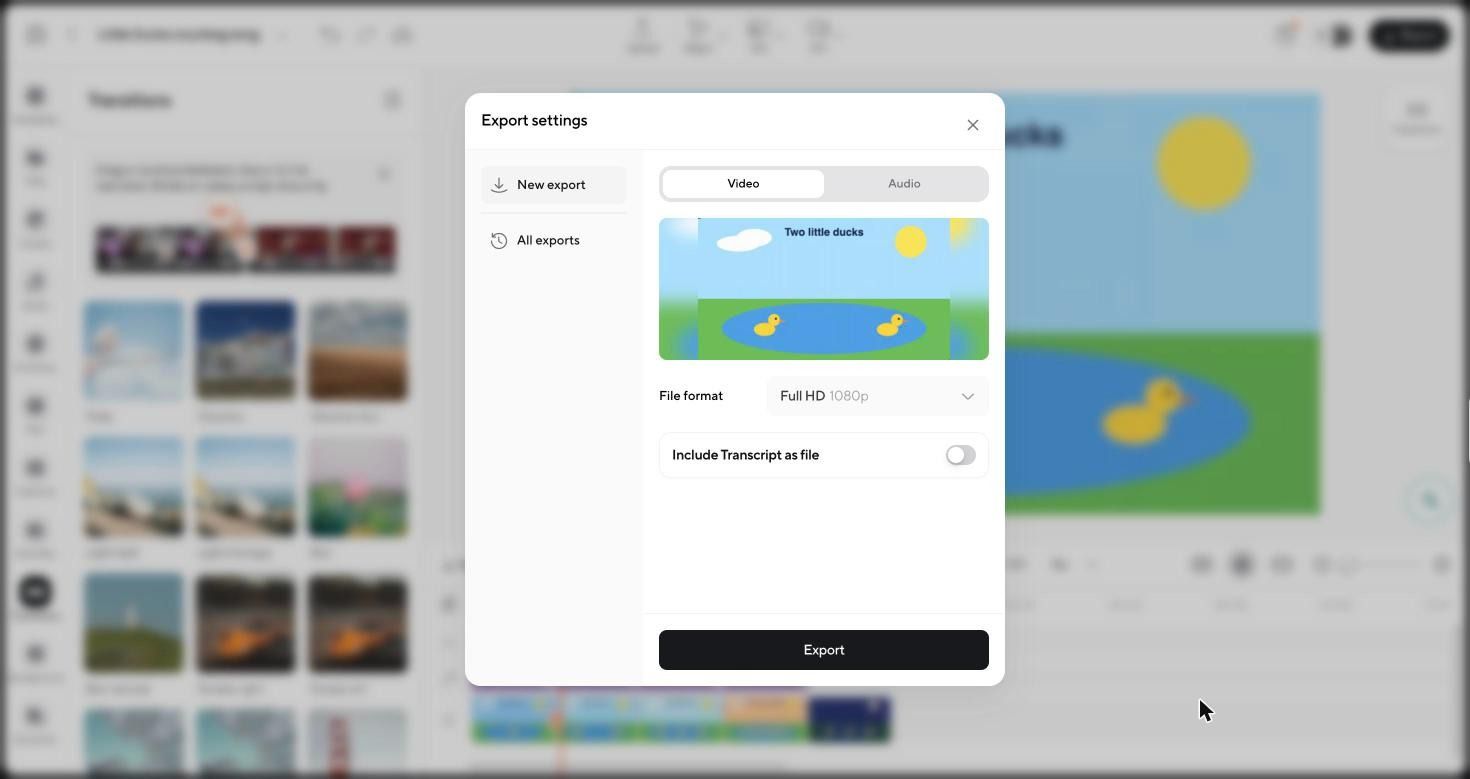
Click Export, set the file format to Full HD 1080p (or Ultra 4K), and export your main YouTube version.
Bonus: turn it into a Short
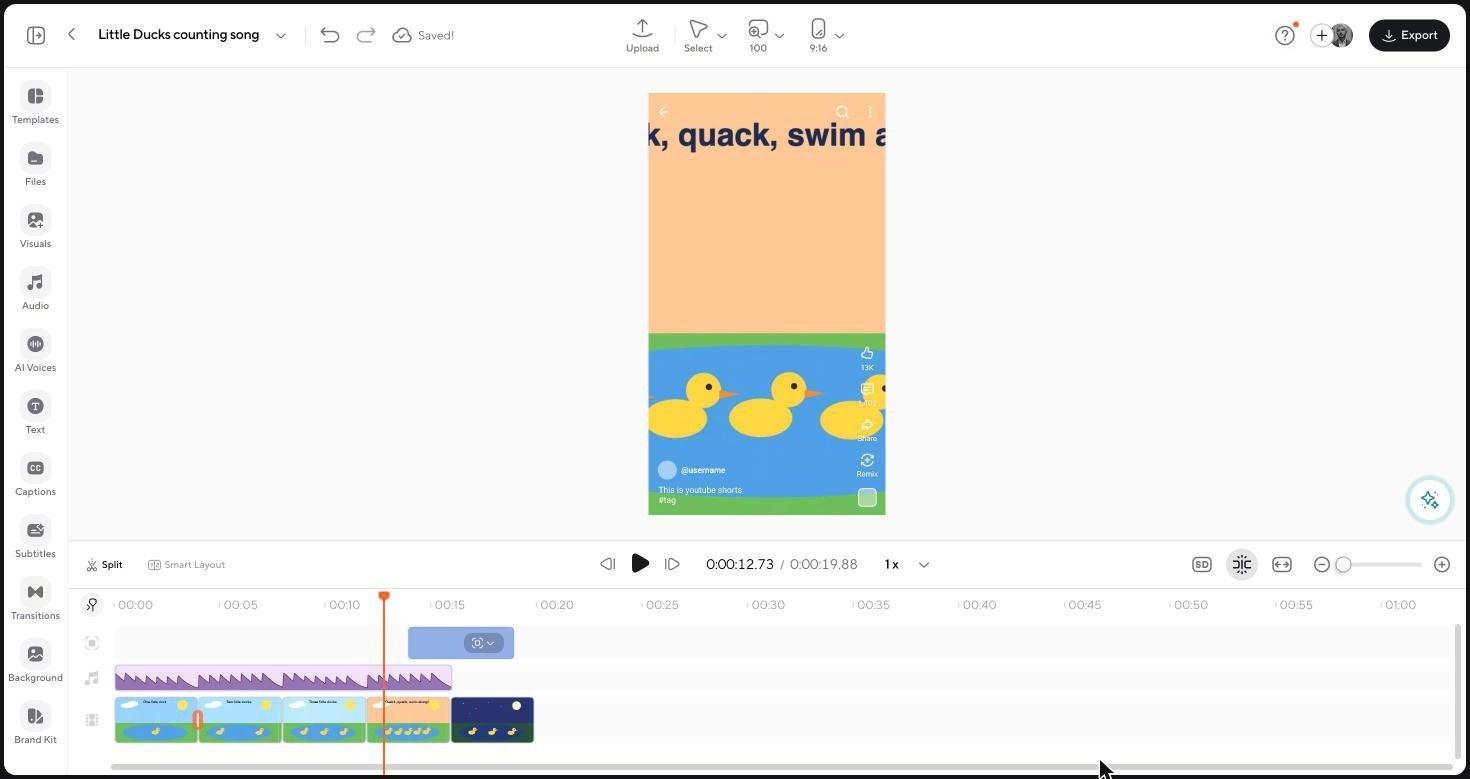
One longer video can feed your Shorts too. Duplicate the project, open the aspect ratio menu, and switch to Portrait 9:16. Keep the catchiest section, usually the chorus plus one verse, as a 20- to 45-second teaser.
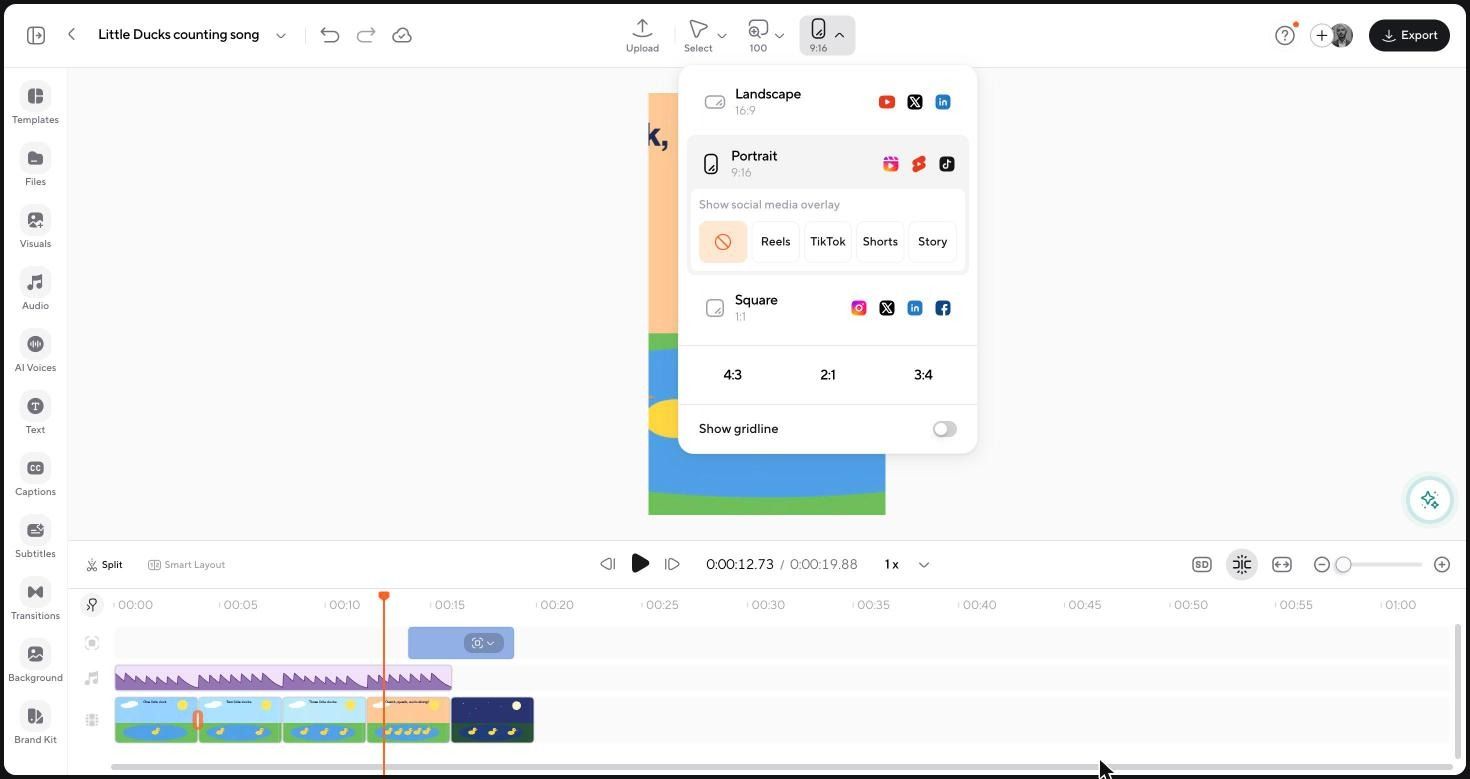
Turn on the Shorts overlay to preview where YouTube’s buttons will sit. In this example, it shows the title getting cropped, so you’d reposition the text and characters before exporting.
Step 6: Upload it correctly as Made for Kids
Nursery rhymes will almost always qualify as made for kids on YouTube. YouTube’s own guidance lists factors like animated characters that appeal to children, language intended for children, simple songs or games, early education, and “songs, stories, or poems for children.” A nursery rhyme channel checks nearly every box.
Choose the correct audience setting
When you upload in YouTube Studio, find the Audience section on the details page and select “Yes, it’s made for kids.” You can also set a channel-wide default under Settings, then Channel, then Advanced settings.
Review YouTube’s current guidance
This setting exists because of YouTube’s agreement with the FTC and the Children’s Online Privacy Protection Act (COPPA). In the US, a “kid” is anyone under 13. YouTube says setting the audience correctly is your legal responsibility, not something to leave to its systems. Read the official page on determining if your content is made for kids before your first upload, and recheck it periodically.
Some features, including personalized ads and comments, are limited on videos made for kids. On the plus side, YouTube says they’re more likely to be recommended alongside other kids’ videos.
Don’t try to dodge the designation
Some creators mark kids’ content “not made for kids” to keep comments or personalized ads. Don’t. Misdesignation can bring consequences on YouTube and legal consequences under COPPA. A nursery rhyme channel is a made for kids YouTube channel, and planning around that beats hoping no one notices.
Can a faceless nursery rhyme channel be monetized?
Yes, a faceless nursery rhyme channel can be monetized through the YouTube Partner Program, as long as the content is original, varied, and genuinely useful to kids and parents. Being faceless isn’t the problem. Being mass-produced is.
In July 2025, YouTube renamed its “repetitious content” policy to “inauthentic content” to make clear it covers content that is repetitive or mass-produced. The current policy flags content that “looks like it’s made with a template” or feels repetitive after watching several videos in a row. It specifically calls out “AI-generated content made with generic or unoriginal templates” and “videos where characters are put in the same situation over and over again with the same outcome.” See YouTube’s channel monetization policies for the full wording.
Kids’ content gets extra scrutiny: a channel focused on low-quality made for kids content can be suspended from the Partner Program entirely. Avoid:
- Mass-produced, near-identical videos with only the color or animal swapped
- Reused recordings of songs you didn’t create or license
- Copied characters from other channels, shows, or brands
- Generic AI templates that look like every other AI kids channel
- Minimal variation between uploads
- Confusing, low-quality AI visuals with warped faces or nonsensical scenes
How to make the channel feel original
Originality isn’t about reinventing “Old MacDonald.” It’s about making your version unmistakably yours:
- Recurring original characters. Give them names, personalities, and small quirks kids remember.
- Original songs mixed with classics. Classics bring search traffic. Originals build your brand.
- Different stories and settings. The counting song happens at the beach. The Colors Song happens in a garden.
- Themed series. “Bedtime with Bear,” “Farm Fridays,” or a seasonal holiday series.
- Varied animation. Change camera angles, scene compositions, and character actions from video to video.
- Recognizable branding. A consistent logo, thumbnail style, and intro sting.
- Clear educational or entertainment value. Every video should teach something or give kids something to do.
YouTube explicitly allows a series following the same characters, as long as each video has a distinct storyline or concept. The rule: consistency is good. Repetition without creative variation is not. (Our faceless true crime YouTube channel guide makes the same case for a very different audience.)
How to grow the channel
Growth on a YouTube kids channel comes from parents and from replays. Focus on:
- Consistent uploads on a steady schedule
- Strong thumbnails: bright colors, one recognizable character, one idea
- Playlists by theme, since parents queue playlists and that drives watch time
- Recurring characters that bring kids back
- Retention checks in YouTube Analytics to find and fix drop-off points
- Sequels to strong themes: if the vehicles song takes off, make one about construction trucks
- Shorts as trailers for your full songs
Build the brand, let AI speed it up
A faceless nursery rhymes channel works when you treat it like a real kids’ brand: original characters, a consistent world, and songs kids want to hear again. AI speeds up asset creation. Async turns those assets into finished videos and Shorts. Your job is to make every upload worth that eleventh replay.
FAQ
Can you make a faceless nursery rhymes YouTube channel?
Yes. Nursery rhyme videos use animated characters, illustrations, music, and voiceovers, so you never need to appear on camera. Build an original world with recurring characters instead of publishing generic, templated videos.
Can AI make nursery rhyme videos?
AI can help with lyric drafts, character designs, scenes, voice, and music. You still need human review for consistency, glitches, and age-appropriateness, plus an editor like Async to assemble the final video.
Can AI-generated kids' videos be monetized?
Yes, if they’re original and varied. YouTube’s inauthentic content policy targets mass-produced, templated videos, including generic AI content. Original songs with distinct storylines are eligible. Near-identical uploads are not.
Are nursery rhymes Made for Kids?
Almost always. YouTube lists songs and poems for children, animated characters, and early education as made for kids factors. Select “Yes, it’s made for kids” when uploading.
Can I use classic nursery rhymes on YouTube?
Many traditional rhymes are in the public domain, so you can usually make your own version. Specific recordings, arrangements, and modern lyric changes can still be protected, so verify each song and record your own.
How do I avoid copyright issues?
Arrange and record your own versions, use tools whose licenses allow commercial YouTube use, never copy other channels’ characters, and keep a record of every asset’s license.
How often should I upload nursery rhyme videos?
Pick a schedule you can sustain without cutting quality. One or two full songs a week plus a few Shorts is realistic for most new channels. Consistency beats volume.