Picture the last true crime story that kept you up past midnight. Now describe the narrator's face. You cannot, and that is the point.
To start a faceless true crime YouTube channel, pick a narrow angle such as fraud or historical cases, research each story from court records and reputable reporting, write an original script rather than a rewrite of someone else's, record a voiceover, build visuals from licensed footage, maps and timelines, then edit, disclose AI imagery and publish.
The story does the work, not a host. That is also the trap. The barrier looks low, so thousands of channels launch with a Wikipedia page, a robotic voice, and a stock forest at dusk, and most stall somewhere between the copyright claim and the demonetization email. The ones that last treat research as the product and the video as the packaging. This guide is about doing it that way.
If you are still deciding whether the format suits you, our broader guide on how to start a faceless YouTube channel covers setup, formats, and general workflow. This article stays inside one niche: research ethics, scripting real events, sourcing visuals you are allowed to use, and monetization rules that hit true crime harder than most categories.
Why true crime works as a faceless YouTube niche
True crime fits the faceless format better than almost any other category because the case is the attraction. Viewers arrive for the story, the evidence, and the unanswered question, not for a presenter.
- Narration is the native form. The genre grew out of radio, podcasts, and documentary voiceover, so a calm voiceover supporting footage is what the audience expects. A faceless YouTube channel here does not feel like a workaround.
- Documentary visuals are cheap and appropriate. Maps, timelines, redacted filings, archival photos, aerial B-roll, and text animation all suit the genre.
- Search demand is evergreen. A good episode on a 1978 disappearance keeps earning views long after a trending upload has died.
- Episodes are repeatable. One research and scripting process produces episode after episode.
What true crime is not is easy money. Every episode is about real people, and the research is the real work.
Choose a clear true crime angle
Pick one lane and stay in it for at least twenty episodes. A recognizable angle helps the algorithm understand your channel and tells viewers what a new upload will feel like.
Angles that work well for a true crime YouTube channel:
- Solved cases with a full arc from crime to conviction, easiest to source because the record is complete
- Historical crime from the 1800s to the mid 1900s, where archives are open and living families are fewer
- Disappearances, where the tension is the open question rather than the outcome
- Scams and fraud, document-heavy, less graphic, and unusually advertiser-friendly
- Courtroom stories built around transcripts, rulings, and legal strategy
- Regional cases from one state or city, the fastest way to own a small niche
Narrow beats broad. "Unsolved disappearances in the Pacific Northwest" gives you a voice, a visual palette, and a repeatable research method. "True crime stories" give you nothing to compete on. For formats outside this niche, the faceless YouTube channel ideas in our main guide list fifteen of them.
Research true crime stories responsibly
Research responsibly by working from primary records first, treating every unproven claim as an allegation, and never presenting reconstruction as evidence. This is the part of how to start a true crime YouTube channel that beginners skip, and it is the difference between a documentary channel and a content mill.
Start with primary sources
- Court records. Dockets, indictments, motions, trial transcripts, and appellate opinions. In the US, PACER, CourtListener, and state court portals cover most of it.
- Police and public records. Incident reports, coroner findings, and records released through FOIA or your country's equivalent.
- Official statements. Press releases from police departments and prosecutors' offices, plus recorded press conferences.
- Reputable news reporting. Contemporaneous local coverage often beats national retrospectives.
- Books and long-form journalism, for context and leads rather than as the spine of your script.
Verify every load-bearing fact against two independent sources. If one outlet reported a detail and nobody else picked it up, it probably does not belong in your narration.
Separate fact from allegation
Write with the qualifier attached, not added later. "Prosecutors alleged" is not the same as "he did". "The medical examiner ruled" is not "she was murdered". Naming an uncharged person as a suspect because a forum thread says so is an ethical failure and a legal risk.
Keep a sourcing sheet with four columns: the claim, the source, the source type, and whether it is a fact, an allegation, or disputed. That sheet is what makes a final accuracy check possible.
Respect victims and families
Real families watch these videos.
- Use victims' names with the care a reporter would, and skip gratuitous detail about how someone died
- Do not speculate about a victim's private life to fill narrative gaps
- Do not use crime scene or autopsy imagery for shock
- Avoid naming minors, uncharged individuals, and relatives who did not choose to be public
- If a family has publicly asked creators to stop covering a case, listen
If you use an AI-generated scene, a stock actor, or an illustration, the audience must be able to tell it is illustrative. Label it on screen.
Write an original true crime script
Write the script as an original narrative built from your own research notes, not a rewrite of the top-ranking article about the case. Rewriting someone else's summary is the fastest route to a reused content problem.
A structure that holds for a fifteen to twenty-five-minute episode:
- Hook. One concrete, verified detail that creates a question. No "in this video I will".
- Context. Place, time, and people: only what the viewer needs to follow the story.
- Timeline. Events in order, with dates and sources. This is the spine.
- Investigation. What was found, what was missed, who was charged, and what the evidence showed.
- Outcome or open questions. Verdict, appeal, cold case status, or what is still unknown.
- Conclusion. What the case changed, and a clear statement of what remains alleged.
Turning raw research into original narration
Raw research notes:
Vehicle located, shoulder of County Rd 9, 21:40. Keys in ignition, driver door unlocked. Phone last pinged tower 4 at 19:12. Two witnesses in the trial transcript, p. 211, report a light coloured sedan. Defense disputed tower range on appeal.
Original narration from those notes:
The car was not hidden. It sat on the shoulder of County Road 9 with the driver's door unlocked and the keys still in the ignition, which is how a passing driver noticed it at twenty to ten that night. Her phone had stopped talking to the network two and a half hours earlier, at 19:12, through a tower her defense team would later argue covered far more ground than the state claimed. Two witnesses described a light coloured sedan. Neither could describe who was driving it.
A copied summary would say the car was found abandoned with the keys inside. The version above adds sequencing, sourcing, the disputed evidence, and a deliberate withholding of the detail that matters. That is original commentary, and it is better television. Read the script aloud before recording: if a sentence is hard to say, it is hard to hear.
Create a voiceover without appearing on camera
Use a consistent, restrained narrator voice, your own or a synthetic one, and prioritize clarity over drama. True crime narration fails in one direction almost every time, which is too much performance.
- Pacing. Around 140 to 155 words per minute. Slow down for the timeline and leave a beat of silence around the hardest facts.
- Pronunciation. Names of victims, towns, and officials must be right. Check local news broadcasts and mark the script phonetically before recording.
- Emotional restraint. No dramatic hush over a real death. Flat delivery is more effective and keeps you out of shock content territory.
- Consistency. Same voice, same tone, same intro and outro every episode.
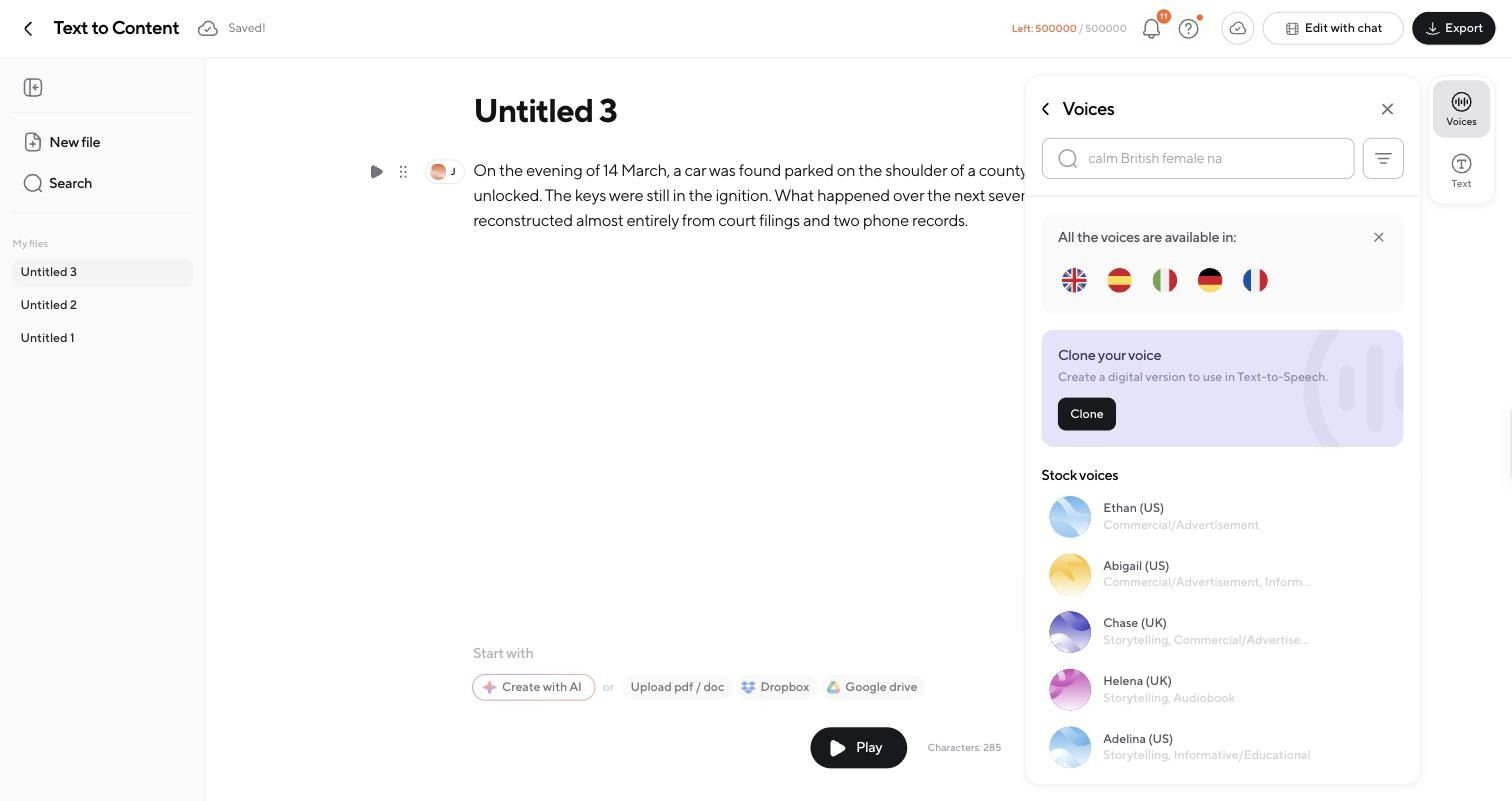
If you use AI narration, choose a voice tagged for storytelling or documentary rather than commercial reads. In Async's text-to-content editor, you paste the script, pick a voice, and generate the narration from the text, so the script and audio stay in one place.
Cloning your own voice does not require a YouTube disclosure. Synthesizing the voice of a real victim, suspect, or officer is a line you should not go near, regardless of policy.
Find or create visuals for faceless true crime videos
Build visuals from material you have the rights to use, and choose shots that support comprehension rather than simulate events. A true crime episode needs less footage than creators expect, because half the screen time can carry information.
- Licensed stock footage for establishing shots, weather, roads, and interiors. Read the license, especially for commercial use and footage of identifiable people.
- Maps. Animated routes and location pins do more narrative work than any B-roll, and you make them yourself.
- Timelines are rendered on screen as the narration moves through dates. The most useful visual in the genre.
- Public documents. Court filings and released records are often usable, but rules vary by jurisdiction, so check before showing a full page and redact what is not central.
- Atmospheric B-roll, sparingly. Endless rainy forest shots are filler.
- Text animation for quotes from transcripts and statements, attributed on screen.
- AI-generated illustrative scenes for moments for which no footage exists.
Disclosing AI generated visuals
YouTube requires creators to disclose realistic altered or synthetic content when it makes a real person appear to say or do something they did not, alters footage of a real event or place, or generates a realistic scene that did not occur. All three describe standard true crime reconstruction, so assume the disclosure applies. The label appears in the player for photorealistic content and in the expanded description for less realistic content. Cosmetic edits, color correction, captions, and cloning your own voice do not need it.
Label reconstruction on screen too, since nobody scrolling past opens your description. And illustrative footage is never evidence: do not cut an AI scene against a factual claim in a way that implies it is what happened. Because these policies keep moving, re-check YouTube Help the week you publish.
Edit the true crime video
Edit for comprehension first: hold on maps and timelines long enough to read them, keep music low, and cut only when the information changes.
- Pacing. A slow cut rate reads as documentary. Rapid cutting reads as a repackaged listicle.
- B-roll placement. Footage under narration about a place or mood, information graphics under narration that carry facts.
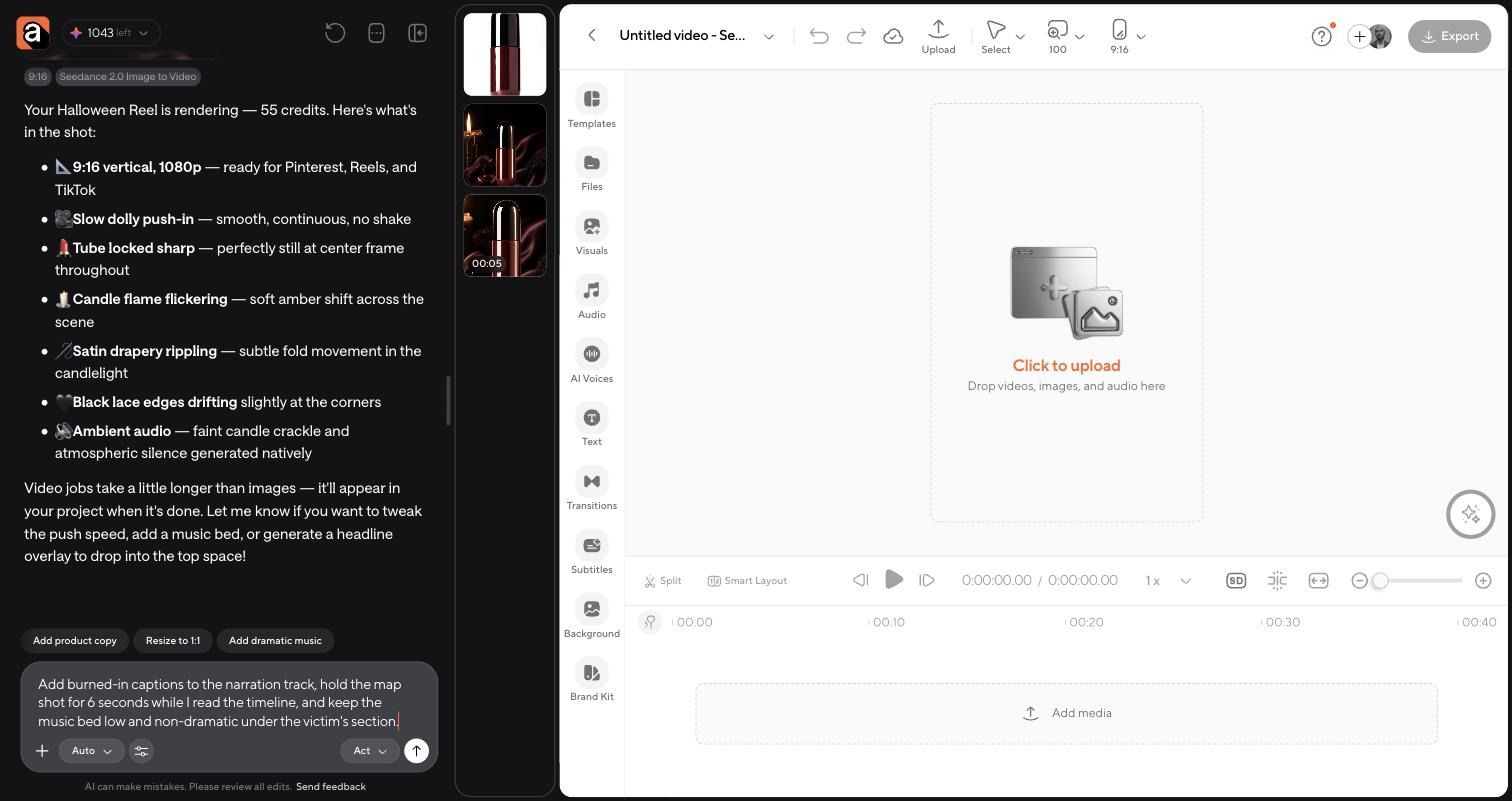
- Maps and timelines. Six to eight seconds on screen minimum. Viewers read slower than you think.
- Captions. On every episode. A large share of the audience watches in mute.
- Music and SFX. A low, static bed at most. No stingers on the discovery of a body, and no music under the victim's section.
- Visual emphasis. Highlight the relevant line of a document and dim the rest, and animate the map route as the narration follows it.
This is where Async fits. Once the research is finished and the script is locked, Async's AI video editor takes that script into a video: narration, supporting visuals, B-roll, captions, music, and the edit itself, in one workspace driven by chat instructions rather than a timeline you have to learn.
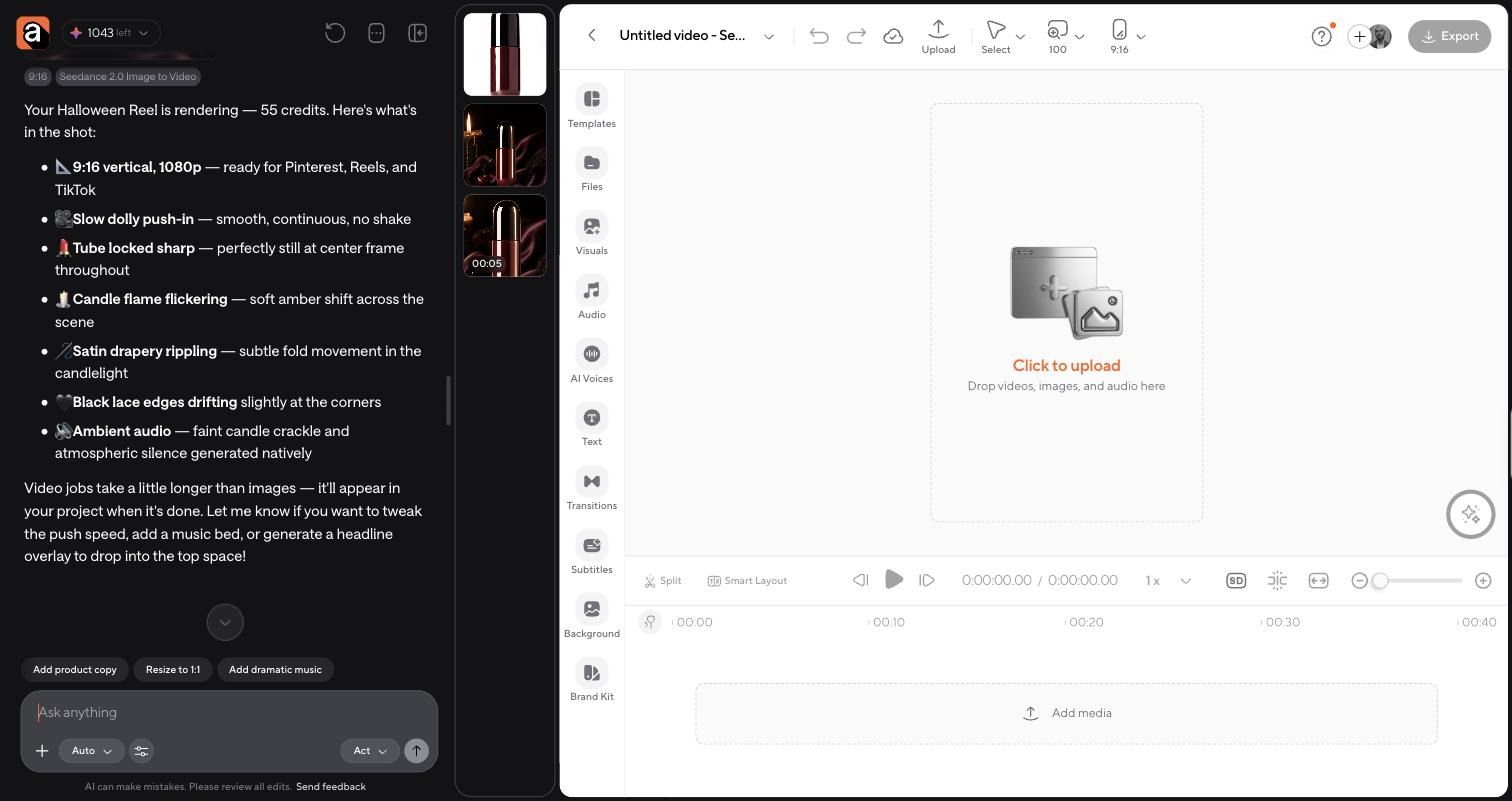
You type what you want changed, and it is applied to the project, which helps when a cut needs specific timing rather than a template.
Async does not research your cases, verify facts, or decide whether something is safe to publish. That stays with you. For a wider comparison, see our roundup of the best video editing software for YouTube.
Build a repeatable publishing workflow
Run the same eight steps every episode so accuracy does not depend on how much time you had that week:
- Research from primary records, logging every claim with its source
- Fact-check the sourcing sheet before writing a line of script
- Script as original narrative, marking allegations as allegations
- Narrate with the same voice and pacing as every other episode
- Gather visuals and record the license or source beside each file
- Edit for comprehension, with captions and restrained sound
- Final accuracy check against the sourcing sheet, watching the cut end to end
- Publish with the AI disclosure set, sources in the description, and a title that does not overstate what is known
The temptation is to turn that process into a template and mass-produce. Do not. YouTube's monetization policies exclude "AI-generated content made with generic or unoriginal templates giving the impression of mass production" and require the substance of each video to be materially varied. Speeding up production is fine. Removing the original work is not.
Once episodes are live, our guide on how to get more subscribers on YouTube covers growth, and if you cut vertical teasers, the best hashtags for YouTube Shorts guide is worth a read.
Can a faceless true crime channel be monetized?
Yes, but the niche carries an advertiser safety risk that other faceless formats do not. Four things decide the outcome.
Originality. YouTube requires original and authentic content and excludes channels that repurpose material without significant original commentary or substantive modification. Scripting from primary sources clears this. A narrated rewrite of a Wikipedia page does not.
Rights. You need commercial rights to every visual and audio asset. Claims on music and news footage are the most common way true crime channels lose revenue.
Context. YouTube's advertiser-friendly guidelines allow violence to be monetized in a news, educational, artistic, or documentary context, and restrict it when the focal point is blood, violence, or injury without other context.
Presentation. Graphic imagery, lingering on injury, shock thumbnails, and sensational titles push a video toward limited ads or none. Restraint is the monetization strategy, not only the ethical one.
Both policies change often, so re-read the current YouTube Help pages before you publish rather than trusting a blog post, including this one.
FAQ
Can a true crime YouTube channel be faceless?
Yes. Narration, archival material, maps, and documents carry the story without a host, and most successful channels in the genre never show a face.
How do you start a true crime YouTube channel?
Choose a narrow angle, research the case from court records and reputable reporting, write an original script, record a consistent voiceover, build visuals from licensed and self-made assets, edit for clarity, then publish with sources listed and any AI content disclosed.
What visuals can you use in true crime videos?
Licensed stock footage, maps and timelines you create, public documents where legally appropriate, archival material you have rights to, text animation and clearly labeled AI scenes. Avoid unlicensed news footage and gratuitous crime scene imagery.
Can you use AI voices for true crime YouTube videos?
Yes. Pick a documentary or storytelling voice, keep it consistent, and never synthesize the voice of a real person involved in the case.
Can faceless true crime channels be monetized?
Yes, if the content is original rather than repackaged, you hold the rights to your assets, and violence carries genuine documentary or educational context rather than shock value.
Do AI-generated true crime visuals need to be disclosed?
Usually yes. YouTube requires disclosure for realistic synthetic content that alters a real event or place or depicts a scene that did not occur, which covers most reconstructions.
Where can you research true crime stories?
Court dockets and transcripts through PACER, CourtListener or state portals, police and coroner records, FOIA requests, press releases and contemporaneous local reporting. Confirm every key fact in two independent sources.
How do you avoid copyright issues with true crime footage?
Use stock footage under a commercial license, create your own maps and graphics, license any music, and do not lift news broadcasts, documentaries, or photographs without permission.