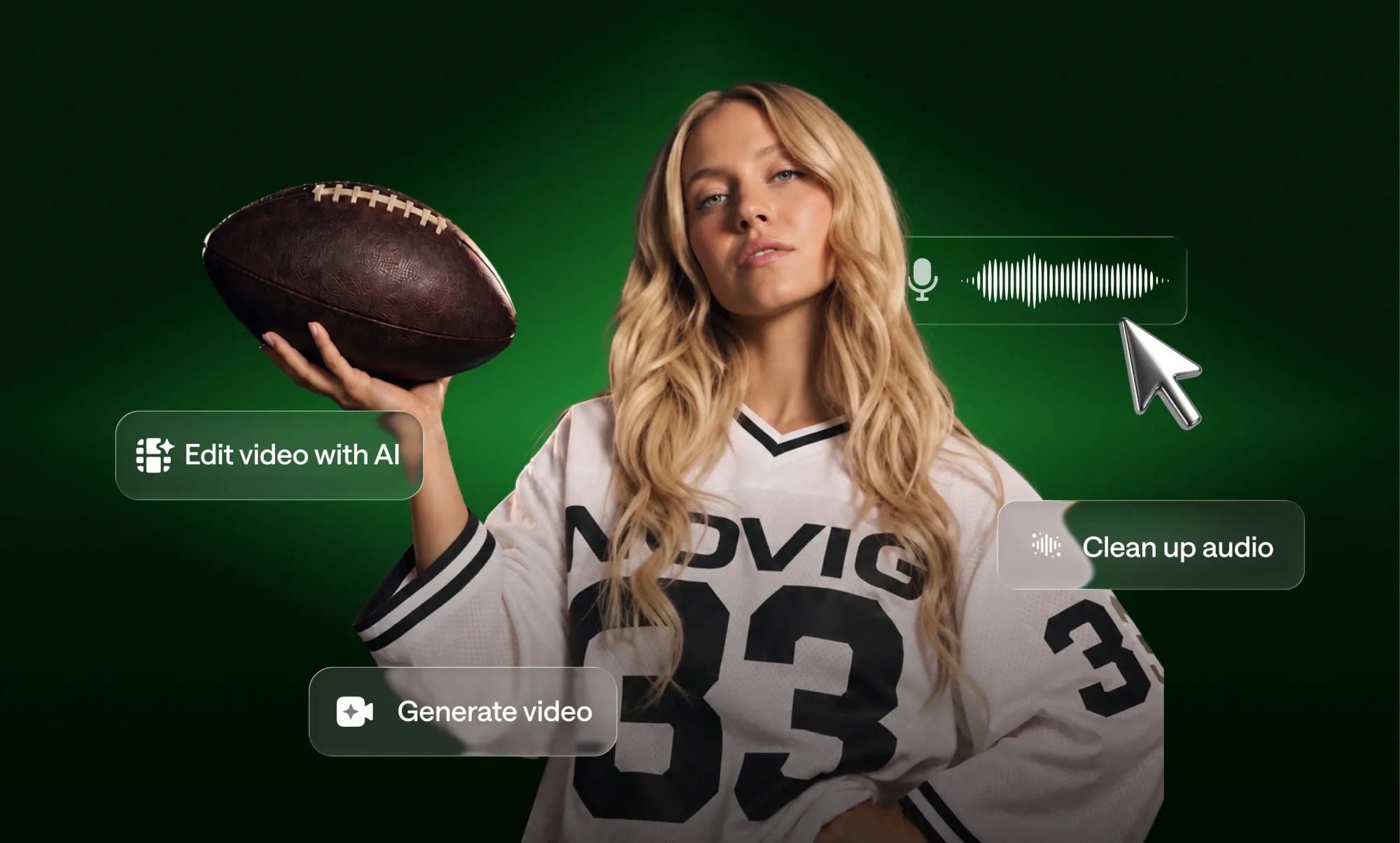
Somewhere in a marketing meeting in early September 2026, someone said the words "what if she holds the football" out loud, and nobody in the room stopped them.
That is how we got here. A 58-second commercial for a sports prediction app you had probably never heard of, starring one of the most photographed people on the planet, holding sporting goods in place of clothing. Within five days, it had been watched close to 39 million times, triggered a global wave of response videos from Olympic athletes, appeared on morning television in three countries, and turned a company with fewer than 60,000 Instagram followers into a name that marketing people argue about at parties.
It also, almost certainly, made your feed unusable for a week. Sorry about that.
Here is the thing, though. If you make a video for a living, the interesting part of this story is not the football. The interesting part is what happened after the ad went live, when thousands of people who were not paid by Novig started making videos about Novig's video. That is the mechanic worth studying, and it is the reason this article exists.
So let's walk through it: what the ad actually is, why athletes reacted the way they did, whether it worked, and what any of this means for the video you are trying to get people to watch this quarter.
What is Sydney Sweeney's new ad?
Sydney Sweeney's new ad is a national brand campaign for Novig, a sports-only prediction exchange, launched on September 9, 2026, under the tagline "Just Sports." Sweeney appears nude throughout the spot, using sports equipment to cover herself, and she joined the company as a strategic partner and equity holder rather than a paid spokesperson.
Here's a sneak peek, in case you haven't seen it already:
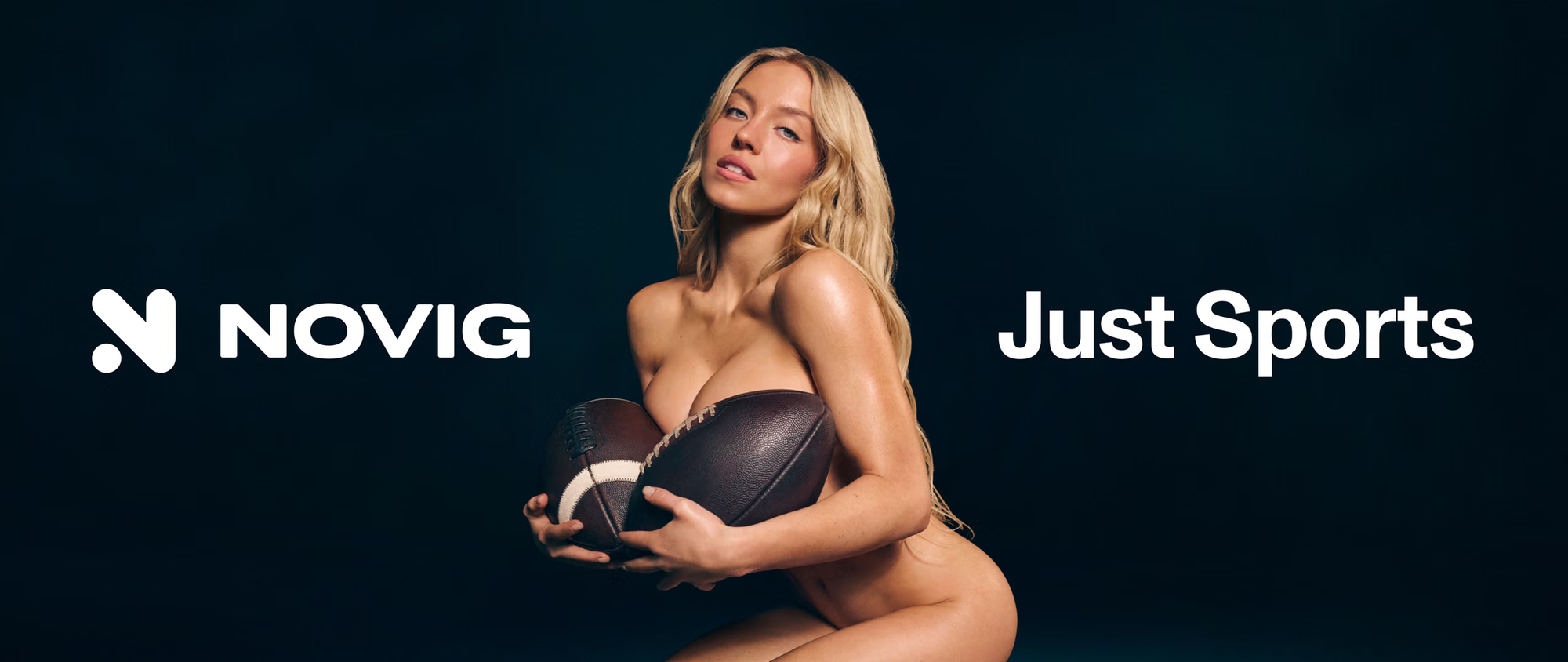
The concept is a visual pun, and a fairly blunt one. Novig's positioning is that it is a prediction market built only for sports, with no political markets and a 21+ minimum age, which is a genuinely unusual stance in that category. The campaign takes "just sports" and runs it through a literalist filter: just sports equipment and nothing else.
The spot opens with Sweeney holding a football in front of each chest and saying, "Think you know sports? Prove it." From there, it moves through a sequence of setups. She perches on a basketball net, spinning a ball. She lies on a bench with a soccer ball balanced on her feet. She swings a golf club. Bass-heavy music runs underneath the whole thing. The tone is deliberately playful rather than sultry, which is worth noting, because a lot of the disagreement that followed came down to whether that distinction survives contact with the actual footage.
Novig described it as the company's first national brand campaign, running across digital, social, online video and out-of-home placements, with more creative planned through football season. The company had gone live nationwide in August under a federally regulated framework, so the campaign was functionally a launch announcement with a very loud voice.
Novig's CEO and co-founder Jacob Fortinsky said in the launch release that the platform is "singularly focused on sports" and credited Sweeney with bringing that message to life "in a way that's impossible to ignore." Sweeney, in the same release, called it "a fun idea" delivered "with confidence, humor and a playful edge."
On the last point, at least, everyone agrees. It was impossible to ignore.
Why is the Sydney Sweeney ad controversial?
The Sydney Sweeney ad is controversial because female athletes said it sexualizes women in sport at a moment when women's sport is fighting to be covered for performance rather than appearance. Critics argue the imagery undoes years of that work. Defenders argue Sweeney is an actor, not an athlete, and that her choice does not speak for anyone else.
It is worth laying out both cases properly, because most coverage picked a side and ran.
The criticism
The strongest version of the critics' argument is not "this ad is rude." It is structural. Female athletes have spent decades being marketed on how they look rather than what they can do, and there is research behind the complaint. One analysis of the Tokyo 2021 Olympics found women were roughly ten times more likely than men to be visually objectified by camera work, meaning shots that panned across a body or lingered on a body part. The same study found commentators were more likely to infantilize female competitors, calling them "girls" and "young ladies."
So when the single most visible piece of sports-adjacent advertising in a given week is a naked actor holding a football, athletes read it as a very expensive step backward.
Australian swimmer Ariarne Titmus, the reigning Olympic 400-meter freestyle champion, called the ad "a kick in the face" and asked how we still live in a world where monetizing a woman's body and sexualizing women's sport is normal. British sprinter Amy Hunt addressed it in a post-race interview with BBC Sport after finishing fourth in the 200-meter final at the Ultimate Championship in Budapest, saying, "Sydney Sweeney, this is what women in sport look like," and adding, "hard work, blood, sweat, tears."
US gymnast Gracie Kramer posted competition footage of herself with the line "IDK what Sydney Sweeney was doing, but this is what a woman in sport looks like." That post reportedly passed 1.2 million likes, and it became the template for everything that followed.
Canadian athletes responded in numbers. Sprint canoeist Sophia Jensen posted training and race footage under "Dear Sydney Sweeney, this is women in sports." Figure skater Madeline Schizas posted a similar edit. Gymnast Ellie Black quoted the ad's own opening line back at it, writing that women's sport is "powerful, skilled, courageous and so much more interesting than being treated as something to look at." High diver Molly Carlson wrote that the ad hit close to home after years of struggling with how her body looked in sport. The official TikTok account for Canada's Olympic and Paralympic team joined in with a montage of its own.
The counterargument
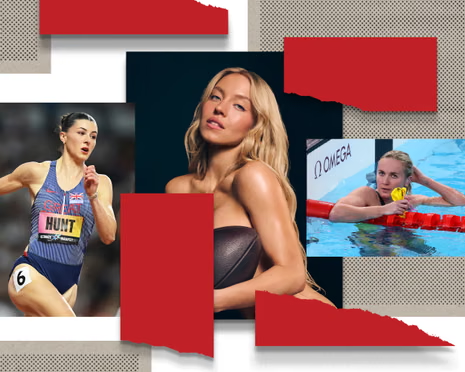
The other side of the debate is not hard to state fairly. Sweeney is an actor appearing in a commercial for a betting product, not a competitor claiming to represent athletes. She has an equity stake in the company and was involved in the creative from the beginning, which makes this a choice she authored rather than one made for her. Several commentators argued that treating one actor's provocative ad as a referendum on women's sport gives the ad more representational weight than it asked for.
There is also a consistency argument that Sweeney herself made. Days into the backlash, she posted an Instagram carousel of magazine covers showing male and female athletes posing in little or no clothing, the implication being that the sports world has been doing this for a long time without much objection.
That post did not calm anything down. Canadian alpine skier Cassidy Gray called it "idiotic" and "senseless" and pushed back on the idea that a commercial is not worth taking seriously. "I fear you're just out of touch," she said, "because it really is that deep."
Which is roughly where the conversation still sits. Both arguments are internally coherent. They just start from different questions: one asks what the ad does to a category, the other asks what one person is entitled to do with her own image.
Our job here is not to settle that. It is to notice that a disagreement this clean, this fast, and this easy to join is not an accident of distribution. It is a property of the creative.
How one video took over the internet
The Novig ad spread because it was built, deliberately or not, to be easy to react to. The idea fits in two words, the visual reads in a single frame, it presents a clear position people can agree or disagree with, and its structure repeats. Those four properties are what separate a video that gets views from a video that gets responses.
Let's take them one at a time, because this is the part you can actually steal.
The idea is two words long
"Just Sports."
You understand the premise before the first shot resolves. There is no setup, no narrative ramp, no thirty seconds of context before the payoff. In short-form video, where the average viewer decides in under two seconds, an idea that needs explaining is an idea that does not travel.
Most brand videos fail here before they fail anywhere else. The concept is a sentence when it needs to be a phrase, and the edit spends its first five seconds doing work the concept should have done for free.
The visual works with the sound off and the context missing
Pull any single frame from the spot, and you get three pieces of information instantly: famous person, sports, provocation. That is why it screenshotted well, why it survived being reposted at low quality, and why people who never saw the original 58 seconds still had a strong opinion about it.
If your hero video only makes sense in full, in order, with audio, you have made something that cannot be excerpted. Excerptability is distribution.
It gave people something to disagree with
This is the uncomfortable one. Passive impressions do not compound. Disagreement does.
The Novig ad did not ask viewers to admire it. It handed them a position, and a large, articulate, highly motivated group of people already had the opposite position ready to go. Female athletes did not need to workshop a response because they had been making that argument for years. The ad just gave them a hook to hang it on.
You do not need to be offensive to get this effect, and you should not try to be. But you do need a point of view. A video that nobody could possibly object to is usually a video nobody feels any need to talk about either.
The format repeats
Same line, same lighting, same joke, different sport. Football, basketball, golf, soccer. The creative device is modular by construction, which means Novig can keep producing variants through the football season without commissioning a new idea each time.
This is the single most practical thing in the entire campaign and the least discussed. A repeatable visual language turns one shoot into a season of assets. If your concept only works once, you have bought a single video at campaign prices.
The ad didn't go viral alone; the reactions did too
The response videos were arguably a bigger content event than the ad itself. Athletes across at least four countries posted competition and training footage under a shared caption format, "Dear Sydney Sweeney" or "this is what women in sport look like," creating a second wave of short-form video that carried the original campaign further than Novig's own media buy could.
Look at what happened structurally. Novig published one video. Within days, there were hundreds of athlete videos, national team accounts joining in, morning television segments, opinion columns, podcast breakdowns, memes, duets, stitches, and a follow-up post from Sweeney that generated its own news cycle.
None of the athlete content was made by Novig. All of it carried Novig's campaign into feeds Novig could not have bought into.
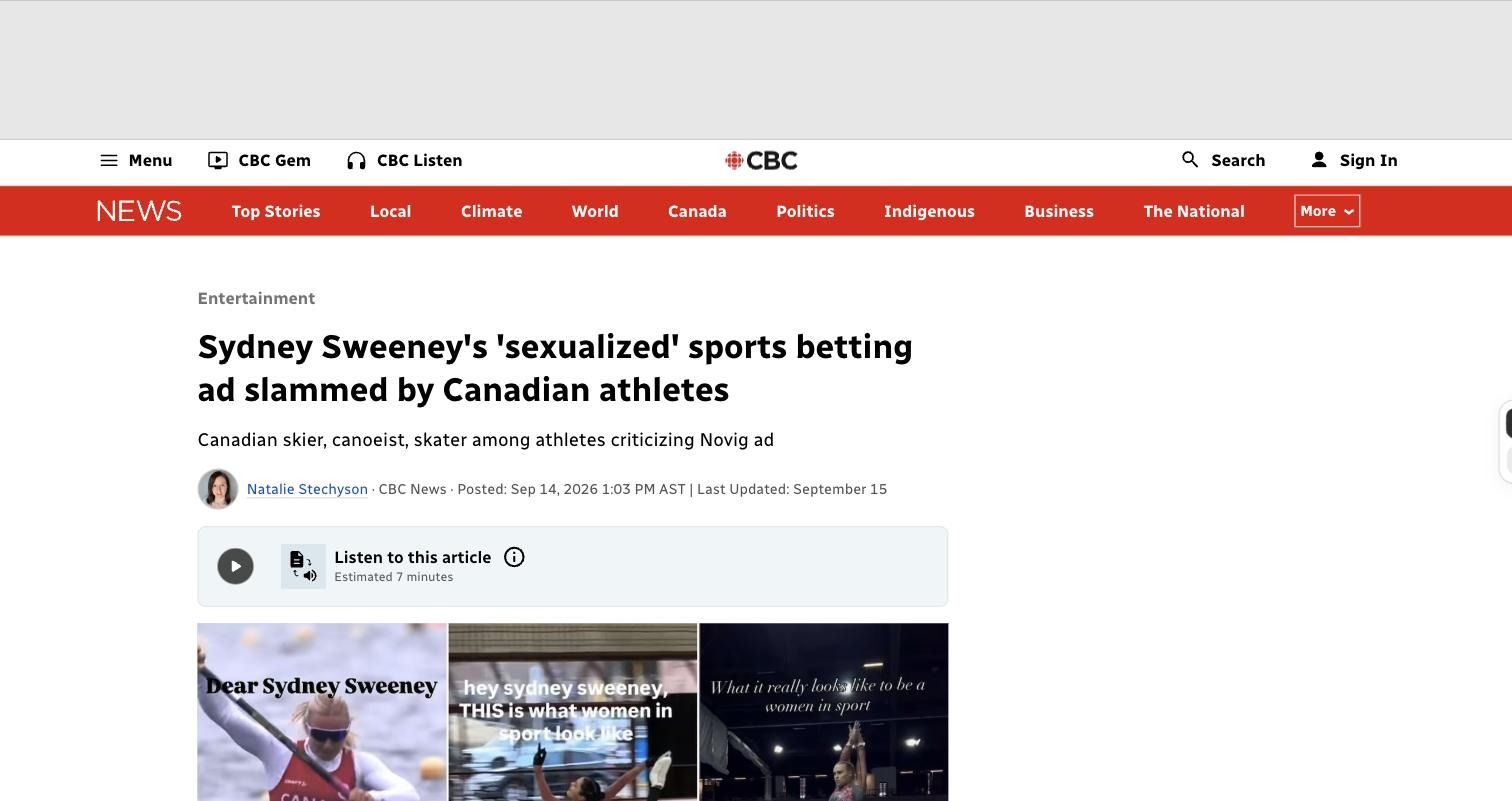
The reason it scaled is that the response had a format. Kramer's version established the pattern, caption plus competition footage, and the pattern was trivially easy to copy. Any athlete with a phone and a highlight reel could participate in under ten minutes. That low production cost is exactly why it spread. A response that requires effort is a response most people skip.
The lesson generalizes well beyond this campaign: a video becomes much bigger when your audience can respond in the same format rather than just watch. Stitches, duets, parodies, reaction cuts, recreations, counter-campaigns. Ask during the concept stage, not after launch, whether there is an obvious way for someone to make their own version.
And then accept the part brands hate. You do not get to choose whether the responses are flattering. Novig got the volume. It did not get to pick the tone. If your brand cannot survive the unflattering version, do not build for response.
For a deeper breakdown of what makes short-form content spread in the first place, our guide on how to make a video go viral covers the mechanics in more detail, and how to make Instagram Reels go viral gets specific about the platform where most of the athlete responses actually live.
Did the controversy actually work?
By reach, the campaign was an enormous success. By brand recall, it is much less clear. Monitoring firms recorded a roughly ninefold increase in Novig mentions across social platforms, with weekly mentions jumping from 392 to 4,633 in four days and estimated reach climbing from 786.6 million to 3.98 billion. But only about 4% of posts mentioned the Novig app at all.
Sit with that last number for a second, because it is the most useful data point in this entire story.
Ninety-six percent of the conversation was about Sydney Sweeney. The ad generated billions of impressions of a debate about a person, attached to a brand most participants never named. That is nothing. Novig went from anonymous to recognizable, and one campaign Instagram post reportedly pulled 860,000 likes and 17,400 comments in a day from an account with under 60,000 followers. By comparison, a rival prediction market's LeBron James campaign post reportedly drew fewer than 55,000 likes, against a reported $15 million-a-year deal.
So on a pure attention-per-dollar basis, Novig won decisively.
But attention is an input, not an outcome. The obvious cautionary tale is Sweeney's own American Eagle campaign from July 2025, which generated a comparable storm, drove an initial sales bump, and then flattened. Within a year, the company's stock had returned to roughly where it started. Brand strategist Shruti Saini put it plainly: celebrity partnerships can create momentum, but they cannot sustain growth without a strong product and a clear brand identity underneath.
The practical takeaway for anyone measuring a video campaign is to stop letting one number stand in for success. Track these separately, because they can and do move in opposite directions:
Viral does not mean effective. It means fast. Those are different properties, and conflating them is how marketing teams end up celebrating a campaign that moved nothing.
What video marketers can learn from the Sydney Sweeney campaign
Five things, and none of them involve taking your clothes off.
Build the idea before the edit. No amount of color grading rescues a weak concept. Novig's concept was one phrase and one visual rule, decided long before anyone touched a timeline. If you cannot state your idea in under five words, you are going to spend the edit compensating.
Make the first frame legible. Someone should know what kind of video they are watching before they have consciously decided to watch it. Our breakdown of why people stop watching your videos gets into how quickly that decision happens and what tends to cause the drop.
Create a repeatable visual language. One concept should generate many assets. Different sport, same joke. Different product, same frame. Different customer, same structure. This is what lets a single shoot cover a season.
Design for reactions, not just views. Before you shoot, ask whether someone could remix, parody, respond to, or recreate this. If the honest answer is no, you are buying every impression you get.
Know the difference between attention and affinity. A campaign can go extremely wide while actively alienating part of your market. Decide in advance how much reputational risk the brand is willing to carry, and do not discover the answer on launch day.
If you are adapting campaign creative into short-form specifically, how to create TikTok ads with AI covers the format-level decisions, and our broader guide to how to use video marketing is a better starting point if you are still building the strategy the creative sits inside.
How to turn one campaign idea into a full video content system
The expensive part of a campaign is the shoot. The waste is treating the shoot as if it produces one video.
Novig did not publish a 58-second ad and went home. It published a hero video into a system: social cuts, out-of-home stills, platform-specific versions, and more creative queued through football season. The athlete responses then added a second layer that the brand never had to fund. The original footage was the raw material, not the deliverable.
Here is the version of that system most teams can actually run, from a single shoot:
Hero campaign video
↓
15-second cut (paid social)
↓
6-second hook (pre-roll, bumpers)
↓
Vertical 9:16 reframe (Reels, TikTok, Shorts)
↓
Captioned version (sound-off feeds)
↓
Product-focused edit (bottom of funnel)
↓
Alternate hooks, same body (hook testing)
↓
Behind-the-scenes cut (organic, owned channels)
↓
Response and remix version (if the conversation gives you one)
Nine assets. One shoot. The only reason most brands do not do this is that historically each of those cuts meant another round trip through an editor, another week, and another invoice, so the 15-second cut got made and the rest quietly did not.
That is the part that has changed. Once the main footage exists, a video editor such as Async can turn the same material into platform-specific cuts, shorter versions, new hooks, captions, translations, and supporting social assets without rebuilding each video from scratch. Chat-based editing means a request like "make me a 15-second version with the hook up front" is an instruction rather than an afternoon. AI reframing handles the vertical versions, subtitles and dubbing handle reach, and AI clip detection surfaces the moments worth cutting around in the first place.
The point is not that software makes your idea good. Novig's idea worked or failed on its own merits well before post-production. The point is that a good idea deserves more than one output, and the gap between one asset and nine should be hours, not quarters.
The actual lesson
Novig spent one shoot and got a month of cultural real estate. Not because the ad was clever, and not because controversy is a strategy anyone should copy on purpose, but because the creative had four properties that made it easy for other people to carry: a two-word idea, a frame that reads instantly, a position worth arguing with, and a structure that repeats.
Three of those four are available to you without upsetting a single Olympian.
The fourth one, the argument, is the one to be careful with. Novig got attention it could not fully convert, and criticism it could not fully control, and the person who absorbed most of the reputational cost was the one with equity in the outcome. That trade might have been worth it for a startup with no name recognition and nothing to lose. It is a much worse trade for a brand that already has customers.
Build the idea that travels. Build it so it can be cut nine ways. Then decide, deliberately and in advance, how loud you are actually willing to be.
FAQs
What is the Sydney Sweeney Novig ad?
It is a national brand campaign for Novig, a sports-only prediction exchange, launched September 9, 2026, under the tagline "Just Sports." Sweeney appears nude, using sports equipment as cover, and she holds equity in the company as a strategic partner.
Why are athletes angry about the Sydney Sweeney ad?
Female athletes say the ad sexualizes women in sport and undermines efforts to have women covered for performance rather than appearance. Olympians including Ariarne Titmus, Amy Hunt, Gracie Kramer, Ellie Black, and Sophia Jensen posted response videos of themselves competing and training.
How many views did the Sydney Sweeney Novig ad get?
The ad had been viewed close to 39 million times by the morning of September 14, 2026, five days after launch, according to CBC News. Related campaign posts drew hundreds of thousands to over a million likes.
Did the Novig campaign work?
It generated a roughly ninefold increase in brand mentions and billions of impressions of estimated reach, but only around 4% of social posts mentioned the Novig app itself. Reach was clearly achieved. Brand recall and conversion are separate questions that the available data do not yet answer.
Is this the same as the Sydney Sweeney American Eagle ad?
No. The American Eagle "great jeans" campaign ran in July 2025 and drew criticism on entirely different grounds. The Novig campaign launched in September 2026. The two are often compared because both generated large controversies quickly, and because the American Eagle campaign's long-term commercial impact turned out to be limited.