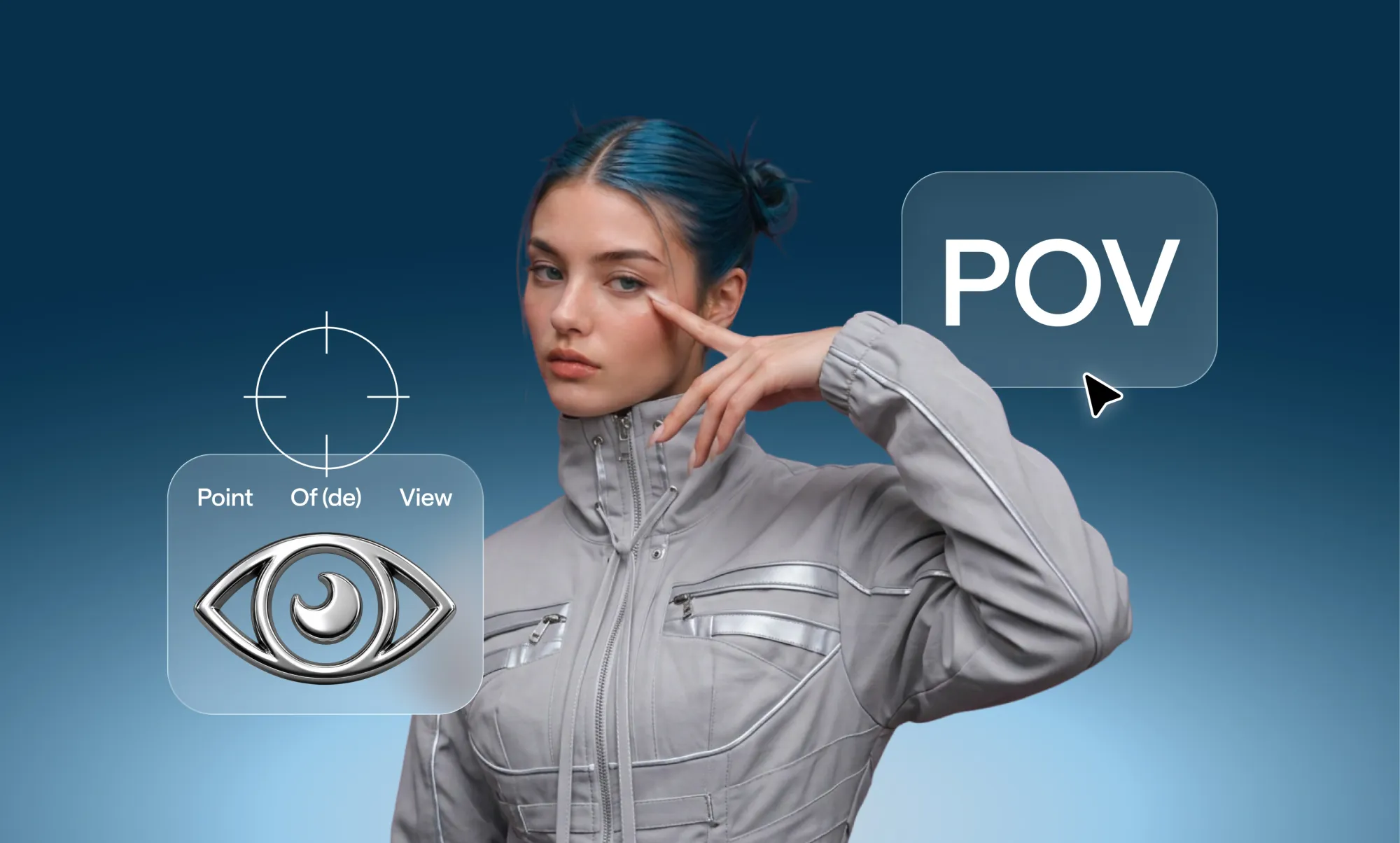
POV stands for “point of view.” It describes the perspective from which someone sees, tells, or experiences something. On TikTok, Instagram Reels, and YouTube Shorts, POV usually introduces a video that asks the viewer to imagine they are inside a particular situation.
Cambridge Dictionary also recognizes POV as an abbreviation for point of view in general speech, storytelling, film, and social media. So the term is not new. What changed is that short-form video turned a film and literature concept into a caption format that millions of people now use every day.
This guide covers what POV means in each place you are likely to see it, then shows you how to write, film, and edit a POV video yourself.
What does POV stand for?
POV is short for point of view. If you have ever wondered what the abbreviation POV means in a comment, a caption, or a work message, that is the whole answer.
In everyday language, it works like this:
“From my POV, the meeting went well.”
That sentence uses POV to mean opinion or perspective. But the term stretches across three related meanings:
- An opinion. How one person sees a situation.
- A storytelling perspective. Whose eyes the audience experiences a story through.
- A visual angle. The physical position a camera or a person is looking from.
Most confusion about POV comes from these three meanings sitting side by side. A film student and a TikTok creator are both using the word correctly, just for different jobs.
What does POV mean in social media?
What POV means in social media is slightly different from the dictionary definition. Creators use POV to place the viewer inside a scene, or to assign them a role and ask them to imagine themselves in it.
For example:
POV: You open your email and see that the client approved the first draft.
That caption does a lot of work in a few words. It tells you who you are, what just happened, and how you are supposed to feel. Everything that follows in the video is read through that frame.
One important point: the video does not always need to be filmed literally through the creator’s eyes. Strict first-person camera work was the original convention, but online usage has become much broader. Today a POV caption often just functions as a setup for a relatable scenario, a joke, or a short story, while the creator films themselves normally.
Purists sometimes complain about this. In practice, the looser version is now the standard on every major platform, and audiences understand it instantly.
What does POV mean on TikTok?
What POV means on TikTok is a caption that hands you a role in the scene before the video even starts. It is one of the platform’s most durable formats because it makes a video feel like something happening to you rather than something you are watching.
The structure is usually consistent:
- The caption establishes the situation.
- The viewer is assigned a role.
- The creator acts out the other side of the interaction.
- The humor or emotion comes from how recognizable the situation feels.
A few examples:
- POV: You join a meeting five minutes late
- POV: Your package finally arrives
- POV: Your boss says, “Can we have a quick chat?”
- POV: You try the product everyone has been recommending
Notice that none of these need explanation. The caption assumes you have lived through the moment already, and the video simply confirms it. POV videos on TikTok are generally designed to make viewers feel present in the scene rather than simply watching it from outside.
That is also why POV works well for sound-driven trends. A recognizable audio clip plus a specific caption gives the viewer two familiar signals at once.
What does POV mean on Instagram Reels and YouTube Shorts?
The meaning is largely the same across short-form platforms. What POV means on Instagram, what POV means on Reels, and what POV means on YouTube all point back to the same idea: a caption that puts the viewer inside the scene.
On Reels and Shorts, POV videos tend to be used for:
- Relatable comedy
- Product demonstrations
- Customer scenarios
- Tutorials
- Mini-stories
- Before-and-after content
What POV means in videos on one platform will read the same way on another, so a setup that works on TikTok usually transfers. The differences are practical rather than definitional. Reels lean visual and aesthetic, so POV setups often appear as on-screen text over a styled shot. Shorts sit inside YouTube’s search and recommendation system, so a POV hook in the first second matters a lot for retention. If you are planning Shorts specifically, it helps to know how long YouTube Shorts can be and which hashtags for YouTube Shorts actually help discovery.
You also do not need to appear on camera. Plenty of POV content is voiceover, screen recording, or stock footage with text. Our lazy guide to making faceless Reels without filming yourself walks through that approach.
What does POV mean in texting?
In texting or casual conversation, POV usually means a person’s opinion or perspective rather than a video format. If someone drops it into a message, read it as “the way I see it.”
“From my POV, we should publish the shorter version.”
That is the most common use. What POV means in text is generally this plain, functional one.
It can also introduce an imagined scenario in a message or a meme, borrowing the video convention:
“POV: You remember the deadline at 11:58 p.m.”
Both uses are normal, and context makes it obvious which one someone means. A POV followed by a colon and a scene is the meme version. A POV inside a sentence is the opinion version.
Is POV slang? Not exactly. What POV means as slang is really just the social-media usage of a much older abbreviation. The word itself is standard English shorthand, used in film schools and newsrooms long before it appeared in a caption.
What does POV mean in film and storytelling?
The original creative meaning is worth knowing, because it explains why the social format works.
- First-person POV. The story is experienced through one character. You know only what they know.
- Third-person POV. The audience watches the character from outside, with more information than any single character has.
- POV shot. A camera technique where the frame shows what a character appears to be seeing, putting the audience directly behind their eyes.
That last one is the direct ancestor of the TikTok caption. A POV shot in a film does without words what a POV caption does with them: it collapses the distance between the audience and the character.
The distinction that trips people up is between the literal camera POV and the broader social-media format. A literal POV means the lens is standing in for someone’s eyes. The social format means the caption is standing in for someone’s situation. Same idea, different tool.
How to write a good POV caption
A workable formula:
POV: You + specific situation + recognizable emotion or result
Examples:
- POV: You finally find a video editor that understands plain English
- POV: Your customer asks for one last tiny revision
- POV: You post the Reel you nearly deleted and it becomes your best one
- POV: You turn a boring product photo into a full campaign
Specificity is what makes these land. “POV: You are happy” gives the viewer nothing to recognize. “POV: Your client says they love it, just one change” gives them a memory. The more precise the detail, the more people feel seen by it, which is the opposite of what most writers expect.
Keep captions short enough to read in the first second, and avoid stacking two ideas into one setup.
How to make a POV video
- Choose who the viewer is in the scene.
- Decide what is happening to them.
- Write a short POV caption.
- Film from the relevant angle, or act out the other character.
- Add captions so the setup is immediately clear.
- Keep only the parts needed to deliver the idea.
Step six is where most POV videos are won or lost. The format depends on speed. Every pause before the payoff gives the viewer a reason to scroll.
POV video ideas for brands and creators
- POV: A customer discovers your product for the first time
- POV: The order is being packed just for you
- POV: You try the before-and-after result
- POV: You are watching the designer reject the tenth draft
- POV: You ask an editor to remove one awkward pause
- POV: Your small business gets its first large order
- POV: You finally finish the video you have been avoiding
- POV: Your client says, “I love it, just one change”
Each of these works because it comes from real workflow friction rather than a generic mood. If you want more prompts in this style, we collected 25+ content ideas to inspire your next post.
How to make a POV video with Async
POV videos are simple in concept and fiddly in execution. The idea takes thirty seconds to write, then most of the work goes into trimming dead air, positioning text, and exporting three different aspect ratios. Async handles that part, so the editing stays as fast as the idea.
Here is the full workflow.
1. Upload your footage or generate the scene
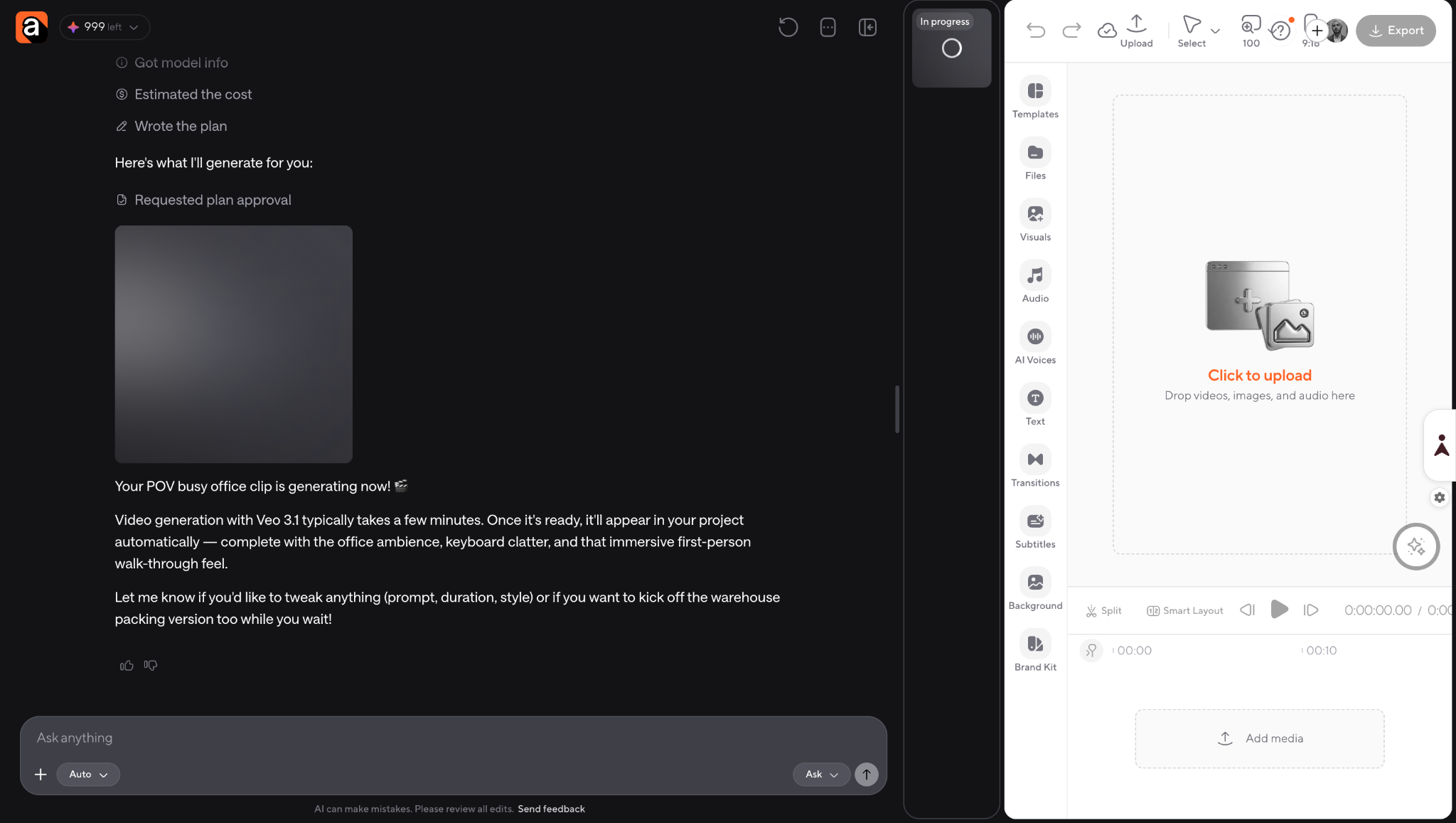
Start with whatever you already have: a phone clip, a screen recording, product shots, or stock footage. If you do not have footage at all, you can generate the scene instead, which is useful for POV setups that would be awkward or expensive to film, like a warehouse packing shot or a busy office.
2. Ask Async to remove empty sections and tighten the timing
This is the step that decides whether a POV video works. Describe what you want in plain language, such as “cut the silences and the first two seconds,” and Async trims the pauses, false starts, and filler. POV depends on a fast payoff, so every second you remove before the punchline protects your retention.
3. Add the POV setup as on-screen text
Place your caption so it is readable in the first frame. Keep it short, keep it specific, and make sure it does not sit under the platform UI, which covers the bottom and right edges of the screen on TikTok, Reels, and Shorts.
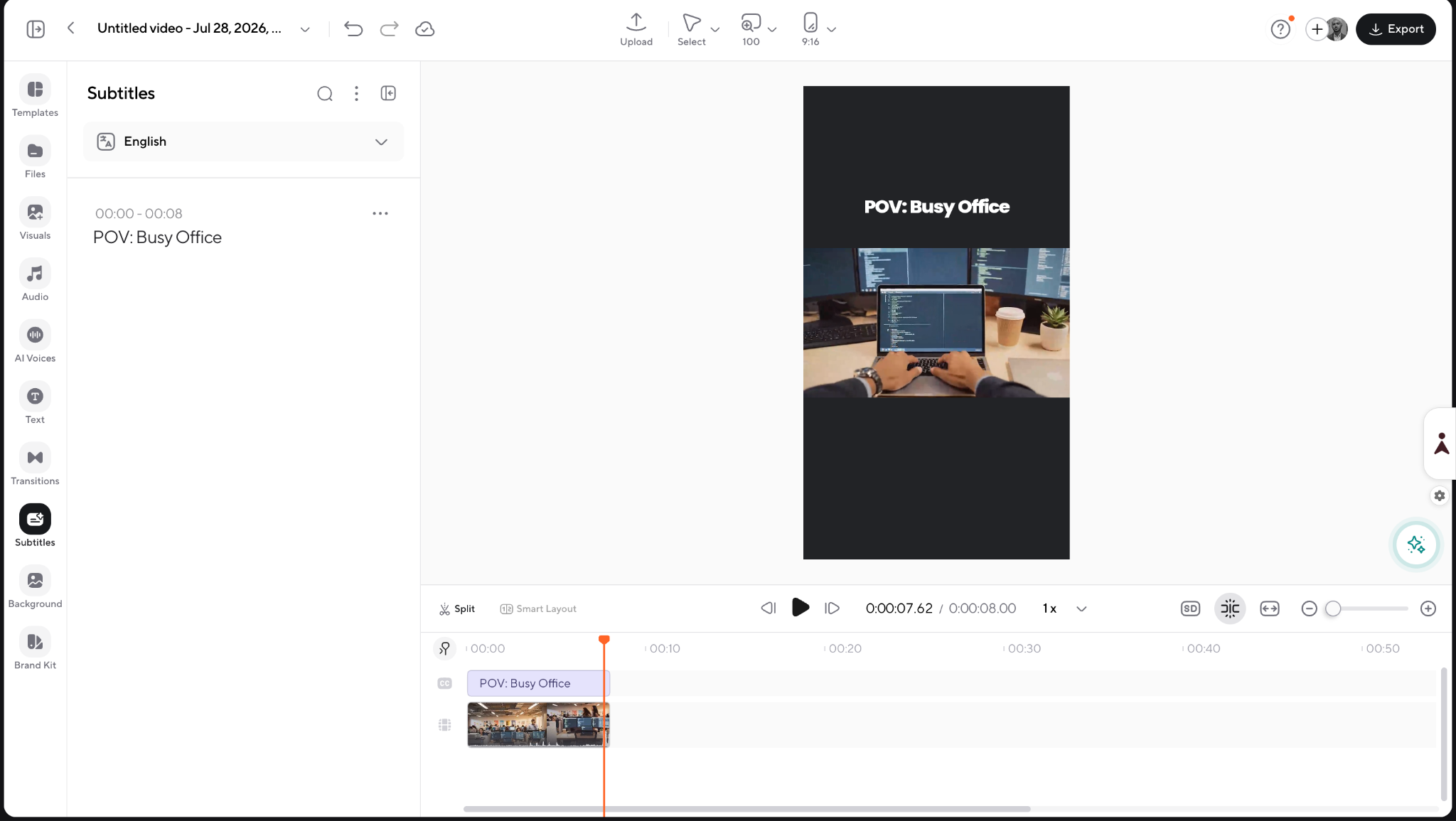
4. Add captions, voiceover, sound, or music
Most people watch muted first, so add captions to your video to make sure the setup reads without audio. If you would rather not appear on camera, a voiceover over generated or stock footage carries a POV scene perfectly well. Add a trending or ambient track last so the timing is already locked.
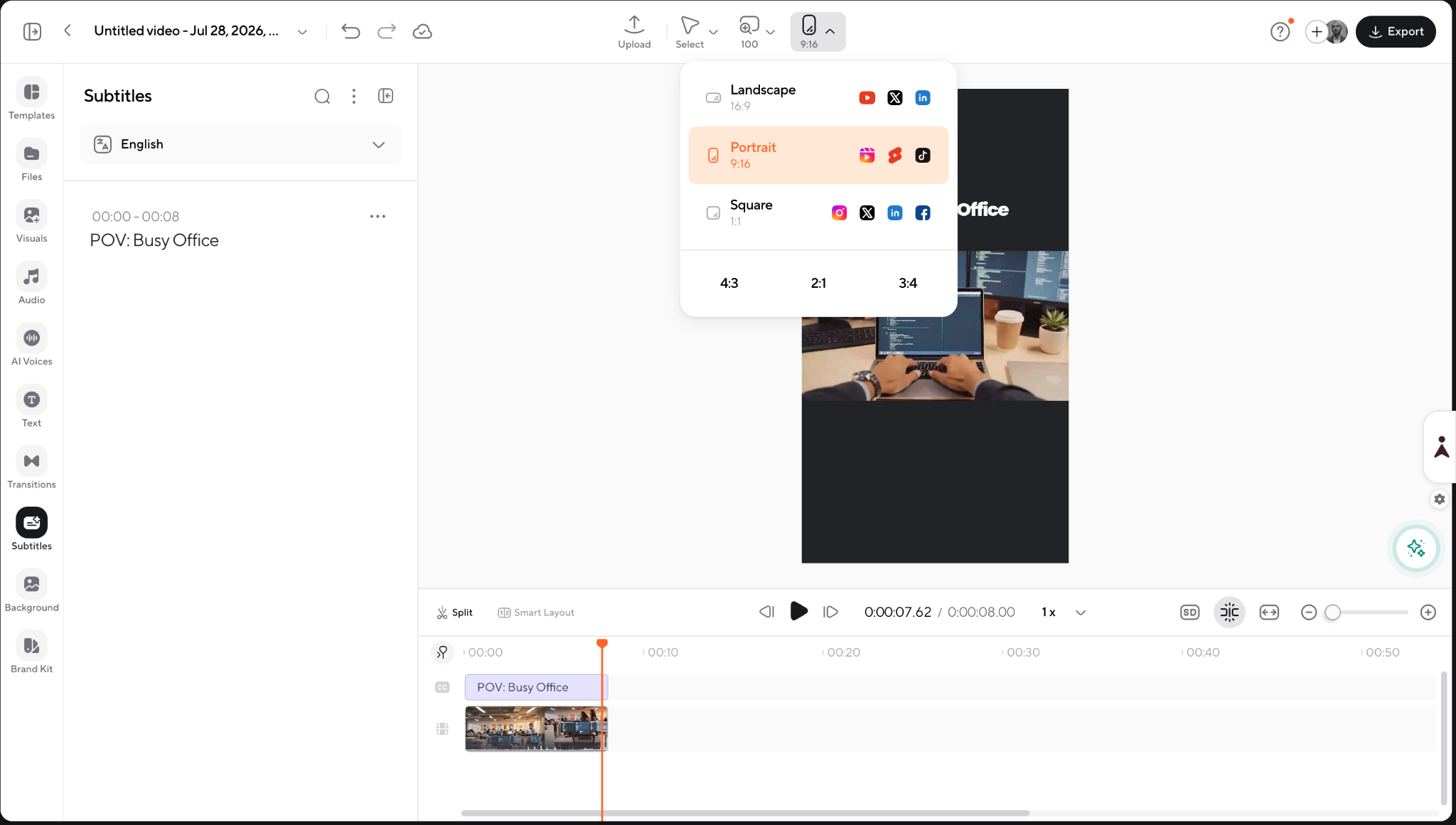
5. Resize the video for TikTok, Instagram Reels, or YouTube Shorts
One POV idea can run on all three platforms. Async reframes the video for each one and keeps your subject and text inside the safe area, so you are not rebuilding the same edit three times.
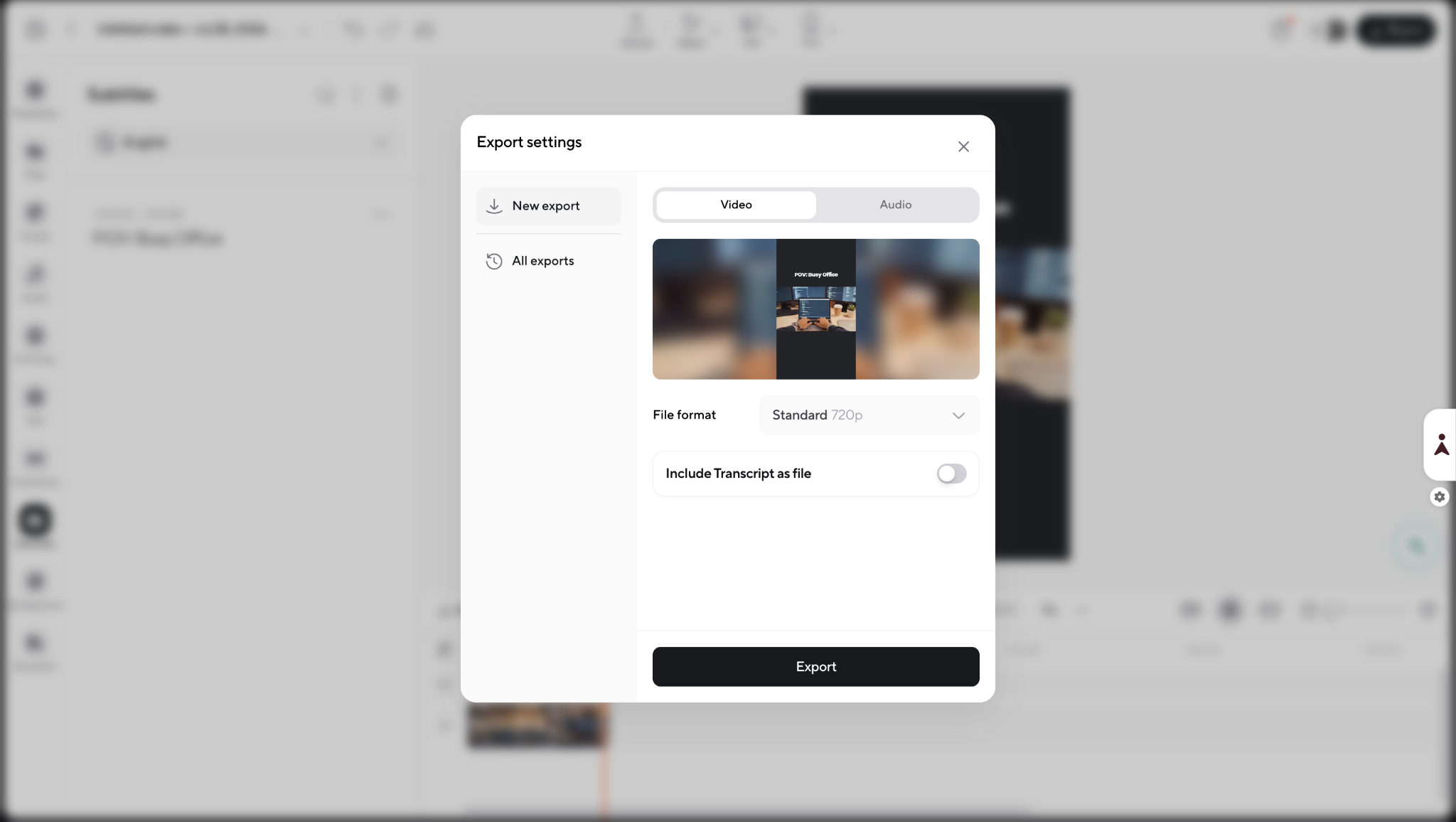
6. Export and publish
Export in the format each platform wants, then publish. Keep the project file, because POV formats are easy to repeat: once one setup performs, you can swap the caption and the scene and run the same structure again.
Because you edit by describing what you want rather than dragging clips on a timeline, a POV video that used to take an afternoon takes a few minutes. That matters most for the format itself, which rewards volume and quick reactions to whatever is currently relatable.
Ready to make your own?
Now that you know what POV means, the format is easy to use: one clear caption, one recognizable moment, and a tight cut. Make your first POV video in Async with our social media video editor, or explore the full AI video editor to script, cut, caption, and resize it in one place.
FAQ
What does POV stand for?
POV stands for point of view. It refers to the perspective someone sees, tells, or experiences something from.
What does POV mean on TikTok?
On TikTok, POV is a caption that assigns the viewer a role in a scene, such as “POV: Your package finally arrives.” The creator then acts out the other side of the interaction.
What does POV mean in texting?
In texting, it usually means opinion or perspective, as in “From my POV, we should publish the shorter version.” It can also introduce an imagined scenario in a meme-style message.
What does POV mean on social media?
On social media, POV frames a video so the viewer imagines themselves inside the situation rather than watching from outside. The meaning is consistent across platforms.
What does POV mean on Instagram?
The same as elsewhere. On Instagram and Reels, POV captions set up relatable comedy, product scenarios, tutorials, and mini-stories.
Is POV a slang term?
Not strictly. POV is a standard abbreviation for point of view that is used in film and writing. Its social-media usage is informal, but the term itself is not slang.
Does a POV video need to be filmed in first person?
No. A literal POV shot films from a character’s eyes, but online the caption alone is usually enough to establish the perspective.
How do you make a POV video?
Decide who the viewer is, choose what happens to them, write a short caption, film or act out the scene, add on-screen text and captions, then cut anything that delays the payoff.